
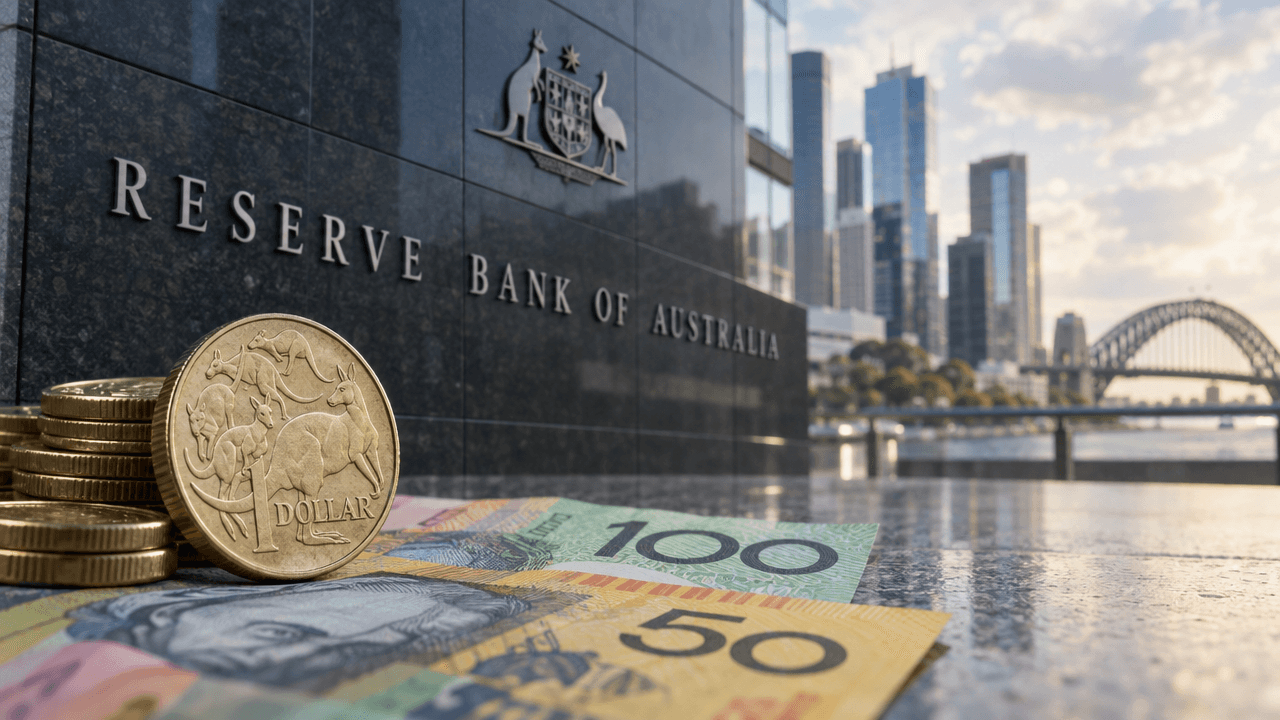
The Australian dollar is approaching a pivotal session as the Reserve Bank of Australia prepares to announce its November policy decision. Markets overwhelmingly expect the RBA to raise the cash rate by 25 basis points, from 4.60% to 4.85%, which would place borrowing costs at their highest level since late 2008. The decision is scheduled for 2:30 p.m. AEDT on Tuesday, November 3. [1][6]
Although the expected increase has been extensively priced into markets, the Australian dollar may still face significant volatility. The immediate reaction will depend less on the rate increase itself and more on the RBA’s updated economic forecasts, guidance on future decisions, and Governor Michele Bullock’s assessment of inflation and household demand.
Why The Rba Is Expected To Raise Rates
Australia’s inflation outlook has deteriorated since the RBA’s previous forecasts. September-quarter inflation reportedly reached 3.7% year over year, remaining well above the central bank’s target range of 2% to 3%. Persistent price pressures have encouraged policymakers to consider another increase despite concerns about the impact of higher borrowing costs on households and businesses. [7]
A 25-basis-point move would be the fifth rate increase of 2026. The RBA has already lifted rates substantially above its estimated neutral level, with analysts at NAB suggesting that a cash rate of 4.85% would be approximately 150 basis points above neutral. [2]
That distinction matters. A move to 4.85% would not simply represent a routine adjustment. It would signal that the RBA believes demand remains strong enough, and inflation risks sufficiently persistent, to justify a restrictive policy setting.
Markets appear to agree that a hike is the most likely outcome. Pricing has indicated an estimated 80% to 90% probability of a 25-basis-point increase, depending on the market measure and timing of the assessment. [1][5] However, high expectations can also limit the Australian dollar’s gains if the final statement sounds cautious.
The Guidance Could Matter More Than The Rate
For currency traders, the central question is whether 4.85% represents the peak of the current tightening cycle or merely the next step toward another increase.
The RBA’s updated Statement on Monetary Policy should provide revised forecasts for inflation, economic growth, and unemployment. Those projections will help traders assess whether policymakers believe inflation will return to target without additional tightening. The central bank’s communication is expected to be especially important because some analysts see a material risk that rates could eventually rise to 5.10%. [5]
A hawkish outcome would likely include language emphasizing that inflation remains too high, demand is resilient, and further rate increases cannot be ruled out. Such a message could support the Australian dollar, particularly against currencies whose central banks are moving toward easier policy.
A more neutral outcome could produce the opposite reaction. If the RBA raises rates but signals that it expects to pause for several meetings, traders may interpret the decision as the end of the cycle. Because a hike is already widely anticipated, the Australian dollar could initially weaken on a “buy the rumor, sell the fact” response.
The biggest surprise would be a decision to leave rates unchanged. With markets assigning a high probability to an increase, a hold could trigger a sharp decline in the Australian dollar and a rally in government bonds as investors rapidly remove expectations for near-term tightening.
How Aud Crosses And Bonds May Respond
AUD/USD is likely to be the most visible expression of the decision, but traders should also monitor AUD/JPY, AUD/NZD, and AUD/GBP. AUD/JPY could react strongly if rising Australian yields encourage carry-trade demand, while AUD/NZD may respond more directly to differences between Australian and New Zealand monetary policy.
The currency’s broader performance will also depend on the US dollar, global risk sentiment, and commodity prices. The Australian dollar is often sensitive to growth expectations because Australia is a major exporter of raw materials. A hawkish RBA can provide support, but a broad sell-off in equities or commodities may offset that benefit.
Australian government bonds should provide an important confirmation signal. Short-dated yields are especially sensitive to expectations for the cash rate. A hawkish RBA statement could push two- and three-year yields higher, while a dovish message may cause them to fall even if the policy rate itself rises.
ASX futures may also react negatively to a higher-rate outlook. Higher borrowing costs can pressure company valuations, particularly for growth stocks, and increase financing expenses for households and businesses. However, the market reaction may be limited if investors conclude that the November increase is the final hike.
Practical Takeaways For Traders
The first priority is to avoid treating the widely expected rate increase as a complete trading signal. The decision, forecasts, and press conference should be considered together.
Traders can monitor three questions
1. Does the RBA describe inflation as broadening or becoming more persistent?
2. Do the updated forecasts imply that inflation will return to target without another rate increase?
3. Does Governor Bullock emphasize patience, or does she retain a clear tightening bias?
Risk management is especially important around the announcement. AUD pairs can experience rapid price swings, widened spreads, and false breakouts as algorithms respond to individual phrases in the statement. Waiting for the initial volatility to settle may provide a clearer view of whether the market considers the outcome hawkish or dovish.
A useful approach is to compare the Australian dollar’s reaction with bond yields. If AUD rises while short-term yields also increase, the market is probably interpreting the RBA as hawkish. If AUD weakens despite higher rates, traders may be focusing on profit-taking, an anticipated policy pause, or broader concerns about economic growth.
What The Decision Means For The Australian Dollar
The RBA’s expected move to 4.85% places the Australian dollar at an important crossroads. Higher interest rates can strengthen the currency by improving returns on Australian assets, but the benefit depends on how long those rates are expected to remain elevated.
The most constructive outcome for AUD would be a rate increase accompanied by upwardly revised inflation forecasts and guidance that additional tightening remains possible. The most negative outcome would be a surprise hold or a hike paired with a strong signal that policymakers are finished.
Ultimately, the November decision is not just about 25 basis points. It is about whether the RBA believes Australia’s inflation problem requires more restraint, or whether it can now pause and evaluate the effects of the tightening already delivered. For Australian dollar traders, that distinction may define the next major move.