
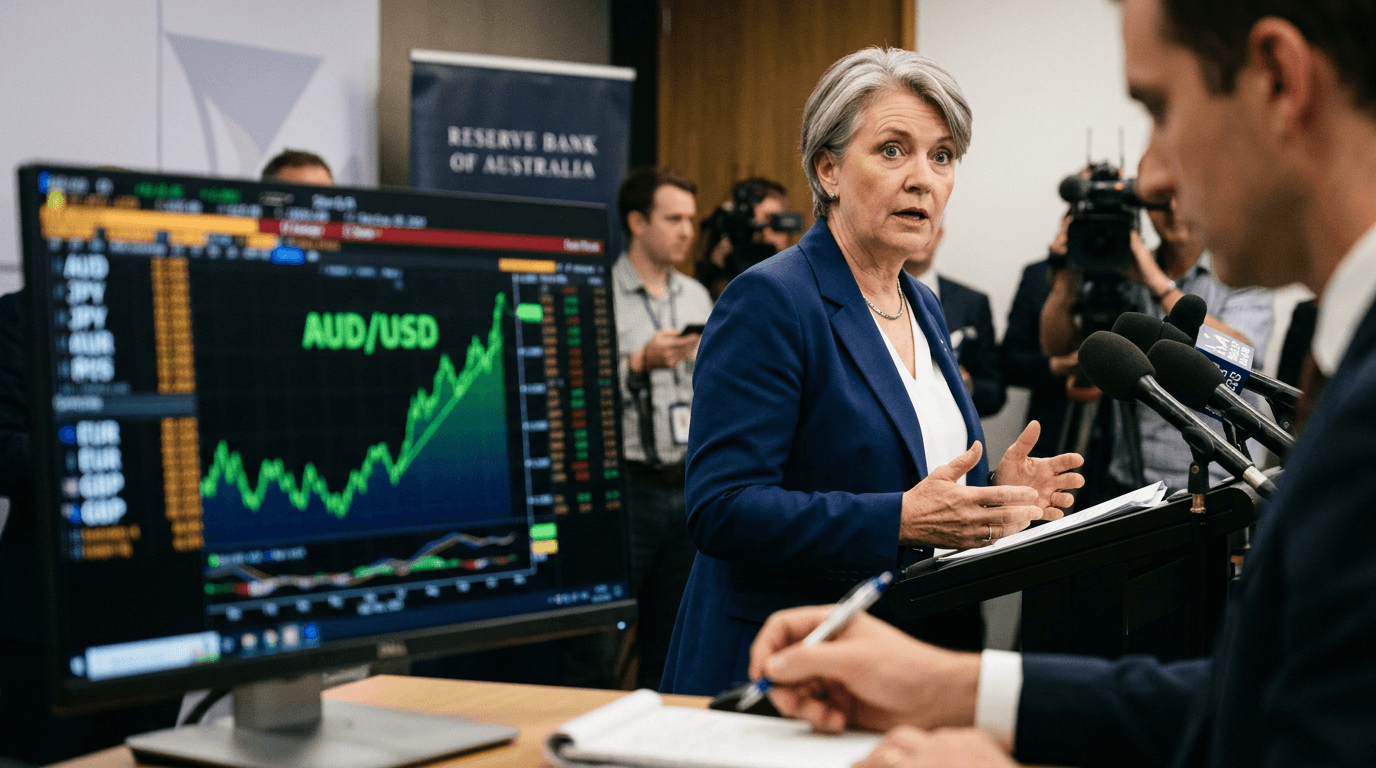
The Australian Dollar surged in Asian trading on Tuesday following remarks from Reserve Bank of Australia Governor Michele Bullock that signaled a potential interest rate increase could occur as soon as March, catching many market participants off guard and reigniting appetite for the currency.[1][2] Bullock's comments marked a significant shift from her recent emphasis on patience, explicitly stating that the RBA's March 17 board meeting would be "live" for a possible rate hike if inflation expectations showed signs of becoming unanchored.[1] This hawkish turn has reverberated through forex markets, prompting traders to reassess their positions on the Australian Dollar and the broader implications for regional monetary policy.
The Bullock Shift: From Patience To Vigilance
Reserve Bank of Australia Governor Michele Bullock took the opportunity at a business conference to clarify the central bank's stance on monetary policy, emphasizing that the board would not necessarily wait for the full first-quarter inflation reading due in late April before deciding on rate adjustments.[1] This was a critical signal for markets that had assumed the RBA would remain on hold through March and wait for comprehensive data before making moves in May. Bullock's statement that "every meeting is live" and that "the board will be looking at whether it needs to be moving more quickly" fundamentally altered market expectations overnight.[1]
The governor specifically noted that she wanted to "dissuade" markets from assuming a measured, data-dependent approach that would delay any decision until after the April consumer price report.[1] Instead, Bullock emphasized the RBA's "very alert" stance regarding inflation risks, particularly those stemming from elevated energy prices in an increasingly volatile geopolitical environment.[3] This messaging shift has direct implications for currency movements, as investors reassess the attractiveness of Australian Dollar-denominated assets in light of potentially higher yields ahead.
Market Repricing: How Quickly Expectations Changed
Prior to Bullock's comments, the market was pricing in only a 24% probability of a quarter-point rate increase in March.[1] Within hours of her remarks, this probability had risen to approximately 28-30%, demonstrating the swift repricing that occurs in foreign exchange markets when central bank signals shift.[2][3] More significantly, markets are now fully pricing in a rate increase by May to 4.10%, with expectations for rates reaching approximately 4.26% by year-end.[1]
This repricing dynamic is crucial for Australian Dollar traders to understand. When markets begin to price in higher interest rates, the currency typically strengthens because higher yields attract international capital seeking better returns. The Australian Dollar rose to around 0.71 against the US Dollar in Tuesday's Asian session, though it later pulled back somewhat amid broader market risk aversion stemming from Middle East tensions.[2][3] Nonetheless, the directional bias created by Bullock's hawkish messaging remains supportive for the currency in the medium term.
Geopolitical Headwinds And Energy Dynamics
While Bullock's rate hike signals have been the primary driver of Australian Dollar strength, the currency's movement has been complicated by escalating Middle East tensions and their impact on global oil prices.[2][3] The US Dollar benefited from safe-haven flows as investors reacted to heightened geopolitical risks, which partially offset the supportive effects of the RBA's hawkish pivot on the Australian Dollar.[3]
However, Australia's status as a net energy exporter provides a unique buffer against some of the negative consequences of rising oil prices.[1] While Bullock acknowledged that prolonged global energy price increases could weigh on consumer demand and economic growth while pushing inflation higher, the structural advantage of Australia's energy wealth helped cushion the currency against the full force of risk-off sentiment.[1][2] This explains why the Australian Dollar showed relative resilience compared to other risk currencies despite broader market volatility.
Key Takeaways For Traders And Investors
The practical implications of Bullock's comments extend beyond simple currency pair movements. First, traders should recognize that the RBA has signaled a genuine willingness to move faster on rate hikes if data warrants, making the March 17 meeting genuinely unpredictable rather than a foregone hold decision.[1][3] This elevated uncertainty could create trading opportunities for those positioned to capitalize on volatility.
Second, the upside potential for the Australian Dollar remains intact if rate hike expectations continue to rise, particularly if upcoming economic data releases such as the Services PMI and Q4 GDP figures support the inflation narrative.[3] These reports could either reinforce Bullock's hawkish stance or provide a reality check on domestic economic momentum.
Third, geopolitical factors will continue to influence broader market sentiment and may periodically override the supportive effect of RBA rate hike expectations. Investors should monitor developments in the Middle East and their spillover effects on global risk appetite and energy markets.
The Australian Dollar's recent strength reflects genuine shifts in monetary policy expectations rather than temporary market noise. For traders monitoring the AUD, the key is to watch for confirmation from upcoming economic data while maintaining awareness that geopolitical developments could create tactical pullbacks.