
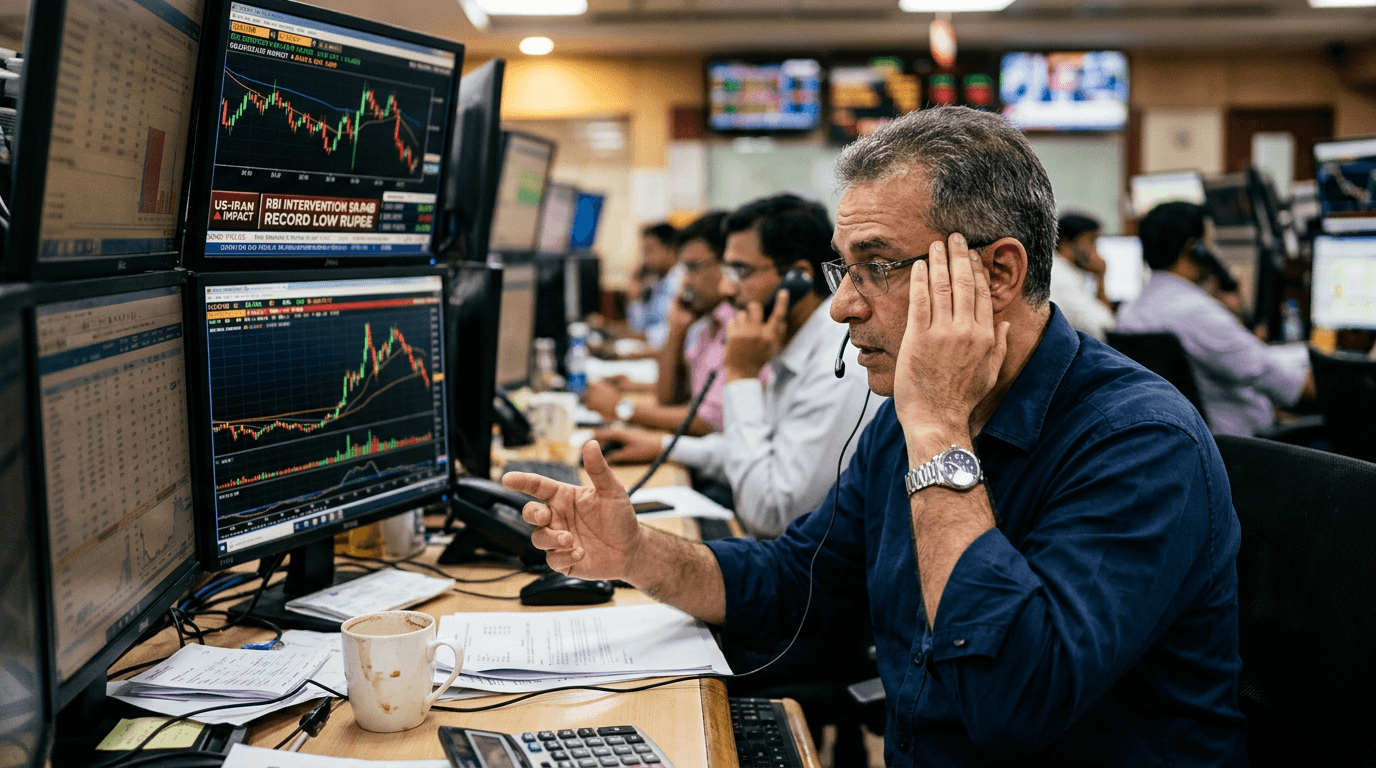
The Reserve Bank of India’s decision to sell a net $8.94 billion in April to defend the rupee marks one of its most forceful interventions of recent years, and it comes at a time when global geopolitics and domestic market sentiment are tightly intertwined[1][4][7]. For traders in USD/INR and Indian assets, this is not just a headline—it is a clear signal that currency risk, policy reaction, and volatility will remain central themes in the months ahead.
Global Shocks, Oil, And The Rupee
The latest bout of rupee weakness has been driven primarily by the U.S.–Iran war, which has sent oil prices surging and intensified risk aversion across emerging markets[2][8][11]. The rupee has fallen roughly 4.5% since the Iran conflict escalated, sliding to a series of record lows against the dollar in the 92–95 range[2][8][11][14]. These moves reflect India’s vulnerability as a major net oil importer, where every spike in crude prices widens the trade deficit and pressures the currency[8][11]. Elevated energy costs also feed directly into inflation expectations, complicating the policy mix for the RBI as it tries to balance growth, price stability, and financial stability[2][11].
As global investors reassess risk, high‑beta currencies like the rupee often come under disproportionate pressure compared with developed‑market FX[2][8]. In this environment, even fundamentally sound economies can see their currencies overshoot fair value in the short term as hedging demand spikes and carry trades unwind[2][9]. For active traders, this creates both opportunity and risk: directional moves can be powerful, but policy responses can be just as sharp.
WHAT RBI’S $8.9 BILLION INTERVENTION TELLS TRADERS
RBI data show that in April the central bank sold a net $8.94 billion in the foreign exchange market to support the rupee[1][4][7]. This intervention has been conducted not only via straightforward spot dollar selling but also through state‑run banks using FX swaps and other derivatives on the RBI’s behalf[4][9]. Such tactics allow the RBI to influence both the spot rate and forward premia, shaping the entire USD/INR curve rather than just today’s price[4][9]. At the same time, India’s overall foreign exchange reserves have dipped by around $8 billion as the RBI leaned on its stockpile to absorb selling pressure, even though they remain at historically high levels near the high‑$680 billion zone[4][13].
For traders, the message is clear: the RBI is willing to deploy reserves aggressively to smooth disorderly moves, especially around new record lows in the currency[1][4][7]. However, history shows that central banks typically aim to manage volatility and pace, not enforce a rigid line in the sand. That means intervention can slow or temporarily reverse moves, but it rarely eliminates the underlying trend if fundamentals and global flows push in the opposite direction.
IMPLICATIONS FOR USD/INR AND INDIAN ASSETS
Intervention of this size often changes market microstructure in ways that active traders can feel directly. In USD/INR, large RBI selling episodes can compress intraday volatility temporarily as order books are supported and panic bids subside[4][9]. But once the initial shock passes, volatility can re‑emerge as markets test how far the central bank’s tolerance extends, particularly if oil remains elevated and geopolitical risks persist[2][8][11]. Some strategists now see USD/INR oscillating within a wider 94–96 band over coming quarters, highlighting expectations for continued two‑way moves rather than a rapid return to pre‑war levels[6].
Local bond markets are also affected. When the RBI sells dollars, it typically absorbs rupee liquidity, which can tighten money‑market conditions unless offset by domestic operations[4][9]. If the central bank later injects rupee liquidity to maintain its monetary stance, that can soften yields but also signal a more complex policy mix. For foreign investors, this combination of FX intervention and evolving rate expectations influences appetite for Indian government bonds and corporate credit, feeding back into the rupee through portfolio flows[2][3][9].
On the structural side, the RBI and policymakers have complemented FX intervention with broader measures designed to attract longer‑term foreign capital, including steps that could potentially draw as much as $40 billion in additional flows over time[3]. These initiatives aim to reduce reliance on short‑term interventions by strengthening the balance of payments and deepening local markets[3].
HOW TRADERS CAN NAVIGATE RBI‑DRIVEN MARKETS
For discretionary and systematic traders, central‑bank‑driven markets require a different playbook from ordinary trend environments. First, position sizing should explicitly account for event risk: RBI actions, war‑related headlines, and oil price shocks can all generate gap moves that overwhelm standard stop‑loss levels[2][8][11]. Using smaller size with wider, pre‑planned risk limits is often more robust than trading full size with tight stops in this environment.
Second, it pays to watch not just spot USD/INR but also the forwards and swaps curve. When the RBI intervenes via swaps, forward premia can compress, affecting carry trades and hedging costs for exporters, importers, and global funds[4][9]. A steepening or flattening of the curve without a corresponding move in spot often signals that policy action is occurring behind the scenes.
Third, volatility products and options become particularly attractive tools. As realized volatility spikes, option sellers face higher risk of large intraday moves, while buyers can benefit from sudden swings around policy events and geopolitical updates[2][8]. Traders using simulated environments can test strategies such as buying downside INR gamma into event windows, then monetising on volatility spikes, or running structured carry trades that factor in both forward premia and tail‑risk hedges.
Key Takeaways For Simulated And Live Traders
This episode underscores that FX trading is not just about charts and macro data; it is about understanding how policy makers react under stress. The rupee’s slide to record lows amid the U.S.–Iran war, alongside a roughly 4.5% drop since the conflict escalated and oil spiked above $114, illustrates how quickly geopolitics can reprice an entire currency complex[2][8][11]. The RBI’s $8.94 billion intervention in April shows that India’s central bank is prepared to lean against disorderly moves, using both spot and derivatives channels to guide markets[1][4][7][9]. But it also highlights that volatility is likely to remain elevated, with USD/INR expected by some analysts to trade in a wider band through the coming quarters rather than snapping back to old ranges[2][6][8].
For traders—whether operating in a simulated setting or live markets—the practical lessons are direct. Build a framework that links geopolitics, commodities, and FX; track central bank behaviour as closely as you track price; and stress‑test strategies for sudden, policy‑driven reversals. Above all, treat central bank intervention not as a guarantee of direction, but as a source of additional, tradable volatility that rewards preparation, risk discipline, and adaptability.