
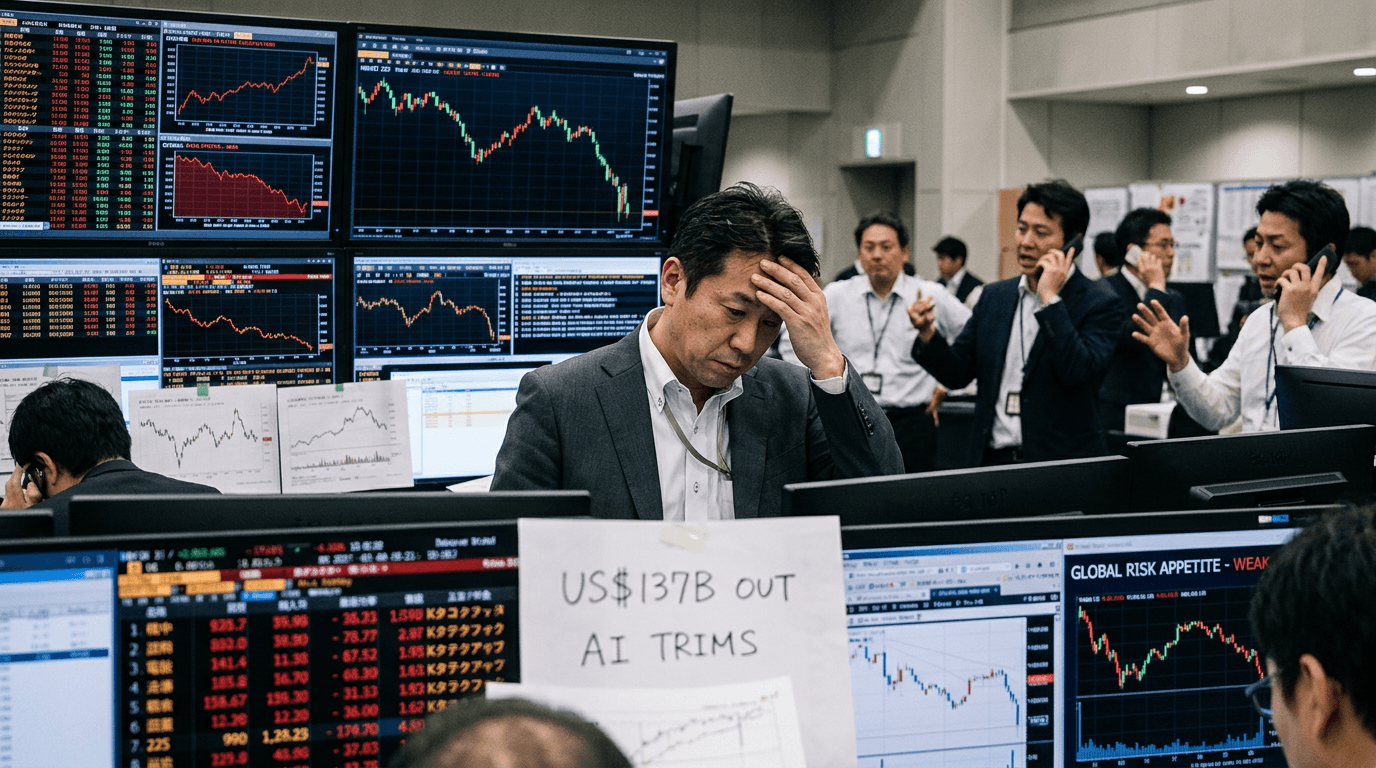
Foreign investors have just yanked a record US$137 billion from Asian equities, a powerful signal that the era of “buy anything linked to AI” is giving way to a more cautious and selective approach to risk. In the space of six months, the unwinding of crowded trades in chipmakers and AI beneficiaries has reshaped regional markets, pressured currencies, and redirected capital back toward the US and perceived safe havens[4].
WHAT’S BEHIND THE RECORD US$137 BILLION EXODUS
According to LSEG data, overseas investors pulled a net US$137.36 billion from shares across South Korea, Taiwan, India, Indonesia, Thailand, Vietnam and the Philippines in the first half of 2026, the fastest six‑month outflow since at least 2010[4]. That figure marks the culmination of months of rising geopolitical tensions, higher oil prices, and mounting concerns that AI-driven rallies had run too far, too fast[3][2].
A key trigger has been the combination of surging energy costs and Middle East conflict risk, which clouds the outlook for oil-importing economies such as South Korea, Taiwan and India[3]. Foreign investors have already sold about US$52 billion of Asian stocks in a single recent month, the largest withdrawal since Bloomberg’s data began in 2009[3]. Against that backdrop, trimming expensive technology exposures became an obvious way to de-risk portfolios.
Another important driver is valuation. AI-linked stocks—especially semiconductor names supplying global cloud and model-build infrastructure—have delivered triple-digit gains in some markets, leaving price-to-earnings multiples well above historical averages[4]. When a theme becomes both crowd favorites and valuation outliers, risk managers start asking: how much of our returns are concentrated in a single narrative?
Ai Winners Get Trimmed: From Euphoria To Rotation
The rally in Asian chipmakers has been central to the AI trade. Markets like South Korea and Taiwan, home to global leaders in memory chips, advanced foundries and AI hardware, saw foreign investors pile in as generative AI and data-center buildouts exploded[4]. As the gains mounted, many global funds ended up heavily overweight a narrow cluster of AI suppliers.
LSEG data show that the largest share of the record outflows in H1 2026 came from South Korea and Taiwan, precisely the markets that had benefited most from the AI boom[4]. Profit-taking in these “biggest winners” is not necessarily a vote against AI itself; it is a response to concentration risk and stretched valuations.
We’ve also seen periods where AI-linked technology stocks underperformed following weaker-than-expected results from major global players, which reinforced the idea that earnings need to catch up with lofty expectations[2]. When headline AI names miss or guide cautiously, it prompts investors to ask whether second- and third-tier beneficiaries are priced too optimistically.
In essence, foreign investors are rotating away from crowded AI trades into areas where the risk/reward looks more balanced. That includes cheaper sectors within Asia, but also other regions and asset classes that offer diversification from the AI story[4].
Pressure On Indices, Currencies And Local Markets
The scale of foreign selling has clear consequences for regional benchmarks. Large, foreign-owned names in technology and financials dominate key indices in South Korea, Taiwan and India, so heavy outflows can translate into index-level drawdowns even when domestic investors remain relatively constructive[4].
Currency markets feel the impact as well. When foreign investors exit, they sell local equities and typically convert proceeds back into their home currencies—often US dollars. That puts downward pressure on local currencies and can complicate monetary policy decisions, especially in economies already wrestling with imported inflation via higher energy prices[3]. We’ve seen this pattern before: foreign selling in equities, weaker local currencies, and central banks forced to weigh growth support against currency stability.
At the same time, the outflows are supporting flows into perceived safe havens and US assets. As risk appetite cools toward crowded AI trades in Asia, global portfolios rebalance toward deep, liquid markets with clearer monetary policy visibility and diversified sector exposure. This doesn’t mean Asia is permanently out of favor; it does suggest the market is re-pricing country and sector risk rather than blindly chasing the AI theme.
Where Global Capital Is Looking Next
The record outflow is not just about exiting Asia; it is about reorienting portfolios. According to recent commentary, investors are increasingly hunting for laggard markets and sectors that haven’t yet fully priced in structural themes such as defense, renewables, and selective industrial upgrades[4]. Southeast Asian markets, with relatively lower valuations and less crowded positioning, are starting to attract attention as possible beneficiaries of this rotation[4].
There is also renewed interest in balance: combining AI exposure with more cyclical, value, and defensive plays. Instead of owning only the highest-beta chipmakers, some investors are adding names in utilities, energy infrastructure, or industrial automation to hedge against volatility in pure AI plays.
For long-term investors, the move signals an important shift from narrative-driven buying (“AI will change everything”) to more nuanced fundamental analysis. Factors such as earnings quality, balance-sheet strength, and geopolitical risk are regaining prominence in portfolio construction.
Lessons For Traders And Simulated Finance Participants
For active traders and participants on simulated finance platforms, this episode offers several practical lessons:
First, concentration risk matters. When one theme—like AI chips—dominates your P&L, your portfolio becomes highly sensitive to any change in sentiment, earnings, or regulation affecting that theme. Diversification is not just a buzzword; it is a risk management tool that can keep drawdowns manageable when crowded trades unwind.
Second, flows can be as important as fundamentals in the short term. The record US$137 billion outflow is a flow story: good companies can see share prices fall simply because large foreign holders are reducing exposure[4]. Understanding who owns what, and how quickly they can move, helps traders anticipate volatility and liquidity conditions.
Third, macro and geopolitics cannot be ignored. Middle East hostilities, oil prices, and currency moves have been key catalysts in this rotation[3][2]. Even the strongest micro-level investment case can be overwhelmed, temporarily, by top-down shocks that force global funds to rebalance.
Finally, simulated finance environments are powerful places to test how portfolios behave under these conditions. By replaying scenarios of heavy foreign selling, currency shocks, and factor rotations from AI to value or defensives, traders can experiment with hedging strategies, position sizing, and diversification without risking real capital. That kind of practice builds the discipline needed to navigate real-world periods of stress.
In the end, the record pullback from Asian equities is less a verdict on AI’s long-term potential and more a reminder that markets periodically recalibrate exuberance. Themes that generate extraordinary profits also generate crowded trades, and crowded trades eventually face mean reversion. The investors who come through these cycles strongest are those who respect valuations, manage concentration risk, and stay alert to how global capital moves when narratives change.