
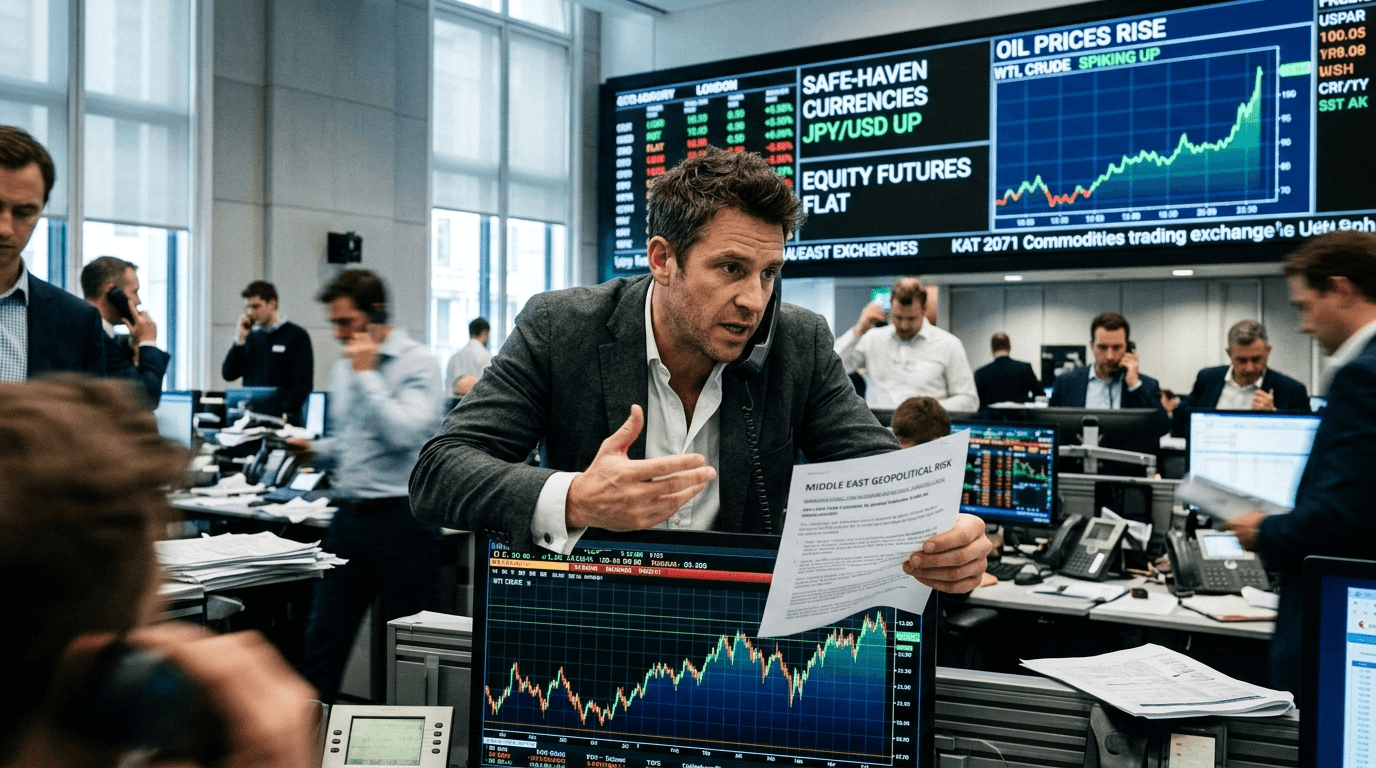
Risk sentiment has turned sharply cautious as renewed tensions in the Middle East push geopolitical risk back to the top of traders’ dashboards, pressuring risk-sensitive currencies and lifting demand for safe havens.[1][4][8][13] Oil prices have snapped higher and global equities have wobbled, feeding a classic “risk-off” pattern in FX and futures markets as investors reassess positions built on calmer conditions earlier in the year.[1][2][7][11] For traders, both live and simulated, this environment is a reminder that geopolitics can flip consensus trades quickly and inject volatility into otherwise quiet markets.[1][11][13]
Geopolitical Shocks And The Risk Mood
The latest flare-up in Middle East conflict has reversed some of 2026’s most popular macro trades, with global equity indices slipping and the US dollar gaining as investors rotate back toward perceived safety.[1][4][13] Renewed military actions and strikes on energy-related infrastructure have rattled markets, shattering a brief period of calm and sending crude benchmarks sharply higher.[2][7][15] Key chokepoints for oil flows, such as routes near the Strait of Hormuz, remain under scrutiny, heightening fears of supply disruption and reinforcing the risk-off tone.[7][10][11]
These moves are not happening in isolation. Higher oil prices come at a time when many investors were already debating how quickly major central banks, especially the Federal Reserve, might cut rates.[1][2][11] The combination of dearer energy and lingering inflation concerns makes central banks less eager to ease, which in turn drags on equities and supports safe-haven demand.[1][2][11] As a result, positions that relied on a smooth disinflation story and stable geopolitics are being challenged, adding to the choppiness in FX and futures markets.[1][11][13]
For traders, the key lesson is that geopolitical shocks rarely follow a neat playbook. Initial moves can be violent, but price action often evolves as new information arrives and markets reassess the probability of escalation versus de-escalation.[11][14][15] Recognizing this dynamic helps avoid overreacting to the first headline while still respecting the need to control risk when volatility spikes.[11][14]
Oil, Safe Havens, And Currency Winners And Losers
In this environment, safe-haven currencies typically see renewed demand, with the US dollar pushing toward multi-month highs as investors unwind short positions and seek shelter from geopolitical uncertainty.[3][4][6] The dollar’s appeal is being reinforced by both higher oil prices and the perception that US assets provide relative safety during periods of global stress.[1][3][6] At the same time, traditional safe havens like the Swiss franc and Japanese yen find intermittent support as investors hedge downside risk in equities and higher-yielding currencies.[6][10][11]
However, higher oil prices complicate the usual safe-haven hierarchy. Research notes that rising energy costs tend to weigh more heavily on currencies of large net energy importers, such as parts of Europe and Asia, while commodity-linked currencies can be relatively more resilient.[5][6][11] Currencies tied to oil and commodities, including the Canadian dollar and Norwegian krone, often benefit from improved terms of trade when crude prices rise, though they still trade within the broader risk-off backdrop.[5][6][10] This creates a nuanced picture: a stronger dollar and cautious mood overall, but with pockets of support in select commodity FX where higher energy prices are a structural positive.[5][6][11]
Emerging market FX is particularly sensitive in these episodes. Higher volatility, rising oil prices, and reduced risk appetite can trigger unwinds of carry trades, leading to sharp but sometimes short-lived moves in high-yielding currencies.[9][11][13] When oil stabilizes or geopolitical risk is perceived as contained, some of these moves can partially reverse as investors tentatively re-engage in higher-yield strategies.[9][11][14] For traders, this underscores the importance of distinguishing between structural shifts and temporary risk-off swings driven by headlines.
Choppy Range Trading And The Fx Volatility Landscape
One notable feature of the current environment is that, despite the sour mood, many major currency pairs remain stuck in relatively contained ranges, with volatility clustering around geopolitical headlines.[8][11][15] Markets swing between fear of escalation and hopes of a quick de-escalation, creating short bursts of volatility rather than a sustained trend in one direction.[11][14][15] Commentary highlights that while safe-haven demand is evident, price moves often fade as investors reassess the actual impact on growth, inflation, and policy expectations.[11][14][15]
For intraday and short-term traders, this backdrop can be both opportunity and trap. Choppy, headline-driven markets reward those who manage risk tightly and avoid over-leveraging into thin liquidity or news spikes.[8][11][12] Poorly timed entries or oversized positions, by contrast, can be punished when reversals set in as quickly as the initial move.[8][12][14] This is particularly relevant for FX and futures participants who rely on leverage, where even modest price swings can translate into outsized P&L swings.
Simulated finance environments provide a controlled arena to practice navigating these conditions. Traders can test how their strategies perform when spreads widen, volatility jumps, and correlations between assets temporarily break down.[10][11][12] SimFi platforms that mirror real-world pricing and margin dynamics allow participants to experience the psychological pressure of risk-off episodes without the capital at stake, improving discipline and decision-making when similar episodes occur in live markets.[10][11]
Practical Takeaways For Traders And Simfi Participants
To translate these macro themes into concrete actions, traders can focus on a few practical principles:
1) Anchor your view in scenarios Outline at least two scenarios: a short-lived flare-up with limited disruption, and a prolonged conflict with persistent energy shocks. For each, sketch expected paths for oil, the dollar, and key FX pairs.[1][6][11] This framework helps avoid reactive trading based purely on headlines.
2) Watch the oil–FX–rates triangle Track how changes in oil prices feed into inflation expectations and rate pricing, and how that, in turn, influences FX trends.[1][2][6] Rising oil with stickier rate expectations tends to favor safe havens and commodity exporters while pressuring energy importers.[5][6][11]
3) Respect safe-haven flows, but question durability Safe-haven demand can drive sharp moves in USD, JPY, and CHF, especially around major geopolitical headlines.[3][4][6] However, these moves can fade quickly if markets start to price a resolution or if attention shifts back to underlying economic data and rate differentials.[9][11][14] Avoid assuming that the first move will define the entire trend.
4) Right-size positions for volatility Choppy trading conditions argue for smaller position sizes, wider stops that reflect current volatility, and clear daily loss limits. Historical episodes show that even professional investors can be caught offside by abrupt reversals when risk sentiment turns on a headline or policy comment.[1][11][14] SimFi environments offer a way to test and refine these risk parameters without financial loss.
5) Use SimFi to stress-test your strategy Simulated trading can be used to replay recent market sessions, test reactions to hypothetical headlines, and evaluate how portfolio risk changes when exposures to oil-sensitive and safe-haven currencies shift.[10][11][12] By tracking simulated equity curves across different geopolitical scenarios, traders can identify strategies that are too fragile to withstand real-world shocks.
Conclusion
Resurfacing Middle East tensions are a timely reminder that geopolitics can upend risk sentiment, fuel sharp moves in oil, and reshape FX performance across safe havens, commodity currencies, and emerging markets.[1][5][11][13] While the immediate reaction has been a souring of risk appetite and renewed demand for safety, markets remain sensitive to how the conflict evolves and how central banks respond to any knock-on effects on inflation and growth.[1][2][11] For traders, the challenge is to navigate this uncertainty with a clear framework, disciplined risk management, and an appreciation for how quickly market narratives can shift.
Simulated finance platforms give market participants a valuable sandbox to rehearse these playbooks, refine position sizing, and stress-test strategies against the very kind of headline-driven volatility dominating markets today.[10][11][12] By combining macro awareness with practical risk controls, both new and experienced traders can turn a sour risk mood into a learning opportunity—and be better prepared for the next geopolitical shock that tests the resilience of global FX and futures markets.[1][11][13]