
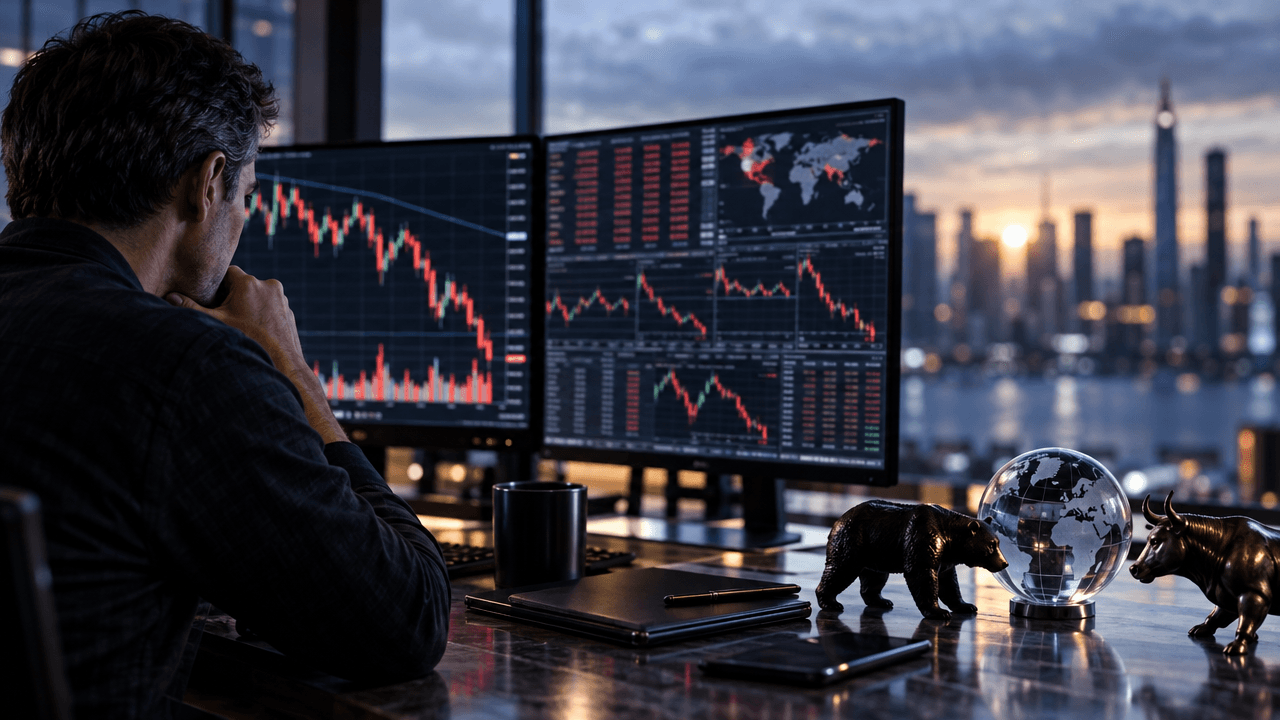
A sharp selloff in artificial intelligence stocks has pushed risk aversion back to the center of the market narrative. The S&P 500 fell 3.7% in the latest session, bringing the benchmark more than 10% below its October record and into correction territory. The Nasdaq Composite dropped 5.28%, while the Dow Jones Industrial Average lost 949.73 points. [7][11]
The damage was concentrated in technology and growth shares, but the pressure is no longer limited to a single corner of the market. As investors question whether AI-related valuations and spending expectations have moved too far ahead of fundamentals, selling has spread across major equity benchmarks. The next important test arrives when U.S. index futures reopen Sunday at 6:00 p.m. Eastern Time. [1][2]
What Risk-off Trading Means
Risk-off trading describes a market environment in which participants reduce exposure to assets perceived as vulnerable to economic uncertainty, elevated valuations, or disappointing growth. Capital often moves toward cash, government bonds, defensive sectors, and other assets viewed as more resilient.
In the current episode, the catalyst has been a sharp reassessment of AI-related equities. These companies have driven much of the market’s gains, but their prices also reflect ambitious expectations for revenue growth, profit margins, data-center investment, and future technological breakthroughs. When investors begin to question any part of that outlook, high-beta shares can experience unusually large declines.
The Nasdaq’s 5.28% fall illustrates this sensitivity. Technology-heavy indexes typically rise faster during periods of optimism, but they can also fall more quickly when traders reduce risk. The Dow’s 1.93% decline was smaller, reflecting its broader exposure to established companies and relatively lower concentration in speculative growth names. [11]
Why Index Futures Matter
Index futures provide an early indication of how investors are processing developments while the stock market is closed. Contracts linked to the S&P 500, Nasdaq-100, Dow, and other benchmarks trade electronically for most of the week. CME equity index futures normally reopen on Sunday at 6:00 p.m. Eastern Time and trade until 5:00 p.m. Friday, with a daily maintenance break. [2][4]
The Sunday session can be especially informative after a major Friday selloff. If futures open significantly lower, it may signal that traders remain concerned about valuation, liquidity, or incoming news. A stable or higher opening does not necessarily confirm that the decline is over, but it may suggest that selling pressure is becoming more selective.
Traders should avoid treating the first futures move as a guaranteed forecast for Monday’s cash session. Overnight markets can be thinner, spreads can widen, and prices can react sharply to headlines. Futures may also retrace before the regular market opens as institutional investors reassess positions and new information becomes available.
Key Risks For The Week Ahead
The central question is whether the AI-led decline remains concentrated in technology or becomes a broader equity liquidation. A widening selloff would indicate that investors are reducing overall exposure rather than simply rotating from expensive technology shares into other industries.
Bond-market behavior will also matter. Falling Treasury yields can suggest that investors are seeking safety, although yields can move for several reasons, including changing expectations for inflation and Federal Reserve policy. Currency markets, credit spreads, and volatility measures can provide additional clues about whether stress is intensifying.
Earnings expectations are another important variable. If analysts begin cutting forecasts for major technology companies or question the return on massive AI infrastructure spending, equity valuations may face further pressure. Conversely, credible evidence of strong demand and improving profitability could help stabilize the sector.
For traders, levels and market breadth deserve attention. A decline led by a handful of mega-cap stocks is different from a session in which most sectors and individual shares fall together. Monitoring the percentage of stocks above key moving averages, trading volume, and the performance of defensive sectors can help distinguish a normal correction from a deeper risk-reduction cycle.
Practical Lessons For Simfi Traders
SimFi traders can use this environment to practice disciplined risk management without exposing real capital. The first priority is position sizing. When volatility rises, a position that seemed reasonable during calm conditions can become too large relative to the account’s risk limits.
Stop-loss placement should reflect the market’s volatility rather than an arbitrary number of points. A stop placed too close to entry may be triggered by normal fluctuations, while a stop placed too far away can create an unacceptable loss. Traders should define the maximum dollar or percentage risk before entering the position.
It is also important to separate analysis from prediction. A bearish market does not mean every short trade is attractive, and an oversold index can continue falling. SimFi participants can test multiple scenarios: a gap lower followed by continuation, a gap lower followed by recovery, or a quiet open followed by renewed selling.
Keeping a trading journal can reveal whether decisions are based on a repeatable process or emotional reactions to headlines. Record the setup, entry logic, planned risk, exit decision, and market conditions. The objective is not to win every trade, but to build behavior that remains consistent when prices move quickly.
Conclusion
Risk-off trading is placing sustained pressure on global equities and index futures, with the AI sector at the center of the latest reassessment. The S&P 500’s move into correction territory, the Nasdaq’s sharp decline, and the Dow’s nearly 950-point drop show how quickly confidence can weaken when highly valued assets lose momentum. [7][11]
Sunday’s futures reopening will offer an important early signal, but it should be viewed as information rather than a definitive market forecast. The more durable lesson is risk management: reduce unnecessary exposure, plan for volatility, and evaluate market breadth instead of focusing on one headline or one index.
For SimFi traders, periods like this provide a valuable training environment. By testing position sizing, scenario planning, and disciplined execution, traders can turn market uncertainty into a practical lesson in preparation.