
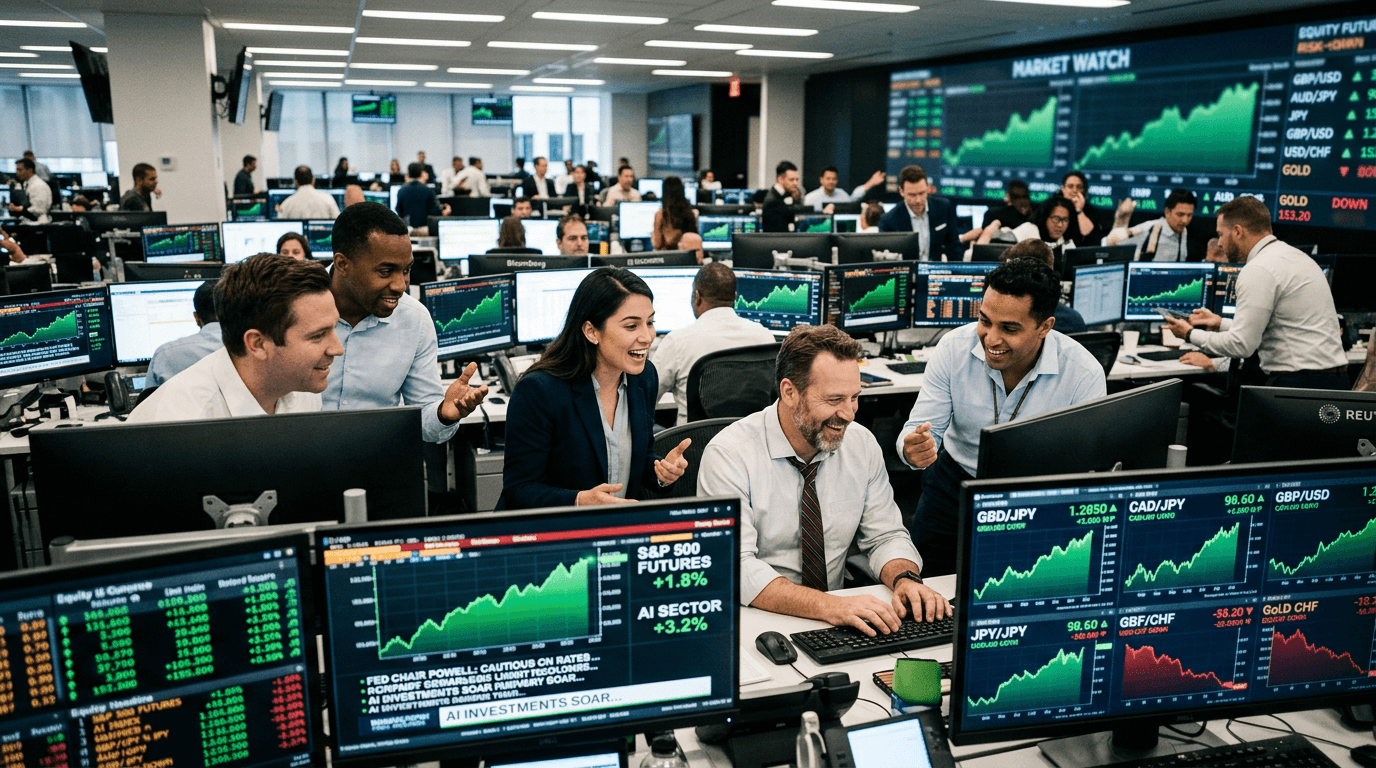
Global investor sentiment has swung decisively back toward risk, with portfolio managers embracing equities, credit, and higher‑beta currencies on the twin narrative of a more dovish Federal Reserve and powerful AI‑driven investment growth.[5][7] For traders, this shift is reshaping price action in equity index futures and risk FX, while gradually eroding the defensive premium embedded in the dollar and other havens.[5]
Global Risk Sentiment Shifts To Risk-on
Recent cross‑asset moves point to a broad-based risk-on environment rather than a narrow tech rally.[5][7] Major global equity indices have been pushing to new highs, and the MSCI All Country World Index—which tracks both developed and emerging markets—has reached a record peak, signaling a resurgence in global risk appetite.[5]
Credit markets are sending a similar message. U.S. credit spreads, which measure the extra yield investors demand to hold corporate bonds instead of Treasuries, have narrowed to their lowest levels since the late 1990s.[5] Tight spreads typically reflect confidence in corporate balance sheets and a willingness to take credit risk, consistent with the bullish tone emerging from institutional investor surveys.
Emerging market assets are participating strongly in this upswing. EM equities have outperformed global indices, underscoring investors’ willingness to move out along the risk spectrum in search of growth and yield.[5] This kind of broad participation—across regions and asset classes—is characteristic of durable risk-on phases rather than short‑lived squeezes.
For traders, the key takeaway is that the prevailing narrative has shifted from “avoid risk and preserve capital” to “lean into growth and AI‑linked themes,” with positioning in futures and FX markets increasingly aligned with that view.[5][7]
Dovish Fed Hopes Rewire The Macro Outlook
The prospect of a more dovish Federal Reserve is central to this improvement in risk appetite.[5][6][7] Futures markets have already priced in multiple rate cuts over the next year, effectively lowering the expected path of U.S. policy rates.[5] Lower real yields reduce discount rates on future earnings, especially for growth and technology sectors, and ease financial conditions across the globe.
Strategists describe this environment as a “Great Resilience Trade,” built on resilient consumers, a softer policy stance, and reduced trade tensions.[5] As rate expectations move down, equity valuations find more support, credit spreads remain tight, and volatility subsides, encouraging investors to add risk rather than hedge it aggressively.[5][7]
From a currency perspective, a dovish Fed typically removes some of the dollar’s yield advantage and diminishes its appeal as a defensive asset.[5] In risk-on episodes, capital often rotates into higher‑yielding or cyclical currencies—such as commodity exporters or select emerging markets—while demand for the dollar, yen, and Swiss franc moderates. This rotation is what traders refer to as “risk FX outperformance,” and it tends to show up first in spot markets and then in options pricing as demand for downside protection in risk currencies falls.
The practical implication: as long as markets remain confident that the Fed will cut rather than hike, risk assets are likely to retain a structural tailwind, even when short‑term data surprises introduce bouts of volatility.[3][7]
Ai Spending As The New Cycle Driver
The second pillar of the current risk-on narrative is the scale and durability of AI‑related capital expenditure.[5][6][7] Analysts increasingly view AI infrastructure—data centers, cloud capacity, networking equipment, and semiconductors—as a multi‑year investment cycle rather than a one‑off boom.[2][6]
This AI capex wave is fueling what some describe as an investment‑led growth narrative into 2026, with demand for chips, servers, and specialized hardware underpinning earnings in technology and industrial value chains.[1][2][7] The enthusiasm is not limited to a handful of mega‑cap names; it is broadening into small caps and cyclicals as investors price in second‑order effects, including productivity gains and new business models.[7]
Lower funding costs from a dovish Fed amplify this dynamic by reducing the hurdle rate for long‑duration projects and venture-style investments in AI.[6] When capital is cheaper and growth stories more credible, equity investors are more willing to pay up for future cash flows, and credit investors are more comfortable financing expansion.
For traders, the AI theme is not just about picking individual winners. It is about recognizing that AI spending is acting as a macro driver, supporting indices, compressing credit spreads, and encouraging flows into sectors and currencies leveraged to global growth.[1][5][7]
What It Means For Futures And Risk Fx
Equity index futures are one of the clearest barometers of this stronger risk appetite. With global indices near record levels and breadth improving, futures pricing reflects expectations of sustained earnings growth and a benign rate backdrop.[5][7] Positioning has been shifting from defensive hedges into directional longs, especially in indices with heavy exposure to technology, industrials, and cyclical sectors that benefit from AI‑driven demand and global growth.[1][2][7]
On the FX side, risk‑sensitive currencies have been outperforming as investors re‑engage in carry trades and growth‑linked exposures. While dollar demand tends to spike during risk‑off episodes, the current environment has seen a gradual rotation out of havens into higher‑beta currencies, including select EM FX and commodity‑linked majors, as investors express their constructive macro view.[5]
Options markets often corroborate these shifts. In a sustained risk‑on regime, implied volatility in risk FX typically grinds lower, and skew (the pricing of downside versus upside protection) becomes less extreme, reflecting reduced fear of sharp risk reversals. Meanwhile, equity index vol can stay relatively contained even as prices grind higher, signaling confidence in the underlying trend.
For SimFi traders, these dynamics offer concrete opportunities: equity index futures become vehicles for expressing directional or relative‑value views on AI‑heavy markets, while FX simulations can be used to explore how different rate and growth scenarios affect risk currencies versus havens.
Practical Takeaways For Traders
First, recognize that the current risk-on phase is driven by both macro and structural forces. Dovish Fed expectations are easing financial conditions, while AI capex is providing a tangible growth engine across sectors and regions.[1][5][6][7] Trading strategies that consider only one side of this narrative risk underestimating the persistence of the trend.
Second, focus on where the risk-on story is most concentrated. Indices and sectors with high AI infrastructure exposure—semiconductors, cloud providers, networking, and industrials tied to data center build‑outs—are likely to remain central to the equity futures narrative.[2][6][7] In FX, currencies linked to growth, commodities, and higher yields tend to benefit most when global risk appetite rises and dollar demand for safety fades.[5]
Third, balance opportunity with risk management. Analysts highlight rising global yields outside the U.S., potential policy divergence, and the build‑up of leverage linked to AI plays as sources of vulnerability.[1][7] Geopolitical tensions can also reprice risk premia quickly, triggering reversals in futures and FX markets.[7] Using simulated environments to stress‑test portfolios against scenarios such as a hawkish pivot, an AI spending slowdown, or a spike in volatility can help traders prepare for these inflection points.
Finally, avoid viewing the risk-on environment as an invitation to abandon discipline. The same “Great Resilience Trade” that rewards bold speculation also benefits balanced portfolios that maintain diversification and hedging while selectively leaning into AI and growth narratives.[5] A thoughtful mix of risk assets and defensive exposure can allow traders to participate in upside while staying resilient to regime shifts.
In short, stronger global risk appetite, anchored in dovish Fed hopes and AI investment, is increasingly visible in equity index futures and risk FX. For traders, the challenge is not simply to recognize that the mood has turned bullish, but to translate that macro story into structured, risk‑aware strategies that can navigate the next phase of the cycle.