
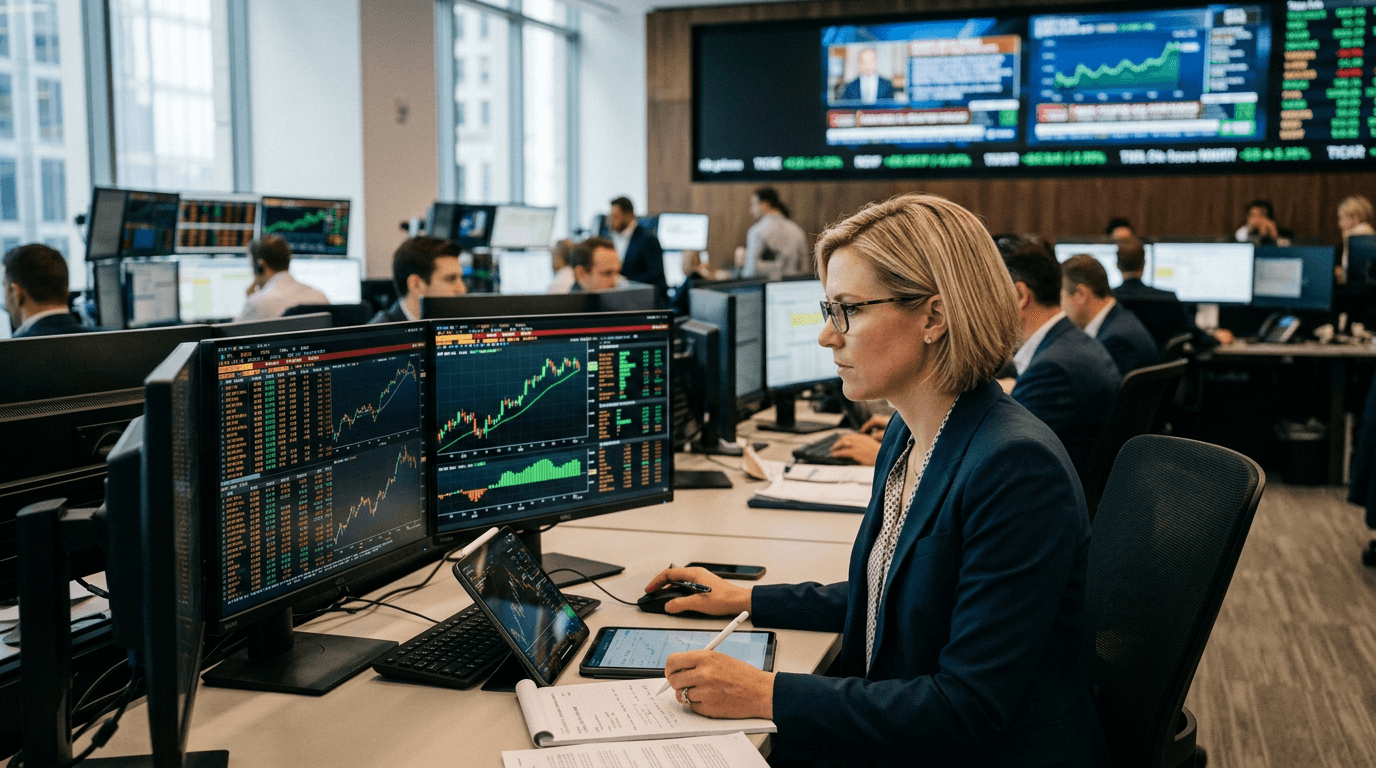
U.S. stock futures are attempting to regain their footing as signs of easing geopolitical stress and softer oil prices encourage investors to move cautiously back into risk assets.[1][3] Futures on the Dow Jones Industrial Average, S&P 500, and Nasdaq-100 have all pushed higher, helped by hopes for progress in U.S.-Iran peace talks and a retreat in crude and the U.S. dollar.[2][3] This shift marks a tentative move away from the defensive positioning that dominated when oil was spiking and Middle East tensions were at the forefront of market anxiety.[1][4]
Market Snapshot: Risk Appetite Returns, But Cautiously
U.S. equity futures rose, with Dow futures up around 0.7%, S&P 500 futures gaining roughly 0.8%, and Nasdaq-100 futures outperforming with gains of about 1.1% as traders reacted to headlines suggesting possible peace progress.[2][3] That move came alongside a pullback in Brent crude and a weaker dollar, a combination that typically eases pressure on global financial conditions and corporate margins.[3][6]
In the cash market, U.S. indices had already started to stabilize after testing key support levels earlier in the month, with the Nasdaq 100 showing particular resilience even as oil-driven stress weighed on broader benchmarks.[1][4] Analysts point to this pattern as a classic “accumulation” phase—buyers quietly stepping in after a period of weakness, especially in growth and tech names that had been hit hardest by risk-off flows.[1][4]
Importantly, this is not a full-throttle risk-on environment. Ongoing tensions in the Middle East, including concerns around the Strait of Hormuz, remain in the background, even as diplomatic signals from Washington and peace-related headlines have taken some volatility out of energy markets.[1][3] Investors are effectively trading a “less bad” scenario: still wary of shocks, but more willing to hold equities and credit than when oil and geopolitical risk were both surging.
Why Geopolitics, Oil And The Dollar Matter For Risk Assets
Markets care about geopolitics not only for the headlines, but for the pathways through which conflict spills into prices, inflation, and growth. The most immediate channel is energy. Rising geopolitical tension in key producing regions often drives oil higher, which can lift headline inflation, squeeze consumer spending, and pressure central banks to stay hawkish for longer.[1][4][6] When oil retreats, as it has on the back of peace hopes, it removes some of that macro pressure and supports equity valuations and risk sentiment.[3][6]
The dollar is the second major channel. Heightened geopolitical risk tends to push investors into the U.S. dollar as a safe haven, tightening global financial conditions, especially for emerging markets and commodity importers. As stress eases and the dollar slips, funding conditions loosen, which can support flows into equities, credit, and higher-beta assets.[3]
Geopolitics also shapes the volatility regime. Periods of elevated tension often correlate with spikes in volatility indices, wider credit spreads, and stronger performance from defensive sectors like utilities, consumer staples, and defense contractors.[1] When headlines shift toward diplomacy and peace talks, volatility can compress, risk premia narrow, and leadership can rotate back toward growth, cyclicals, and small caps.
For traders, the key lesson is that geopolitical risk is less about predicting the next headline and more about understanding how those headlines transmit into macro variables—oil, inflation expectations, yields, the dollar—and then into asset prices.
How Investor Positioning Is Shifting
The recent bounce in futures suggests investors are gradually rebalancing away from ultra-defensive postures built up during the height of geopolitical concerns.[1][4] Earlier, rising oil prices and uncertainty led many to favor cash, short-duration bonds, low-volatility equity strategies, and energy or defense plays.[1][4] As conditions calm, capital is tentatively rotating back toward broader equity indices and growth-oriented sectors.
The Nasdaq 100’s outperformance is a clear example. Despite being pressured earlier in the month, the index has shown strong resilience as investors return to secular themes like artificial intelligence and digital transformation, where earnings growth remains robust.[1][4] This rotation aligns with expectations from some strategists that easing pressures later in the year could support lower bond yields and higher equity valuations, especially for longer-duration assets like growth stocks.[1][5]
However, this repositioning is incremental, not all-or-nothing. Many portfolios remain “barbelled,” combining quality growth and large-cap tech exposure with more defensive holdings to hedge against the risk that geopolitical tensions re-escalate or that inflationary shocks reappear via the energy channel.[1][4][5] Futures markets give an early glimpse of this balancing act intraday, as traders adjust exposure ahead of the cash open.
What This Environment Means For Active Traders
For active traders, including those on SimFi platforms, this type of environment is rich with short-term opportunities—provided risk is managed with discipline.
First, volatility can compress quickly when geopolitical stress eases, leading to sharp reversals in trades that were positioned for “fear.” Short volatility strategies (such as selling options) may suddenly look more attractive, but they carry meaningful tail risk if negative headlines return unexpectedly. Structuring trades with defined risk—using spreads rather than naked short options, for example—can be crucial.
Second, sector and factor rotations tend to accelerate around inflection points in sentiment. When markets shift from defensive to risk-on, high-beta and growth names often outperform in the short run, while defensives and traditional safe havens may lag.[1][4] Traders who can identify these rotations early—watching futures, sector ETFs, and relative performance ratios—can potentially capture outsized moves over days to weeks rather than months.
Third, futures themselves become a powerful tool for expressing views on geopolitical risk. Index futures allow traders to quickly dial up or down exposure to broad equity markets as newsflow evolves, without having to reconfigure entire cash portfolios. That’s why you often see futures react first to overnight headlines about peace talks, energy disruptions, or diplomatic breakthroughs, with cash markets catching up at the open.[2][3]
Practical Takeaways For Simulated And Live Trading
For traders using simulated environments, this backdrop offers a valuable testing ground for strategies that integrate macro and geopolitical signals:
- Build scenarios: Create playbooks for “escalation” and “de-escalation” scenarios—how you would adjust index, sector, and FX exposure if oil jumps 10% on new tensions, versus if it drops on peace headlines.
- Track cross-asset signals: Practice monitoring oil, the dollar, volatility indices, and futures together, and map how changes in each tend to affect your equity or index strategies.[3][6]
- Test rotation strategies: Use historical and current data to backtest how quickly sectors like tech, energy, and defensives respond to shifts from risk-off to risk-on, and refine entry/exit rules based on those patterns.[1][4]
- Refine risk management: Simulate how your portfolio would behave if a peace-driven rally reversed abruptly due to a negative surprise. Set stop-loss, position sizing, and hedging rules that acknowledge the inherently unpredictable nature of geopolitics.
By training in a simulated setting first, traders can develop frameworks for responding to evolving geopolitical conditions and cross-asset moves, then apply those frameworks more confidently when real capital is at stake. As U.S. stock futures and risk assets regain footing on hopes of easing geopolitical stress, the edge goes not to those who can predict every headline, but to those who understand how macro channels connect the news to prices—and who are prepared with a plan when sentiment turns.