
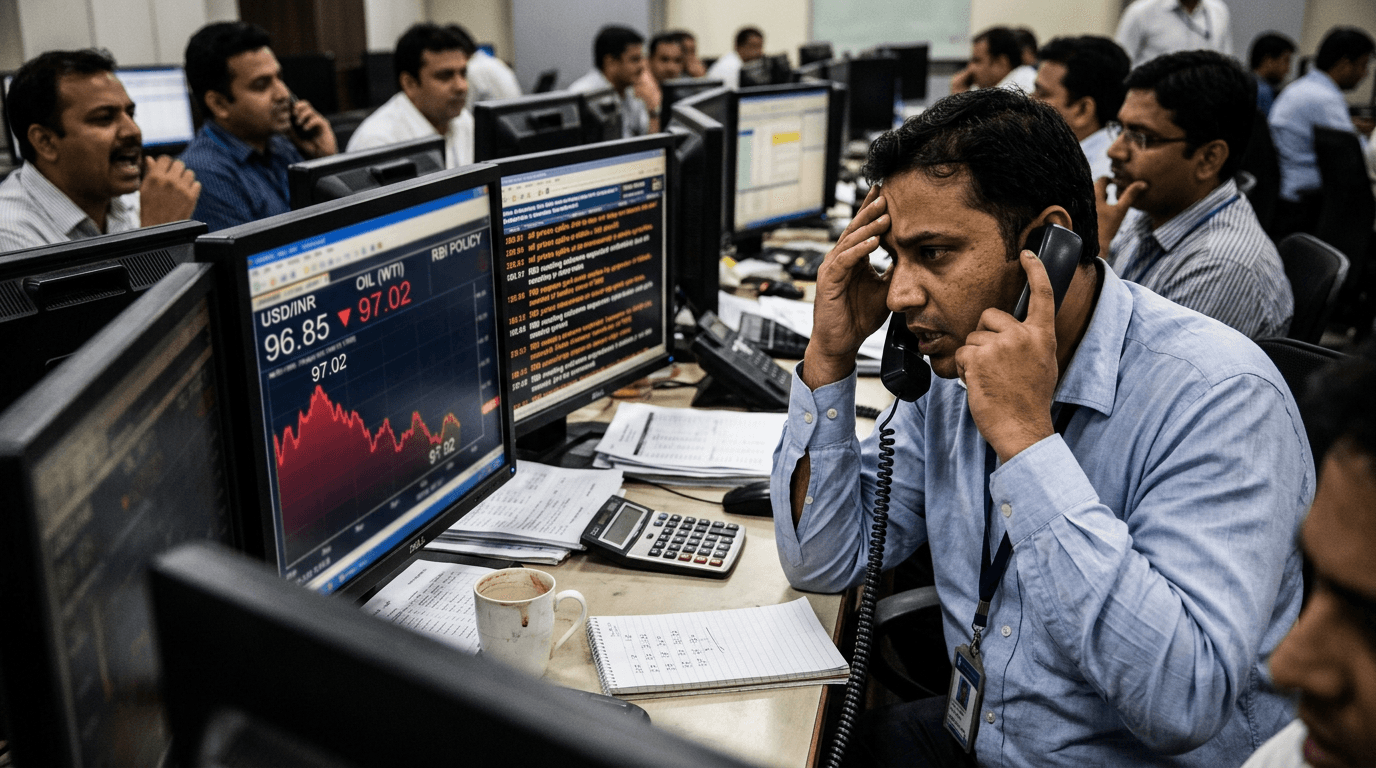
The Indian rupee’s slide to record lows, with USD/INR pushing toward the 97 handle, is a textbook example of how a global shock can cascade through emerging markets. A sharp jump in crude oil prices has hit India’s import-heavy economy at the same time that investors are flocking to the US dollar and other safe-haven assets, amplifying pressure on the currency. For traders, this is not just a headline — it is a live case study in macro risk, central bank policy, and FX market dynamics.
WHAT IS DRIVING THE RUPEE’S SLIDE?
At its core, the rupee’s weakness reflects three intertwined forces:
1) Oil shock 2) Global risk-off sentiment 3) Relative yield and growth dynamics versus the US
India imports the vast majority of its crude oil needs. When global oil prices spike, India’s import bill surges in rupee terms. That worsens the trade deficit and raises concerns about the current account balance. The market quickly prices in higher demand for US dollars to pay for imports, which pushes USD/INR higher.
At the same time, when risk sentiment deteriorates globally — for example due to geopolitical tensions, supply disruptions, or fears of slower global growth — investors typically reduce exposure to emerging market assets and rotate into perceived safe havens like the US dollar, US Treasuries, and the Japanese yen. That portfolio rebalancing creates additional outflows from Indian equities and bonds, feeding further rupee weakness.
Layer on top of this the interest rate differential: if the Federal Reserve is seen as more hawkish than the Reserve Bank of India (RBI), or US yields move higher relative to Indian yields, USD assets become more attractive on a risk-adjusted basis. Even if India’s growth outlook is solid, the funding cost and risk premium can make investors more cautious, especially in volatile periods.
For traders, the combination of an oil shock and risk aversion is a classic “double-whammy” for an oil-importing emerging market currency like INR.
OIL SHOCK, INFLATION, AND INDIA’S EXTERNAL BALANCE
The surge in oil prices affects India through multiple channels, all of which matter for how USD/INR trades.
Trade balance and current account Higher crude prices mean India must spend more dollars on imports. Unless exports rise equally, the trade deficit widens and the current account deteriorates. A weaker external position usually translates into a weaker currency as the market anticipates persistent demand for foreign currency.
Inflation and real income Oil is a key input for transportation, manufacturing, and logistics. Rising crude prices tend to filter into higher fuel costs, which can then pass through to broader inflation (food, goods, and services). Higher inflation erodes real incomes and can weigh on domestic demand. For markets, the risk is that sustained inflation pressures may force the RBI to tighten policy, slowing growth.
Policy trade-offs The RBI and government face a policy dilemma: absorb the shock through the currency (letting the rupee weaken), through higher inflation (tolerating more price pressure), or through tighter policy and subsidies (which affect growth and public finances). The balance they choose shapes expectations for USD/INR.
If markets believe the oil shock is temporary and manageable, they may tolerate a weaker rupee as a “shock absorber.” But if oil stays elevated or climbs further, concerns about a structurally weaker external position can trigger more persistent rupee selling, especially from global macro funds and systematic strategies.
RBI DILEMMA: INTERVENE OR TOLERATE WEAKNESS?
Whenever USD/INR hits fresh record highs, one question dominates trader conversations: how will the RBI respond?
FX intervention The RBI has a sizeable stock of foreign exchange reserves, accumulated over years of intervention and capital inflows. It can deploy these reserves to smooth volatility, leaning against disorderly moves in USD/INR by selling dollars and buying rupees.
However, there are limits. Heavy intervention depletes reserves and can invite speculative attacks if markets sense the central bank is defending an unsustainable level. As a result, the RBI typically aims to manage the pace of depreciation rather than defend a fixed line in the sand.
Rate policy and liquidity Beyond spot intervention, the RBI can influence the rupee via interest rates and liquidity operations.
- Hawkish stance (higher rates, tighter liquidity) supports the rupee but risks slowing growth and tightening financial conditions.
- Dovish stance (lower rates, ample liquidity) supports growth but can weaken the currency further and fuel inflation expectations.
Communication Forward guidance and messaging also matter. Clear communication that the RBI will act to prevent “excessive volatility” — a phrase it often uses — can itself stabilize markets by discouraging one-way speculative positioning.
For traders, the key is not trying to guess the exact level the RBI defends, but understanding the reaction function: how does the bank balance growth, inflation, and currency stability? That framework is more durable than any single FX level.
What This Means For Traders And Simulated Finance
A move of USD/INR toward 97 is not just a chart event; it re-prices risk across Indian and global assets.
Equities and bonds - Indian equities may face pressure from higher input costs, margin squeezes, and foreign outflows. Exporters with USD revenues can outperform the broader market, while domestic-demand-focused sectors may lag. - Indian bonds may become more volatile as markets weigh the path of inflation and RBI policy. Higher yields can cushion some outflows but also tighten financial conditions at home.
Corporate and household impact - Corporates with unhedged foreign currency debt face higher repayment costs in rupee terms. - Import-dependent sectors (energy, chemicals, airlines) see cost pressures rise. - Households may face higher fuel and transportation costs, weighing on discretionary spending.
In a SimFi environment, traders can use these dynamics as a learning laboratory: testing macro theses, stress-testing portfolios, and practicing risk management around macro shocks without putting real capital at risk. Simulated trading allows:
- Experimentation with different hedging strategies around USD/INR
- Testing correlations between the rupee, crude oil, Indian equities, and global risk sentiment
- Practicing event-driven trading approaches around RBI meetings and major data releases
HOW TRADERS CAN NAVIGATE USD/INR VOLATILITY
Whether in live markets or simulated environments, a structured approach to this type of FX move can make the difference between opportunistic trading and random speculation.
1) Anchor in the macro narrative Define the core drivers: oil prices, global risk sentiment, US yields, and RBI policy expectations. Ask: is the move in USD/INR proportional to these drivers, or is sentiment overshooting? This helps frame whether you are trading momentum or mean reversion.
2) Watch key data and event triggers Keep an eye on:
- Crude oil price trends and major OPEC/geopolitical developments
- India’s trade balance, current account, and FX reserve data
- Inflation prints (CPI, WPI) and any changes in fuel pricing policies
- RBI policy meetings, minutes, and unscheduled announcements
In a simulated setting, you can backtest how USD/INR responded to past oil spikes or RBI interventions to refine your playbook.
3) Manage position size and leverage High volatility can amplify both profits and losses. Sensible steps include:
- Smaller position sizes relative to volatility
- Wider, pre-defined stop-loss levels based on ATR or historical ranges
- Avoiding over-leveraging in a single directional bet on USD/INR
4) Use correlated markets for confirmation Confirm your INR view with other assets:
- Are Indian equities and bonds moving in line with FX?
- Is the broader EM FX complex under pressure, or is the move INR-specific?
- Is the US dollar broadly strong (DXY higher), or is this mainly about India?
5) Treat central bank reaction risk as a constant When a currency is at record lows, surprise policy actions — verbal or actual — are always on the table. In simulated trading you can rehearse “what if” scenarios: a surprise rate hike, a larger-than-expected FX intervention, or a policy shift. Understanding how such tail events alter P&L and risk metrics is invaluable preparation for real-world trading.
Conclusion
The rupee’s fall to record lows with USD/INR nearing 97 is a powerful reminder that macro forces can move markets quickly and dramatically. A combination of oil shock, risk aversion, and shifting yield differentials has pushed India’s currency into uncharted territory and sharpened focus on the RBI’s next steps.
For traders, this environment is rich with information and opportunity — but also risk. Using a disciplined, macro-informed framework, and leveraging simulated trading to rehearse strategies and stress-test assumptions, can transform this episode from a headline shock into a deep learning experience. Whether you are building your first FX playbook or refining a seasoned macro strategy, the current rupee story offers a timely, real-world case study in how global forces, local fundamentals, and policy choices collide in the currency market.