
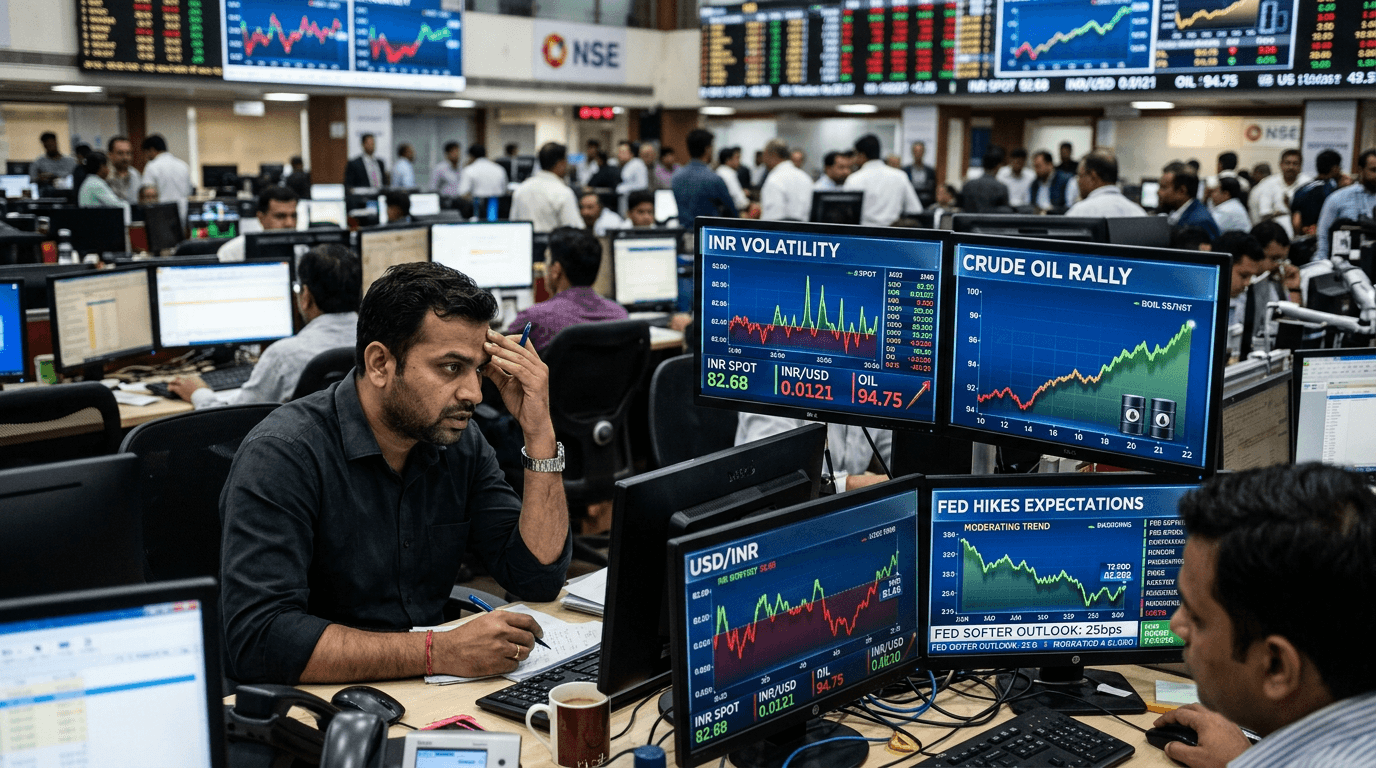
The Indian rupee is caught in a classic tug-of-war: support from easing expectations of U.S. Federal Reserve rate hikes on one side, and pressure from a relentless crude oil rally on the other.[9] For traders and investors, this mix of global monetary dynamics and commodity shocks is creating a nuanced, range-bound but volatile environment for USD/INR.
Market Snapshot: A Currency Held In Check
Recent levels show the rupee trading around 96.20 per dollar, with traders expecting an opening in a tight 96.18–96.22 band.[9] That narrow range reflects a market where opposing forces are roughly balanced, preventing either a sharp appreciation or a decisive breakdown.
On the supportive side, softer U.S. inflation data has cooled the odds of a near-term Fed rate hike, taking some strength out of the U.S. dollar and easing pressure on emerging market currencies like the rupee.[9] At the same time, an ongoing rally in crude oil has revived concerns about India’s external balances, limiting optimism and keeping INR volatility elevated.[9]
This combination often translates into a “wait-and-see” posture among market participants, with interbank positioning light and corporates cautiously hedging their exposure rather than making aggressive directional bets.[7]
Fed Expectations: A Tailwind For The Rupee
The U.S. Federal Reserve is a central driver of global FX flows, and the rupee is highly sensitive to shifts in Fed expectations.[13] When markets price out the risk of additional rate hikes—or begin to anticipate future cuts—dollar strength typically moderates, offering breathing room to currencies that had been under pressure.[4][7]
Recent U.S. inflation data has done exactly that: by coming in softer than feared, it has tempered worries that the Fed might need to push rates higher again in the near term.[9] Lower perceived odds of a hike reduce the appeal of U.S. assets, leading to:
- A softer dollar
- Easier global financial conditions
- Improved risk appetite for emerging markets
In prior episodes, Fed rate-cut hopes have helped the rupee stage meaningful recoveries, with USD/INR forward premiums rising as market participants anticipate more benign U.S. policy.[4][7] Similar dynamics are at play now, even if the current support is being partly offset by commodity-related headwinds.
For rupee traders, the key takeaway is that macro data like U.S. inflation, payrolls, and Fed communication directly and quickly feed into INR pricing. Monitoring these releases is as important as tracking domestic Indian indicators.
Crude Oil Rally: The Major Headwind
India is a large net importer of crude oil, and higher prices mechanically worsen its trade and current account balances.[2] When crude rallies:
- The cost of oil imports rises
- Demand for dollars from oil companies increases
- The current account deficit tends to widen
- Concerns about external vulnerability resurface
Earlier periods of falling crude prices provided a clear tailwind for the rupee, easing import costs and supporting the currency.[2] The current situation is the mirror image: surging crude is a drag that counteracts the relief coming from cooler Fed hike bets.[9]
Beyond pure balance-of-payments math, higher oil prices also raise the risk of imported inflation for India. If energy costs push domestic prices higher, the Reserve Bank of India (RBI) may need to weigh tighter policy or more active intervention, adding another layer of complexity to the INR outlook.
For both real-money investors and simulated traders, crude oil is not just a commodity chart—it is a direct input into India’s macro narrative and a key variable in any INR strategy.
Inr Volatility And Range-bound Trading
The current set-up—Fed tailwind versus crude headwind—naturally leads to a range-bound but choppy market. Traders anticipate the rupee will open little changed, yet they also acknowledge elevated volatility driven by shifting global cues.[9]
In such conditions, several patterns often emerge:
- Spot levels oscillate within a relatively tight band
- Corporates increase hedging to protect against adverse moves
- Interbank liquidity focuses more on intraday opportunities than on big trend trades
- Forward premiums move with evolving Fed expectations and U.S. yields[3][7]
For short-term participants, this environment favors disciplined risk management, clear stop-losses, and respect for key technical levels rather than aggressive “all-in” positioning. For longer-term investors, the focus shifts to whether oil’s strength or the Fed’s eventual easing path will dominate the medium-term narrative.
Simulated finance platforms can be particularly useful here: they allow traders to test strategies suited to range-bound markets—such as mean-reversion, options-based volatility plays, or carry trades—without real capital at risk.
What This Means For Traders And Investors
Against this backdrop, both traditional and simulated traders need a structured framework to think about USD/INR:
1. Anchor on global drivers The rupee is currently more a reflection of global forces—Fed policy expectations and crude prices—than purely domestic news.[9] This makes international macro data indispensable for any INR view.
2. Watch India’s external balance narrative As oil rallies, markets reprice the risk to India’s current account deficit and external financing needs, which can cap rupee gains even when the dollar is soft.[2][9]
3. Anticipate policy and intervention RBI’s stance, while not the headline today, sits in the background as a stabilizing force. Expectations of central bank action have previously helped support the rupee during periods of stress.[5]
4. Align strategies with regime In a tug-of-war regime, strategies that acknowledge both sides—using hedges, options, or simulated scenario analysis—are more robust than one-way bets on appreciation or depreciation.
For users of SimFi platforms, this environment is ideal for practicing macro-aware FX trading: building scenarios around different paths for the Fed, oil, and RBI responses, and seeing how USD/INR might react under each.
Conclusion
The Indian rupee’s current story is a study in competing global forces. Softer U.S. inflation and cooling Fed hike bets are offering support, preventing a sharper slide in the currency.[9] At the same time, surging crude oil prices are squeezing India’s external balances, curbing optimism and keeping volatility elevated.[9]
For traders, the message is clear: this is not a one-factor market. Successful INR strategies will integrate monetary policy expectations, commodity dynamics, and India’s external accounts into a single coherent view. Whether you trade live capital or simulate decisions, understanding this interplay is critical to navigating the rupee’s next moves.