
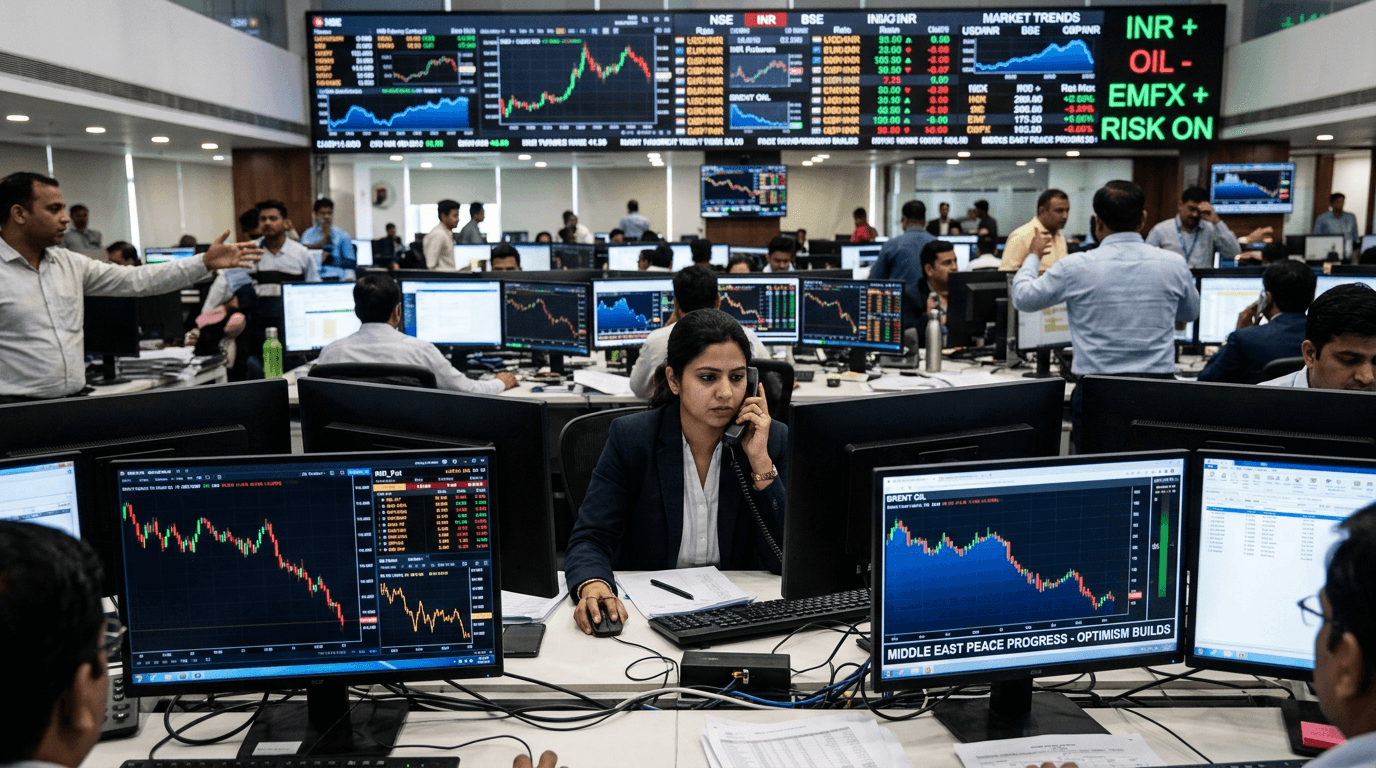
For the third straight session, the Indian rupee has extended its gains against the US dollar as easing tensions in the Middle East and hopes for a durable peace deal have lifted global risk sentiment and reduced demand for safe-haven dollar assets.[11][3] This combination of softer crude prices, a weaker dollar, and improved risk appetite is giving emerging-market currencies, including the rupee, a welcome reprieve after weeks of geopolitical stress.[3][7]
Market Context: A Three-day Rupee Rally
Recent trading sessions have seen the rupee steadily appreciate as markets respond to signs of de-escalation in West Asia and progress toward a US–Iran agreement.[11][6] In one session, the rupee closed about 5 paise stronger at 94.53 against the dollar, marking its third consecutive day of gains.[11] On other days, sharper moves were recorded, with the currency gaining around 0.7% in a single session as traders unwound long dollar positions built during earlier tensions.[3]
Lower crude oil prices have been central to this rally. As hopes of a peace deal in the Middle East pushed benchmark oil prices down, the pressure on India’s import bill eased, improving the current account outlook and reducing concerns about external vulnerability.[3][7] This macro relief has translated directly into a stronger rupee, alongside broad gains in Indian equities and risk assets.[2][9]
Key takeaway: The rupee’s recent strength is not an isolated move, but part of a broader risk-on environment driven by lower oil prices, a softer dollar, and easing geopolitical stress.
Why Middle East Peace Matters For Inr
India is one of the world’s largest importers of crude oil, so every sustained move in energy prices has a direct impact on the rupee.[3][7] When tensions in the Middle East flare, fears of supply disruptions and higher transport costs tend to push oil prices up, widening India’s trade deficit and pressuring the currency. In contrast, credible progress toward peace—especially in the form of US–Iran agreements or ceasefires—can cap or reverse oil price spikes.[2][6]
Recent headlines suggesting a possible peace deal and the reopening of key shipping routes have helped keep oil below previously feared levels, providing relief to energy-importing economies like India.[2][6] As crude retreated, traders trimmed defensive dollar positions and reallocated risk to emerging-market assets, including Indian equities and rupee-denominated instruments.[3][5]
The rupee also benefits indirectly via improved investor confidence. When geopolitical risks recede, global funds typically rotate back into higher-yielding and growth-oriented markets. For India, this can mean stronger portfolio inflows into bonds, stocks, and rupee assets, reinforcing currency strength and lowering volatility.[6][7]
Key takeaway: Easing Middle East tensions translate into lower oil prices, improved trade dynamics, and stronger capital flows—all supportive factors for INR.
Impact On Inr Futures And Em Currency Baskets
As the rupee extends gains in the spot market, its influence is increasingly felt in INR futures and broader emerging-market currency baskets. Traders in FX derivatives use rupee futures to express views on Indian growth, oil prices, and geopolitical risk, and the recent rally has prompted a repricing of these contracts toward stronger INR levels and reduced volatility.
Improved risk appetite has also buoyed baskets of emerging-market currencies, where the rupee features prominently alongside peers such as the Indonesian rupiah, Thai baht, and South African rand. When geopolitical tensions ease and the dollar softens, these baskets typically see inflows, as investors favor carry trades and growth exposure over safe-haven holdings.[3][7]
At the same time, some participants are reassessing their hedge ratios. Corporates with dollar liabilities and import exposures may reduce aggressive hedging as currency stress subsides, while exporters might take advantage of the rally to lock in favorable rupee levels through futures or options. For speculators, the environment encourages strategies that lean into momentum and relative-value trades between EM currencies.
Key takeaway: The rupee’s spot gains are reshaping pricing and positioning in INR futures and EM FX baskets, with implications for hedgers, speculators, and asset allocators.
THE RBI’S ROLE AND POLICY BACKDROP
While global geopolitics and risk sentiment are driving the headline moves, domestic policy remains a crucial anchor for the rupee. The Reserve Bank of India (RBI) has been active in supporting the currency during periods of stress, deploying its FX reserves and introducing measures to attract dollar inflows.[3][10] These initiatives helped stabilize the rupee when it approached record lows, laying the groundwork for the current rebound once external conditions improved.[3][10]
Central bank intervention can cut both ways. On the one hand, RBI support can prevent disorderly depreciation and reassure markets that volatility will be contained. On the other hand, when the rupee strengthens too quickly, the central bank may lean against excessive appreciation to protect export competitiveness and avoid sudden tightening of financial conditions.[6][10]
For traders and investors, this means that the rupee’s path is shaped by a blend of market forces and policy choices. Monitoring RBI communication, intervention patterns, and broader monetary policy signals is as important as tracking oil prices or geopolitical headlines.
Key takeaway: The rupee’s rally rests on both external relief and internal policy support, with the RBI acting as a stabilizing force throughout the cycle.
How Traders And Investors Can Respond
For market participants, the current environment offers both opportunity and the need for discipline. Short-term traders in spot and futures markets may look to capitalize on momentum in the rupee and other EM currencies, while keeping a close eye on news flow from the Middle East and US monetary policy announcements.[7] A sudden reversal in peace talks or a shift toward a stronger dollar could quickly challenge the recent gains.
Longer-term investors might use this period to reassess their EM FX exposure and hedging strategies. With oil prices lower and geopolitical risk apparently receding, India’s macro fundamentals—growth prospects, inflation dynamics, and fiscal trajectory—become more central to currency valuation. Allocating to rupee assets via diversified EM portfolios or simulated strategies can help investors understand how INR behaves across different regimes.
Simulated finance platforms, such as those used by professional and retail traders alike, are particularly useful in this kind of environment. By testing rupee and EM FX strategies under varying assumptions about oil prices, peace deals, and RBI policy, participants can build robust playbooks without taking real capital risk. Scenario analysis—such as “peace holds and oil stays low” versus “talks collapse and oil spikes”—helps clarify how sensitive INR positions are to geopolitical shocks.
Key takeaway: Use the current rally to refine trading frameworks, stress-test FX strategies, and balance optimism about peace with prudent risk management.