
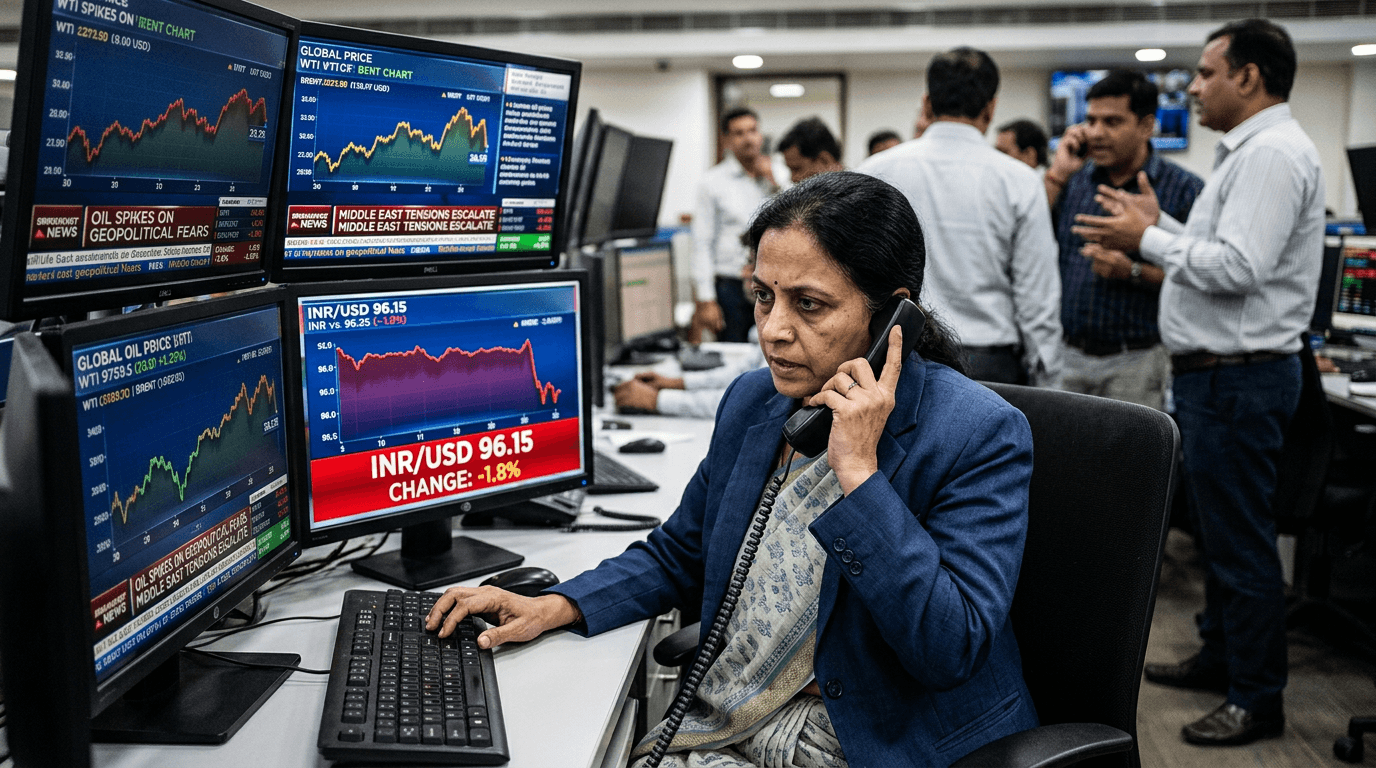
The Indian rupee’s slide to a one‑month low past 96 per dollar is a classic example of how geopolitics, commodities, and central bank policy collide in emerging markets. A renewed spike in crude prices following fresh hostilities in the Middle East and stepped‑up U.S.–Iran tensions has put sudden pressure on the currency, reviving worries about India’s inflation and trade balance just as markets were hoping for a period of stability.[5][7] In the background, traders report the Reserve Bank of India (RBI) leaning against the move, likely stepping in to smooth volatility and cap the rupee’s losses.[4][5]
WHAT JUST HAPPENED TO THE RUPEE?
In recent sessions, the rupee weakened past 96 per U.S. dollar, marking its lowest level in over a month and not far from record lows seen earlier this year.[5][7] The drop comes after a sharp jump in crude oil prices, with Brent pushing toward the triple‑digit mark as traders priced in supply risks from renewed Middle East hostilities and the risk of broader disruption from U.S.–Iran clashes.[5][7]
For India, this combination is particularly toxic. When oil jumps, import bills rise almost immediately, widening the trade deficit and amplifying demand for dollars from refiners and corporates. That extra dollar demand can push the rupee lower, which in turn makes oil even more expensive in local terms — a double hit that markets know all too well.
The rupee has already had a tough year, having fallen more than 6% against the dollar and ranking among the weaker emerging market currencies as global yields rose and risk sentiment remained fragile.[1][5] The latest move past 96 per dollar is therefore not occurring in isolation; it is reinforcing an existing trend of depreciation that investors have watched unfold over several months.[1][5]
Why Oil And Geopolitics Hit India So Hard
India is a large net importer of crude oil, so its external accounts are highly sensitive to energy price shocks. A sustained rise in oil prices tends to:
- Widen the current account deficit, as the country spends more dollars on imported fuel.
- Raise input costs across the economy, from transport to manufacturing, putting upward pressure on inflation.
- Increase fiscal strain if the government chooses to absorb some of the price rise through subsidies or tax cuts.
When oil spiked and global yields surged earlier this year, the rupee fell to a record low around 96.38 per dollar as markets repriced both inflation and growth risks for India.[5] The renewed Middle East flare‑up is resurrecting those concerns, with traders again asking how far the rupee might be allowed to weaken before policy support becomes more forceful.[5][7]
There is also a confidence channel. Periods of geopolitical stress often drive global investors into the dollar and U.S. Treasuries, increasing the dollar’s strength versus most currencies. That makes it harder for emerging markets like India to resist depreciation without expending foreign exchange reserves or tightening policy more aggressively than they would like.
RBI’S PLAYBOOK: HOW THE CENTRAL BANK LEANS AGAINST VOLATILITY
The RBI’s approach to the rupee is not to defend a fixed level but to prevent “disorderly” moves and overshooting. Its toolkit includes:
- Direct spot market intervention, selling dollars from its reserves to meet demand and smooth volatility.
- Adjusting rules on banks’ foreign exchange positions, as it did earlier when it tightened limits to curb speculative pressure and stabilize the currency.[4]
- Using forward and swap markets to influence liquidity and hedging costs.
When the rupee slipped past 95 per dollar earlier this year, traders reported heavy RBI involvement that helped stabilize the currency and limit further intraday losses.[4] More recently, as the rupee slid past 96 on oil‑driven pressure, market participants again pointed to likely RBI intervention to cap the move and keep daily swings contained.[4][5][7]
This pattern is important for traders: the RBI appears willing to tolerate a gradual depreciation trend driven by fundamentals, but it tends to push back against sharp, one‑way moves that risk triggering panic, speculative attacks, or destabilizing capital flows.[4][5] Understanding that reaction function is crucial when positioning in USD/INR or related assets.
What This Means For Traders And Investors
A weaker rupee and higher oil prices do not affect all segments of the market equally.
For import‑heavy sectors such as airlines, chemicals, and logistics, rising fuel costs and currency depreciation squeeze margins and may pressure earnings expectations. For export‑oriented sectors — notably IT services and parts of pharmaceuticals — a softer rupee can be a tailwind, improving competitiveness and boosting rupee revenues from dollar billing.
Fixed income markets also feel the impact. Higher expected inflation from costlier imports can push bond yields higher as investors demand more compensation, while any suspicion that the RBI might eventually have to tighten policy to contain inflation can further steepen the curve.[5] Equity markets often respond by favoring exporters and domestic defensives while de‑rating high‑energy‑cost and rate‑sensitive sectors.
For currency traders, the key questions now are:
- Does the oil spike prove temporary, or does it mark the start of a higher‑for‑longer regime?
- How aggressively will the RBI use reserves to prevent further rupee weakness?
- Will global risk sentiment worsen, strengthening the dollar and adding another leg to the move?
In practice, that means watching crude benchmarks, RBI liquidity operations, FX reserve data, and global yield moves as closely as the USD/INR spot rate.
Key Takeaways For Simulated Trading
For traders using simulated finance (SimFi) platforms to refine their strategies, this episode offers several valuable lessons:
First, macro shocks cascade across assets. A single catalyst — renewed Middle East hostilities and an oil spike — can move FX, commodities, bonds, and equities together. Building and testing multi‑asset views in a risk‑free environment helps you understand how those linkages behave under stress.
Second, central bank behavior is a strategy input, not an afterthought. The RBI’s pattern of intervening near extreme levels or during disorderly moves means that risk‑reward for trend‑following trades can change abruptly once those “reaction zones” are approached.[4][5] Simulated trading lets you experiment with rules like scaling out of positions as the rupee nears prior RBI defense areas.
Third, hedging is not just for corporates. Elevated FX volatility and shifting forward premiums make it essential to think about how you would protect an equity or bond portfolio from currency and oil shocks. Using a simulated environment, you can test approaches such as pairing Indian equity exposure with USD/INR longs or crude‑linked instruments, and study how those hedges behave when stress hits.
Finally, scenario planning beats prediction. No one can reliably forecast the path of geopolitical tensions or oil prices, but you can map out scenarios — swift de‑escalation, prolonged standoff, or further escalation — and pre‑plan how you would adjust positions in each case. Practicing those playbooks in a SimFi setting builds discipline that is hard to develop in the heat of live markets.
In the weeks ahead, the rupee’s path will be shaped by the interplay between oil prices, global risk appetite, and RBI’s willingness to spend policy capital defending against disorderly depreciation. For traders and investors alike, the current episode is a timely reminder that in emerging markets, macro risk can reprice currencies quickly — and that those who understand both the fundamentals and the central bank’s playbook are best placed to navigate the volatility.