
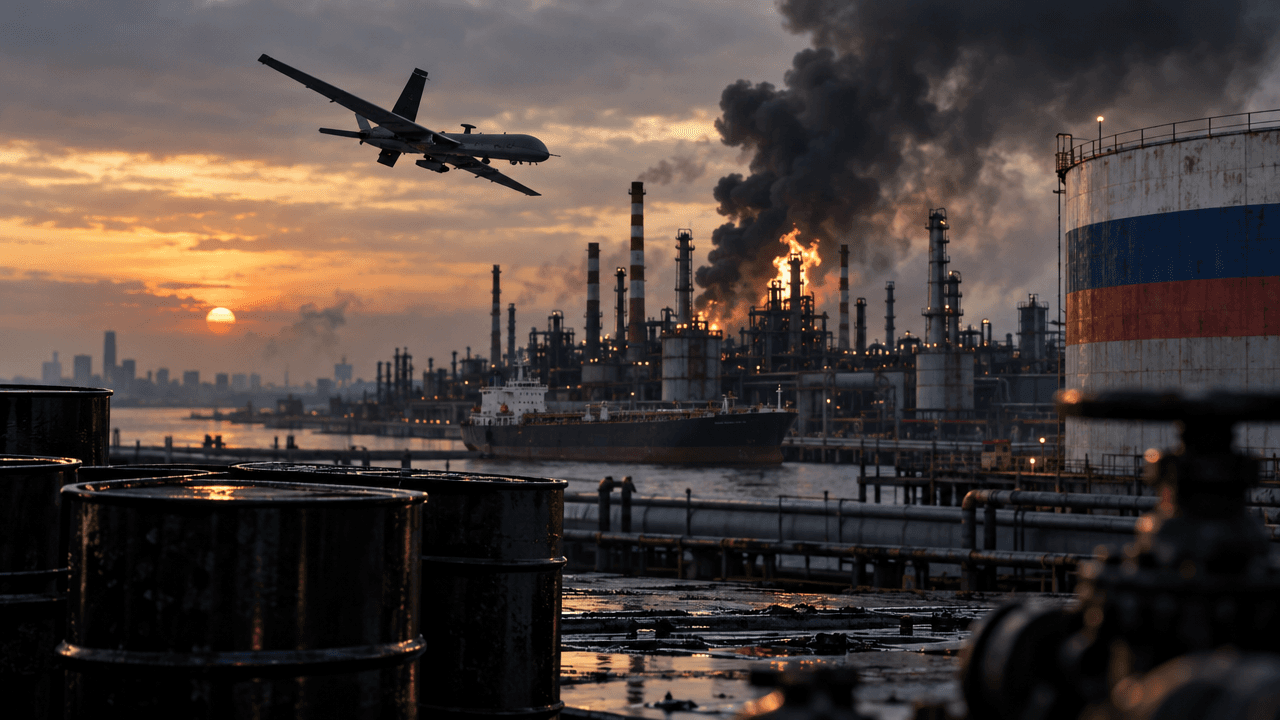
A sharp decline in Russian crude processing is turning Ukraine’s drone campaign into a broader energy-market risk. Reports indicate that Russian refineries were processing around 400,000 metric tons of crude per day after nearly daily strikes, down from more than 700,000 tons at the end of October. That represents an estimated decline of roughly 45%, or about 3 million barrels per day in current processing volumes. [1]
The disruption matters because refineries sit between crude production and the fuels consumed by households, businesses, militaries, and transport networks. Damage to processing infrastructure can reduce gasoline, diesel, jet fuel, and other petroleum-product supplies even when crude remains available. If the disruption persists, its effects could move beyond Russia’s domestic fuel market and influence global crude prices, refined-product spreads, shipping patterns, and inflation expectations.
What The Numbers Mean
The reported reduction is substantial. Processing of more than 700,000 metric tons per day in late October fell to approximately 400,000 tons per day after about 20 days of attacks, according to industry estimates cited by Reuters. [1] In percentage terms, that is a reduction of approximately 43% to 45%.
For traders, however, refinery throughput should not be confused with total Russian oil production. A refinery converts crude into usable products; it does not determine how much crude is extracted from oil fields. When refining capacity is unavailable, producers may attempt to store crude, redirect it through pipelines, or export more unprocessed oil. That means the initial effect can be mixed: fewer refined products may be available while additional crude enters international markets.
This distinction is essential. A refinery outage is not automatically bullish for crude. The market response depends on whether lost processing capacity creates a larger shortage of fuels than the amount of crude diverted into exports adds to global supply.
Why Refined Products Could Tighten
The most immediate concern is the availability of middle distillates, particularly diesel. Diesel powers freight, agriculture, construction, mining, and backup generation, making it economically important well beyond the transport sector. The International Energy Agency has warned that falling Russian diesel output and exports are contributing to pressure in international middle-distillate markets. It also lowered its forecast for Russian refinery throughput to an average of 4 million barrels per day for the remainder of 2026 and 2027. [3]
A prolonged reduction in Russian refining could therefore widen diesel cracks, the difference between the price of diesel and the cost of crude used to produce it. Refiners elsewhere may benefit from stronger margins, but replacing lost output is not instantaneous. Alternative plants need available capacity, suitable crude grades, reliable shipping, and sufficient inventories.
Gasoline markets could also come under pressure. Russia has already experienced periodic domestic fuel shortages, and recent reporting indicated that average retail gasoline prices rose 0.5% during the week of November 17 to 23. [14] Moscow may respond with export restrictions, stock releases, or other measures designed to prioritize domestic consumers. Such policies could reduce the amount of Russian fuel reaching international buyers.
The Crude-price Paradox
The disruption creates two opposing forces for crude prices. On one side, lower refinery activity can reduce crude demand inside Russia. If producers cannot process their oil, some barrels may be redirected toward export markets, increasing available supply and weighing on benchmark prices. Recent analysis has noted that refinery shutdowns have forced Russia to divert unprocessed crude to exports, contributing to a potential global supply surplus. [6]
On the other side, a prolonged disruption could reduce overall Russian energy exports if storage, pipeline, port, or operational constraints prevent producers from moving the additional crude. Reports have suggested that traders expected Baltic and Black Sea crude exports to decline by around 100,000 to 200,000 barrels per day in November, with the latest attacks raising concerns that reduced export capacity—not stronger refinery demand—could drive the decline. [11]
The balance between these forces will determine whether the event is primarily bearish for crude, bullish for crude, or most supportive of refined products. At present, the strongest direct risk appears to be tighter fuel markets, while the crude-price impact remains dependent on export flows and the duration of the outages.
What Traders Should Watch
The first indicator is refinery recovery. Temporary shutdowns may have limited long-term impact if damaged units restart quickly. Repeated strikes, however, could prevent maintenance teams from restoring capacity and push outages from short-term interruptions into a structural supply problem. The IEA has said the frequency and intensity of attacks suggest Russian crude processing rates may struggle to recover meaningfully. [3]
The second indicator is Russian product policy. Export bans or tighter quotas could remove gasoline and diesel from international markets, increasing pressure on regional prices. The third is seaborne crude movement from Russian ports. Rising exports would signal that displaced refinery demand is being replaced by overseas supply; falling exports would point to a more serious disruption to the country’s overall oil system.
Traders should also monitor diesel cracks, refinery utilization in Europe and Asia, freight rates, inventories, and inflation-sensitive assets. A sustained rise in fuel costs can feed into transportation, food, manufacturing, and consumer prices. That could complicate decisions for central banks already balancing economic growth against persistent inflation risks.
The Broader Market Lesson
This episode demonstrates why energy markets respond not only to changes in oil production but also to damage across the processing and logistics chain. Russia remains a major participant in global energy markets, so disruption at its refineries can affect product balances even if oil wells continue operating.
For SimFi traders, the practical takeaway is to avoid treating a single headline as a complete trade signal. Assess the direction of crude exports, the speed of refinery repairs, government responses, and regional fuel inventories before forming a view. The most reliable opportunities may appear in relative markets—such as diesel versus crude, or refined products versus benchmark oil—rather than in crude futures alone.
Ukraine-related disruption has made Russian refining capacity a key market variable. If outages remain temporary, extra crude exports could limit the effect on oil prices. If attacks continue and repairs lag, refined-product shortages could intensify, supporting fuel prices and reviving inflation concerns. The central question is no longer simply how much crude Russia produces, but how much of that crude it can process, move, and sell.