
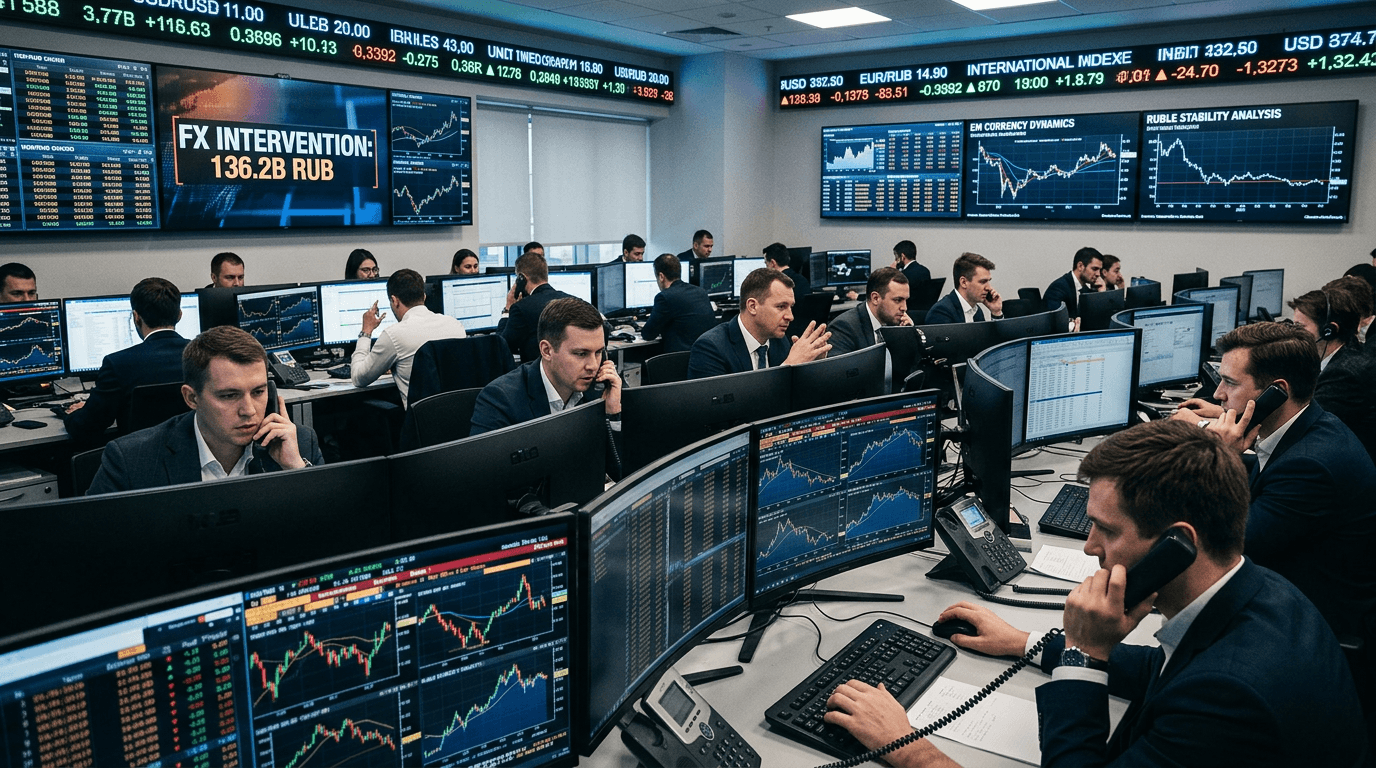
Russian foreign exchange intervention is back in the spotlight, with September’s operation logged at a hefty 136.2B on key economic calendars, underscoring a return to large-scale central bank activity in the FX market.[1][4][13] Such a figure places the Bank of Russia’s actions firmly in the “macro‑relevant” category, where policy moves can ripple beyond the ruble into broader emerging‑market FX and risk sentiment. For traders, this is not just a Russia story; it is a regime-shift signal for global currency markets.
Ruble Stability Back In Focus
The central bank’s renewed intervention push is primarily about regaining control over ruble dynamics in an environment still shaped by sanctions, energy price volatility, and restricted access to global capital markets.[5][6][12] Since 2022, Russia has leaned on an aggressive toolkit—sharp rate hikes, capital controls, and FX operations—to avert a full-blown currency crisis, achieving relative stability despite a challenging external backdrop.[5][6][8][12] The scale of the current intervention suggests policymakers are unwilling to let the ruble drift too far, either weaker (inflation risk) or stronger (budget pressure from FX‑denominated energy revenues).[5][12]
From a policy perspective, the Bank of Russia has long framed FX intervention as an emergency tool rather than a daily mechanism, especially after it moved toward a more flexible exchange-rate regime in 2014.[8] The decision to resume sizeable operations therefore signals perceived stress points—such as heightened volatility, disorderly order flow, or a mismatch between the ruble and fundamentals—that authorities judge cannot be left solely to market forces.[8][6] For market participants, this marks a reminder that in Russia, FX policy can pivot quickly when financial stability is at stake.
WHAT A 136.2B INTERVENTION SIGNALS
On most economic calendars, the Russian Forex Intervention line for September prints at 136.2B, indicating a substantial amount of official buying or selling over the period.[1][4][10][13] While the exact currency denomination and composition depend on the central bank’s reporting conventions, the key takeaway is the scale: triple‑digit billions imply the authorities are leaning hard into the market rather than merely “smoothing” daily moves.[1][8] Historically, such large interventions in emerging markets have been associated with attempts to cap volatility, anchor expectations, and send a strong policy signal to both domestic and foreign participants.[2][14]
Academic and empirical work on FX intervention shows that while changing the long‑term level of an exchange rate is difficult, reducing short‑term volatility and preventing disorderly markets is more achievable.[2][14] In other words, the Bank of Russia may not be trying to dictate an exact ruble rate, but it is clearly trying to enforce a corridor of “acceptable” outcomes.[8][14] For traders, that usually translates to shorter-lived extreme moves, more technical respect for key levels, and rising importance of central bank communication alongside traditional macro drivers.
Implications For Global Fx And Emerging Markets
Russia’s FX story does not unfold in isolation. Research on ruble turmoil after the invasion highlighted spillover effects into partner currencies and broader risk pricing, as markets adjusted to a more fragmented global monetary landscape.[11] Large ruble interventions can alter correlations within the emerging‑market FX complex, especially for countries with commodity links, trade exposure to Russia, or similar “sanctions premium” embedded in their risk spreads.[5][11] Even traders who never touch ruble pairs can feel the impact through shifts in EM FX baskets, carry‑trade performance, and volatility indices.
Intervention at this scale can also influence sentiment toward central-bank credibility in other emerging economies. When one major EM central bank demonstrates a willingness to deploy FX reserves aggressively, others may feel pressure to clarify their own stance on defending currencies, particularly in periods of dollar strength or risk-off conditions.[14] This can lead to synchronized communications, opportunistic rate moves, or preemptive interventions elsewhere—adding a policy dimension to what might otherwise look like purely market-driven FX trends.[14][11] For risk managers, the lesson is that country-specific news can quickly become a cross-market factor.
What Traders And Simfi Participants Should Watch
For traders on platforms like E8 Markets, the resumption of large-scale Russian FX intervention is a valuable live case study in how policy and price action interact. In a SimFi environment, participants can model scenarios around ruble stabilization versus renewed weakness, testing how different paths would affect EM FX baskets, commodity-linked currencies, and global risk proxies such as equity indices or credit spreads. This is an opportunity to experiment with multi‑asset strategies that incorporate central-bank behavior as a core input rather than a background assumption.
In practical terms, several indicators deserve close monitoring. First, ruble crosses against the dollar and euro: look for whether intraday spikes are being faded more quickly, suggesting a stronger official presence.[6][8] Second, implied volatility in EM FX options: a sustained decline in ruble volatility may feed into broader compression, impacting the pricing of hedges and carry strategies.[14] Third, policy communication from other emerging‑market central banks: watch for references to FX stability, reserve adequacy, or “unwarranted market moves,” which often precede or accompany intervention.[11][14] Using simulated portfolios, traders can test how their strategies behave under higher or lower volatility regimes triggered by such policy shifts.
Scenario Planning And Risk Management
From a risk-management perspective, large FX interventions highlight the importance of planning for “policy reactions,” not just macro data releases. In SimFi, participants can design stress tests based on plausible ruble paths: a scenario where intervention successfully caps volatility and a scenario where markets challenge the central bank, forcing additional rate hikes or capital controls.[6][8][12] Each scenario can be mapped to potential moves in correlated assets—oil, other commodity currencies, EM sovereign spreads—to understand where portfolios are most exposed.
Another critical takeaway is that central-bank actions can change the distribution of outcomes, even if they do not fully reverse underlying trends. For example, intervention may reduce the probability of extreme ruble crashes but raise the likelihood of sudden, policy-driven reversals when official flows step back or global conditions change.[2][14] Traders should incorporate this “fat-tail management” into position sizing, stop‑loss placement, and diversification. Simulated trading offers a low‑risk environment to pressure-test whether strategies remain robust when policy volatility, rather than price volatility alone, becomes the dominant driver.
Conclusion
Russia’s September FX intervention figure of 136.2B is more than a calendar entry; it is a tangible sign that the Bank of Russia remains willing to deploy significant firepower to shape currency outcomes.[1][4][13] For global markets, that choice reinforces a broader theme in the post‑invasion era: monetary and FX policy in major emerging economies can pivot quickly in response to geopolitical and financial stress, altering correlations and risk premia far beyond national borders.[5][11][14] For traders and SimFi participants, the practical edge lies in understanding these dynamics, building scenario-based strategies, and treating central-bank behavior as a tradable factor, not just a headline.