
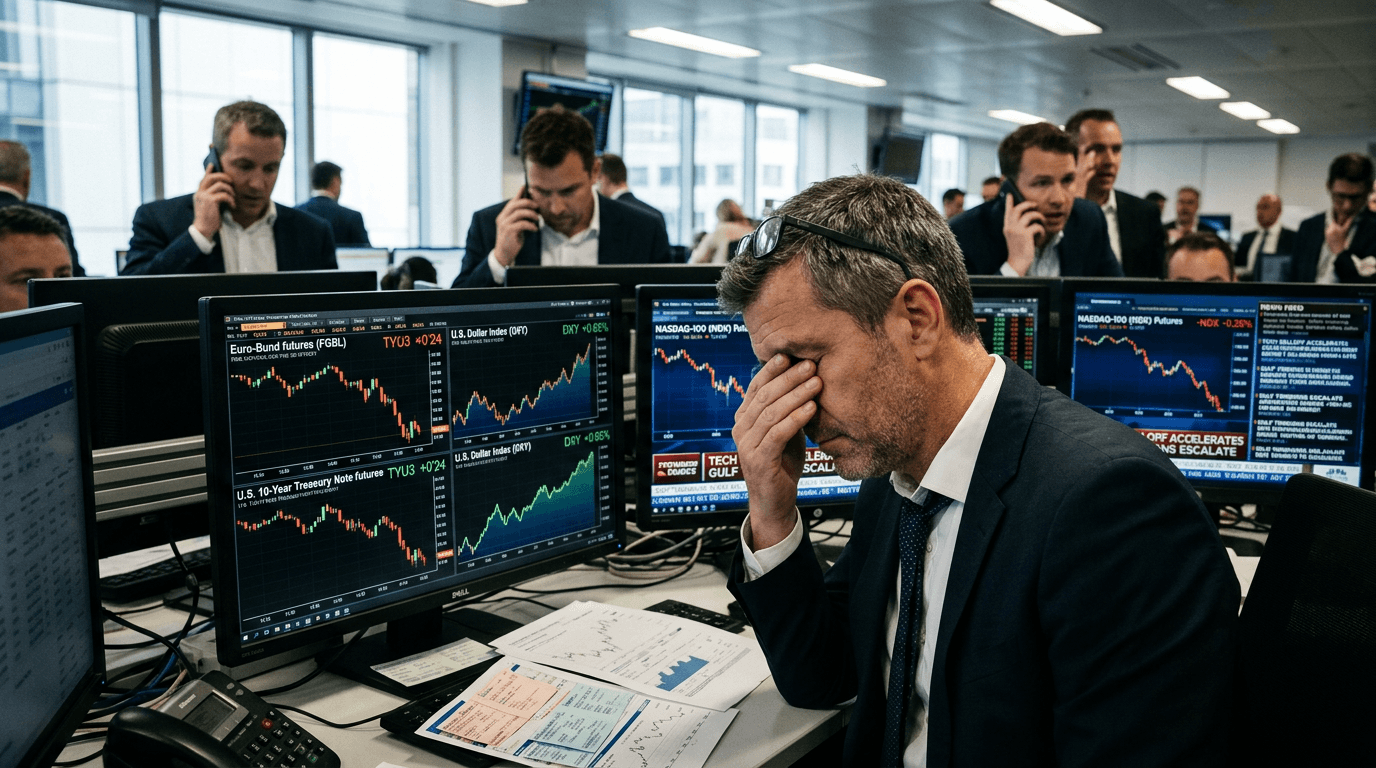
Safe-haven demand is back at the center of global markets as renewed Gulf tensions and a sharp selloff in Asian technology stocks drive investors out of risk assets and into the U.S. dollar, the yen, and Treasuries.[1][3] Major FX pairs, equity indices, and futures are all reacting to a classic risk-off shift that is reshaping positioning across both developed and emerging markets.[5][8]
Market Backdrop: Gulf Tensions And A Stronger Dollar
The immediate catalyst for the latest move has been an escalation in tensions around the Gulf, including threats to shipping and energy infrastructure that have revived worries about supply and regional stability.[3][5] Episodes of Middle East conflict have repeatedly triggered similar reactions, with prior flare‑ups sending oil higher, gold up, and the dollar stronger against both major and safe‑haven currencies.[7][8]
This time is no different: oil prices have jumped on renewed supply concerns, reinforcing a bid for the dollar as markets price in the inflationary implications and potential for a more hawkish Federal Reserve stance.[5][7] In recent weeks the dollar index has pushed to its highest levels in over a year, helped by rising Treasury yields and an increase in implied probabilities of future Fed rate hikes.[1][12] The euro is trading near a 13‑month low, sterling is down on the month, and the yen sits close to 40‑year lows versus the dollar, underscoring the breadth of greenback strength.[1][12]
Key takeaway: Geopolitical risk in the Gulf is not just a regional story; it is a global macro shock that filters into oil, inflation expectations, and central bank pricing, all of which support the dollar when uncertainty spikes.[5][11]
WHY THE DOLLAR LEADS IN RISK‑OFF ENVIRONMENTS
In periods of elevated geopolitical risk, investors tend to gravitate toward assets perceived as safe havens, and the U.S. dollar typically sits at the top of that list.[11] The reasons are structural: the dollar is the dominant reserve currency, underpinned by the depth and liquidity of U.S. financial markets and the central role of the U.S. economy in global trade and finance.[11] When stress rises, global institutions seeking to reduce risk often sell local assets and move into dollar cash, Treasuries, and highly liquid dollar‑denominated instruments.[7][8]
This flow can be amplified when U.S. yields are also moving higher, as investors are compensated more for holding dollar assets.[3][12] Recent trading has seen selling pressure in global bond markets and higher short‑duration yields, reinforcing the attractiveness of the dollar compared with low‑yielding alternatives like the yen or Swiss franc.[3][8] At the same time, a more hawkish tone from Fed officials and a pullback in expectations for near‑term rate cuts have supported the narrative that U.S. rates may stay higher for longer.[1][12]
Key takeaway: Safe‑haven flows and rate‑differential flows are currently aligned in favor of the dollar, creating a powerful combination that FX traders ignore at their peril.[1][11]
TECH‑LED EQUITY SELLOFF: THE SECOND SHOCK
The geopolitical backdrop has been compounded by a sharp, tech‑led equity correction centered in Asia, with flagship semiconductor and AI‑related names driving a broader valuation reset.[2][3] Investors are questioning whether the pace of AI and hardware spending can sustain elevated multiples, prompting profit‑taking across technology leaders and pressuring regional indices.[2] A Samsung‑led rout in Asia has spilled over into global sentiment, pushing risk‑sensitive currencies lower and weighing on futures linked to major U.S. stock indices.[2][3]
As equities sell off, the dollar has emerged as the dominant macro driver, with the Dollar Index breaking above a key technical range and extending gains on safe‑haven demand.[2][12] Asia‑Pacific currencies, including the Australian dollar, have dropped as much as 1% or more in a single session, and high‑beta pairs have underperformed as investors reduce exposure to cyclical risk.[2][3] This equity‑FX feedback loop is typical in corrections where funding currencies and safe‑haven assets become the preferred destination for capital.[7][8]
Key takeaway: The current environment is a twin shock—geopolitical risk plus a tech valuation reset—which amplifies risk‑off behavior and strengthens the case for elevated dollar volatility.[2][3]
CROSS‑ASSET RIPPLE EFFECTS: YEN, YIELDS, GOLD, AND EM FX
One of the most closely watched repercussions has been the move in the yen, which is trading near multi‑decade lows as higher U.S. yields and persistent dollar strength push the pair toward levels that could invite official intervention.[1][12] The yen’s failure to rally meaningfully, even in a risk‑off episode, highlights how wide the U.S.–Japan rate gap has become and how dominant the dollar is in current positioning.[4][12]
Government bond markets are also feeling the strain, with selling pressure and higher yields across U.S. Treasuries and European sovereign debt.[3][8] Rising yields reflect both uncertainty and a repricing of inflation and policy risk as oil rebounds and markets reassess the trajectory of global growth.[5][7] Safe‑haven gold has caught a bid, while emerging‑market currencies—from the Brazilian real and Mexican peso to the Indian rupee—have come under broad pressure against the dollar.[7][8]
For risk assets, the combination of higher volatility, stronger dollar, and rising yields is challenging: equities face valuation headwinds, credit spreads can widen, and carry trades in EM FX become more vulnerable to unwinds.[7][8] Crypto assets have shown that they are not immune either, with prior Middle East‑driven episodes producing notable drawdowns in bitcoin and other major tokens.[7][8]
Key takeaway: When the dollar rallies on both conflict fears and yield support, the impact is felt across every major asset class—from equities and bonds to commodities, EM FX, and crypto.[7][8]
Implications And Practical Lessons For Simulated Traders
For traders working in a simulated finance environment like E8 Markets, these episodes are valuable case studies in how macro narratives translate into price action.[11] The first lesson is to track the full story, not just the headline: Gulf tensions, oil moves, Fed commentary, and tech sector dynamics are all intertwined in driving today’s dollar strength.[1][5][11] Watching only one piece of the puzzle can leave you exposed to sudden reversals when another driver takes over.
The second lesson is to think in terms of risk premia rather than one‑off shocks.[11] Both oil and the dollar embed a premium for Middle East risk that expands and contracts as news flows evolve.[5][7] In a SimFi setting, traders can test scenarios where that premium is either overstated or understated, building strategies around mean reversion, event‑risk hedging, or cross‑asset relative value between FX, indices, and commodities.[11]
Third, pay close attention to correlations and regime changes.[2][7] Periods of calm often see weaker links between FX, equities, and commodities, but in risk‑off regimes those correlations can tighten abruptly: equities down, dollar and gold up, yields higher, EM under pressure.[7][8] Simulated trading allows you to stress‑test portfolio ideas across such regimes, refine position sizing, and rehearse response plans for sudden volatility spikes.
Key takeaway: Use current market turmoil as a laboratory—study how the dollar, oil, tech stocks, and yields interact, and practice building robust strategies that can survive sharp swings in sentiment.[11]