
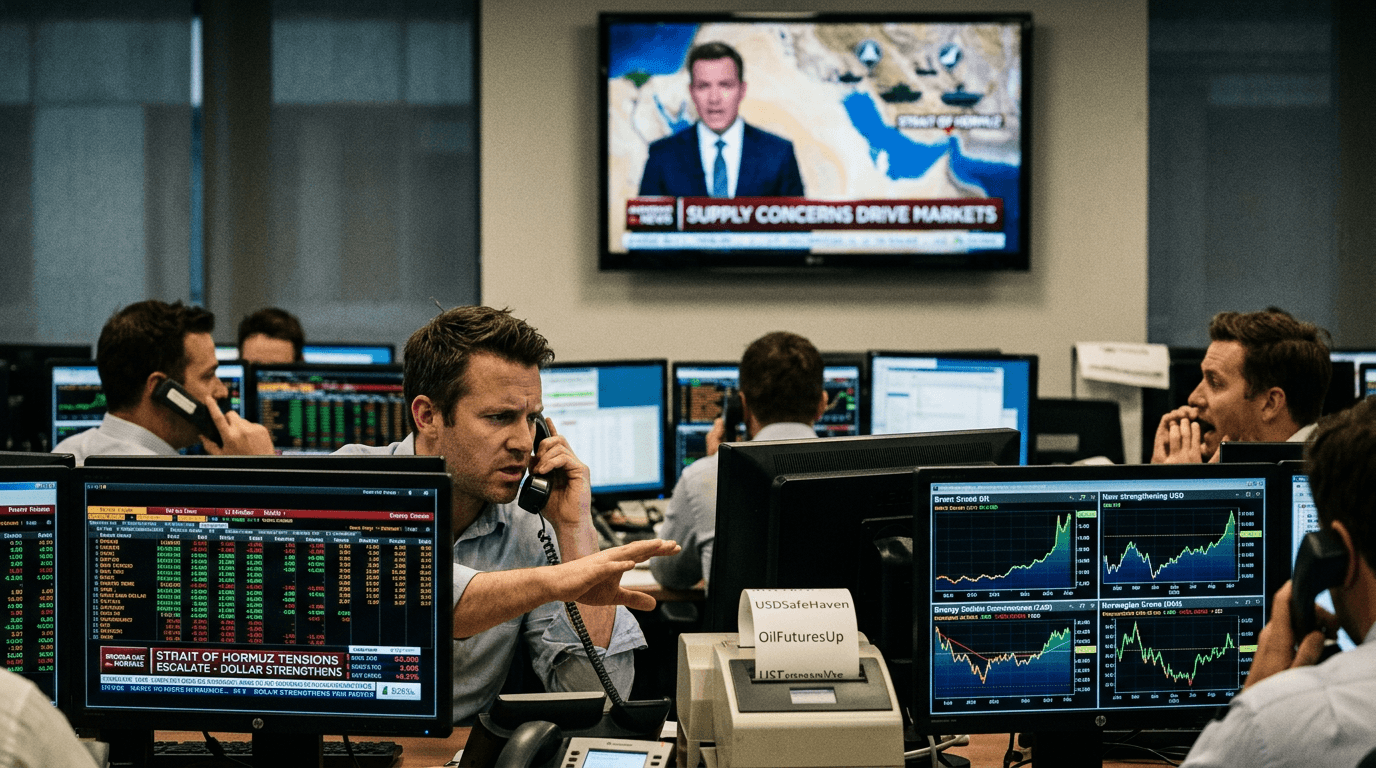
Geopolitical risk is back at the center of markets, and once again the Middle East is the focal point. Rising tensions around the Strait of Hormuz, intermittent ceasefire headlines, and sharp moves in oil have pushed traders to seek safety in the U.S. dollar while repricing risk across energy-linked currencies and futures. For market participants, understanding how these dynamics connect is crucial to navigating the current environment with discipline rather than emotion.
Global Risk Backdrop: Why The Strait Of Hormuz Matters
The Strait of Hormuz is a narrow maritime chokepoint linking the Persian Gulf to the rest of the world, and it is one of the most important energy corridors on the planet. A significant share of globally traded crude oil and liquefied natural gas (LNG) typically passes through this channel, making it a single point of failure for energy markets when tensions flare.[1][2]
Recent military confrontations and threats in the area have led to attacks on tankers, raised threat levels to “severe,” and sharply reduced shipping traffic.[5][7] When commercial vessels either halt transits or are forced to reroute around much longer sea routes, physical supply is effectively constrained, even if global production has not changed. This translates into:
- Higher transportation costs and longer delivery times
- Elevated risk premia embedded in crude benchmarks like Brent
- Greater sensitivity of oil prices to any new political headline
Earlier in the year, tentative signs of a U.S.–Iran ceasefire and partial reopening of the strait briefly eased concerns, allowing oil prices to pull back and the dollar to soften. But the subsequent resumption of fighting and warnings from naval coalitions about severe threats to shipping have reintroduced uncertainty for energy markets and global trade.[6][7] As long as the viability of this corridor remains in question, markets must continuously price in the chance of further disruption.
Safe-haven Dollar: How Geopolitics Feeds Fx Flows
In times of elevated geopolitical risk, investors tend to gravitate towards assets perceived as “safe havens.” The U.S. dollar typically sits at the top of that list due to the depth and liquidity of U.S. financial markets, the dollar’s role as the dominant reserve currency, and the global reach of the U.S. economy.
Middle East tensions and the possibility of prolonged supply disruptions have coincided with robust U.S. economic data. Strong growth and relatively higher interest rates reinforce the dollar’s appeal, because investors are not just buying safety—they are buying yield. The combination of risk aversion and favorable rate differentials has kept the dollar hovering around multi‑week highs, even when brief ceasefire headlines momentarily dented its strength.
In FX terms, this often manifests as:
- Broad dollar strength against risk-sensitive currencies (EM FX, high‑beta G10)
- Mixed performance against other havens like the Japanese yen and Swiss franc, where relative rates matter as much as perceived safety
- Elevated volatility as markets swing between “risk‑off” (flight to dollar) and “hopeful” periods (when ceasefire or diplomatic headlines emerge)
For traders, the key is recognizing that dollar flows in this environment are not driven by a single factor. They reflect a combination of geopolitics, energy prices, interest rate expectations, and global risk sentiment. A strong data print from the U.S. can reinforce dollar strength that was initially triggered by events thousands of miles away in the Gulf.
Energy-linked Fx: Complex Winners And Losers
Oil is not just a commodity; it is a macro variable that shapes the fortunes of entire currencies. When Middle East tensions push energy markets into the spotlight, FX pairs linked to oil and gas exporters and importers can move sharply, sometimes in ways that surprise traders who look only at price charts and not at the underlying macro story.
On the exporter side, currencies like the Canadian dollar (CAD), Norwegian krone (NOK), and, to an extent, the Mexican peso (MXN) and Russian ruble (RUB), are often labeled “petro‑currencies.” Higher oil prices can improve these countries’ terms of trade, support government revenue, and, in theory, strengthen their currencies.
However, in a genuine risk‑off environment triggered by geopolitical shocks, that relationship can become more nuanced:
- Oil exporters may benefit from higher prices, but their FX can still weaken if global investors are broadly cutting risk and exiting EM or higher‑beta currencies.
- Liquidity considerations matter: even fundamentally supported currencies can sell off if large funds are deleveraging and reducing positions across regions.
On the importer side, energy‑dependent economies in Asia and Europe may see their currencies pressured as higher oil prices worsen trade balances and raise inflation risks. Central banks may be forced into difficult choices between supporting growth and containing price pressures, and FX markets respond quickly to those policy trade‑offs.
Overlaying all of this are the Gulf currencies, many of which maintain pegs or quasi‑pegs to the dollar. While their spot FX may appear stable, local financial markets can experience increased volatility, and expectations about peg stability can shift in extreme scenarios. Traders focusing only on the headline exchange rate can miss the subtler signals embedded in forwards, swaps, and local funding markets.
Market Behavior: From Oil Futures To Broader Risk Pricing
Energy futures markets provide a real-time window into how traders are pricing both immediate supply risk and longer‑term geopolitical uncertainty. When shipping through Hormuz slows or faces attack threats, front‑month contracts often react first, with spreads between near‑term and longer‑dated futures widening as traders demand compensation for short‑term disruption risk.
These moves cascade into broader assets
- Equity sectors: energy stocks, shipping firms, and industrials exposed to higher input costs can see outsized moves.
- Credit markets: energy producers and transport companies may face changing spreads as investors recalibrate default risk.
- Volatility indices: measures like the VIX can rise not only on equity concerns but also as correlation between assets increases during stress episodes.
For FX traders, this cross‑asset feedback loop is critical. A spike in oil does not exist in isolation—it interacts with rate expectations, equity risk, and credit spreads, all of which influence currency flows. Understanding these linkages helps traders avoid over‑simplified narratives like “oil up equals CAD up,” which may fail in a complex risk environment.
Practical Takeaways For Traders And Simulated Finance Users
Whether trading live capital or using a Simulated Finance (SimFi) platform to build skills, geopolitical energy shocks are valuable case studies in macro trading discipline. A few practical lessons stand out:
1. Track the full narrative, not just the headline Follow both geopolitical developments (ceasefire talks, military strikes, shipping advisories) and economic data (U.S. growth, inflation, central bank commentary). Dollar and oil do not move purely on conflict news; they respond to the interplay between risk and fundamentals.
2. Respect correlation shifts In quieter markets, relationships between oil, FX, and equities can be relatively stable. During crises, correlations can flip or intensify. Use your simulated environment to test scenarios where energy prices spike but risk sentiment remains fragile, and observe how FX pairs respond.
3. Focus on risk management first Events around the Strait of Hormuz are reminders that markets can gap, spreads can widen, and liquidity can thin. Position sizing, diversification, and robust stop‑loss discipline matter more than ever when geopolitical risk is driving price action.
4. Think in terms of risk premia Oil prices and the dollar both embed risk premia related to Middle East tensions. As news evolves, those premia expand and contract. Rather than chasing every move, aim to understand what risk is being priced in—and whether the market may be overreacting or underestimating a scenario.
As Middle East tensions keep the Strait of Hormuz and global energy flows under strain, the safe‑haven dollar and energy‑linked FX will remain in focus for traders worldwide. By studying this environment through a structured, analytical lens—rather than reacting to every headline—you can turn a complex geopolitical shock into a learning opportunity about how macro forces, risk sentiment, and cross‑asset correlations truly work.