
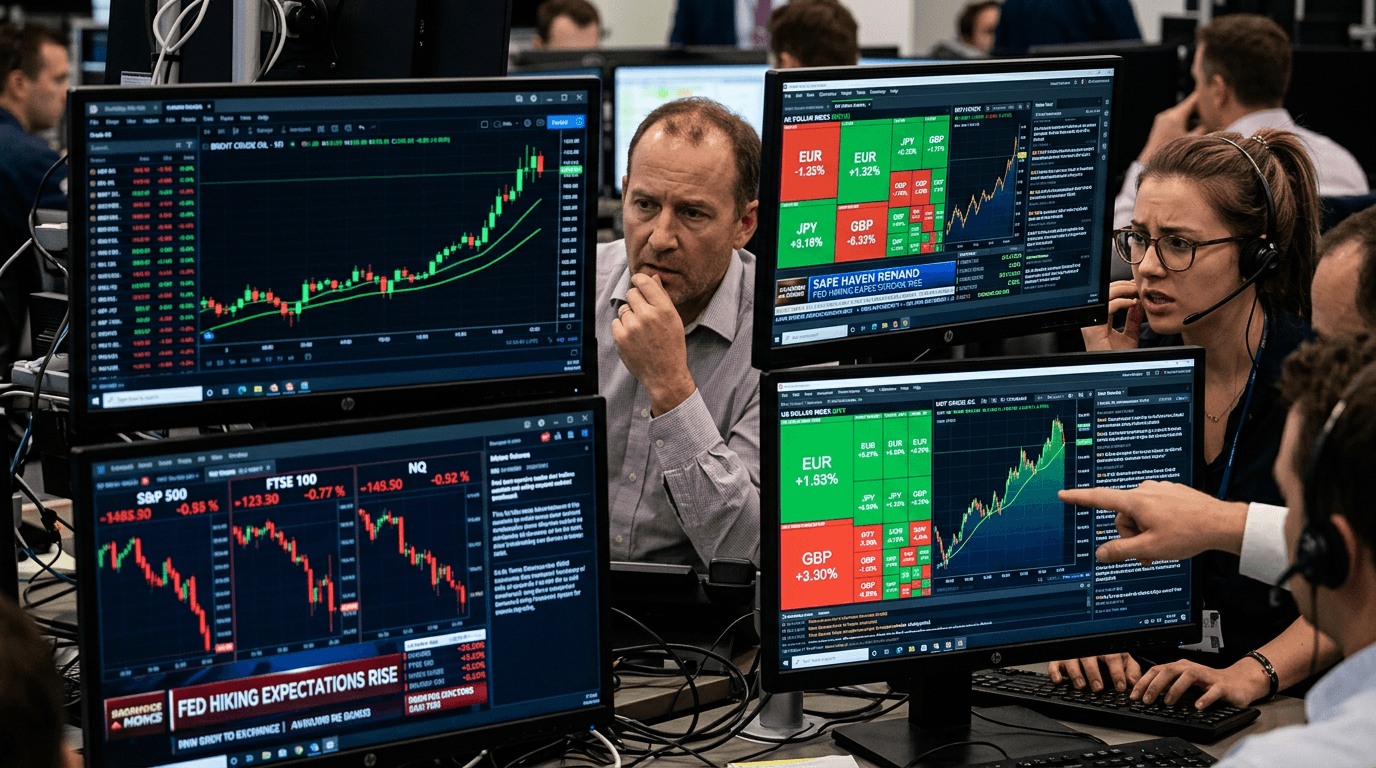
Safe-haven demand is flowing back into the U.S. dollar as renewed Gulf and Iran tensions push oil prices higher and revive inflation fears across global markets.[6][5][16] As energy benchmarks climb and traders reassess the path of Federal Reserve policy, the greenback is edging toward recent highs against the yen and other major currencies, reinforcing its role as the world’s preferred crisis currency.[6][9][15] For traders—whether live or in simulated environments—this is a textbook example of how geopolitics, commodities, and central bank expectations can quickly reshape FX and macro landscapes.[16][15]
Safe-haven Flows Return To The Dollar
Episodes of heightened Middle East risk typically trigger a “flight to safety,” and the current flare-up in Gulf and Iran tensions is no exception.[16][15] Market participants wary of supply disruptions and escalation are rotating out of risk assets and into more defensive positions, with the U.S. dollar a primary beneficiary.[6][8][9] The dollar index, which tracks the currency against a basket of majors, has been supported near recent highs as investors seek security in dollar-denominated assets during a period of elevated uncertainty.[9][6]
This renewed demand is not simply emotional; it reflects both the dollar’s deep liquidity and the institutional habit of pricing global stress through the greenback.[12][16] Large asset managers, corporates, and sovereigns often hedge or rebalance into dollars when risk premiums rise, magnifying moves in FX even when broader asset price changes appear modest.[10][12] For traders, recognizing this behavioral pattern is key: geopolitical shocks tend to show up first in oil, then in rates expectations, and very quickly in the dollar.
Why Middle East Tensions Boost The Greenback
The main transmission channel from Gulf tensions to the dollar is energy.[16][15] The Strait of Hormuz carries roughly a fifth of global oil shipments, so any threat to its stability translates almost immediately into higher crude prices and wider risk premia in energy-sensitive economies.[2][16] As war-related disruptions and renewed attacks raise the risk of prolonged supply issues, Brent and WTI futures have spiked, reigniting concerns that inflation could prove stickier than previously expected.[2][14][15]
Because the United States has evolved into a net energy exporter, its economy is relatively more insulated from oil shocks than those of major importers like Europe and Japan.[1][11][12] This relative advantage, combined with the dollar’s reserve currency status, makes U.S. assets comparatively more attractive when energy prices surge.[12][16] Analysts have noted that the tensions in Iran and the Gulf have contributed to recent upward momentum in the dollar, with one estimate suggesting the greenback could gain roughly 0.5–1% for every 10% rise in oil prices during acute stress.[9][15]
Higher energy prices also reshape expectations for the Federal Reserve.[6][5][15] Oil-driven inflation pressures reduce the probability of near-term rate cuts and can even spark speculation about additional hikes, especially if core inflation proves stubborn.[6][5][15] As markets price in a more hawkish Fed path relative to other central banks, interest rate differentials tilt in favor of the dollar, reinforcing its safe-haven bid.[6][10] For traders, connecting these dots—oil, inflation expectations, Fed pricing, then FX—is essential to building robust macro views.
Impact On Oil, Equities And Index Futures
The Gulf tensions and Iran conflict are not just an FX story; they are rippling through oil markets and equity index futures.[2][14][16] Brent crude has climbed back above the psychologically important $100 per barrel level at times, while U.S. benchmark WTI has posted sharp daily gains as supply disruptions and geopolitical risk premia are repriced.[2][14][15] These moves increase volatility across energy-linked sectors, benefiting producers and integrated oil majors while pressuring transportation, airlines, and energy-intensive industries.
Index futures are responding by embedding higher inflation and rate expectations into earnings and valuation assumptions.[5][15] Higher discount rates generally weigh on growth and tech-heavy benchmarks, while value and commodity-linked indices can show relative strength.[15][16] At the same time, risk-off sentiment driven by headlines—such as strikes, vessel seizures, or stalled ceasefires—can amplify intraday swings as systematic strategies and discretionary traders reposition.[2][14][16]
For participants in simulated markets, this environment offers a live case study in cross-asset correlation. You can observe how a spike in oil implied volatility feeds into index futures, and how both interact with the dollar and rates futures. Testing strategies that hedge equity exposure with energy or FX, or that exploit divergence between sectors, is especially relevant in periods when geopolitics dominates the macro narrative.
Yen, Euro And Other Currencies Under Pressure
One notable feature of the current episode is the strain on the Japanese yen, traditionally seen as a safe haven.[8][13] The dollar has traded near multi-decade highs against the yen, reaching levels that raise the risk of official intervention as Japanese authorities grow uncomfortable with rapid depreciation and imported inflation.[6][8][13] While the yen can still attract safe-haven flows, ultra-low domestic rates and the asymmetric impact of higher energy prices leave it vulnerable when U.S. yields rise.[11][16]
The euro has also struggled under the weight of the energy shock.[9][11][14] Europe’s dependence on imported oil and gas means surging prices squeeze margins and consumer budgets more directly, dampening growth prospects and narrowing the policy options for the European Central Bank.[11][14] As a result, stress periods often see the dollar strengthen at the euro’s expense, especially when U.S. assets are perceived as relatively safer and better insulated.[9][12]
Other currencies—from emerging market importers to commodity-linked exporters—are reacting based on their specific exposures to energy prices, U.S. rates, and geopolitical proximity.[16][15] For traders, this is an opportunity to go beyond headline dollar strength and explore relative value and cross-currency trades: for example, contrasting the behavior of oil exporters’ FX with that of heavy importers as the Gulf tensions ebb and flow.
What Traders And Simfi Participants Should Watch
While the current environment is supportive of the dollar, many FX strategists caution that the war-driven surge may be temporary.[10][17] Surveys point to lingering skepticism about the long-term safety of U.S. assets and still-meaningful downside risks for the dollar over the coming years as global diversification progresses.[10][17] That means traders should treat safe-haven rallies as dynamic, not permanent, and be prepared for sharp reversals if geopolitical risks fade or the Fed’s stance shifts.
In practice, several indicators merit close attention. First, monitor oil prices and term structure: backwardation or steepening curves can signal persistent supply fears.[2][16] Second, watch inflation data and breakevens, which will influence Fed expectations and rate differentials.[5][15] Third, follow central bank communication, particularly any sign that policymakers are prioritizing financial stability over inflation fighting as volatility rises.[10][17]
For those trading in a simulated environment, the goal is not only to predict direction but to understand the relationships. Build scenarios where oil spikes, the dollar strengthens, and index futures wobble—and then stress-test your positions against alternative outcomes where ceasefire hopes trigger an unwind of safe-haven flows.[1][3][10] Use position sizing, diversification across asset classes, and clear exit rules to manage risk. The current Gulf and Iran tensions offer a rich, real-time laboratory for learning how macro narratives propagate through markets and how a “safe-haven dollar” can both protect and challenge portfolios.