
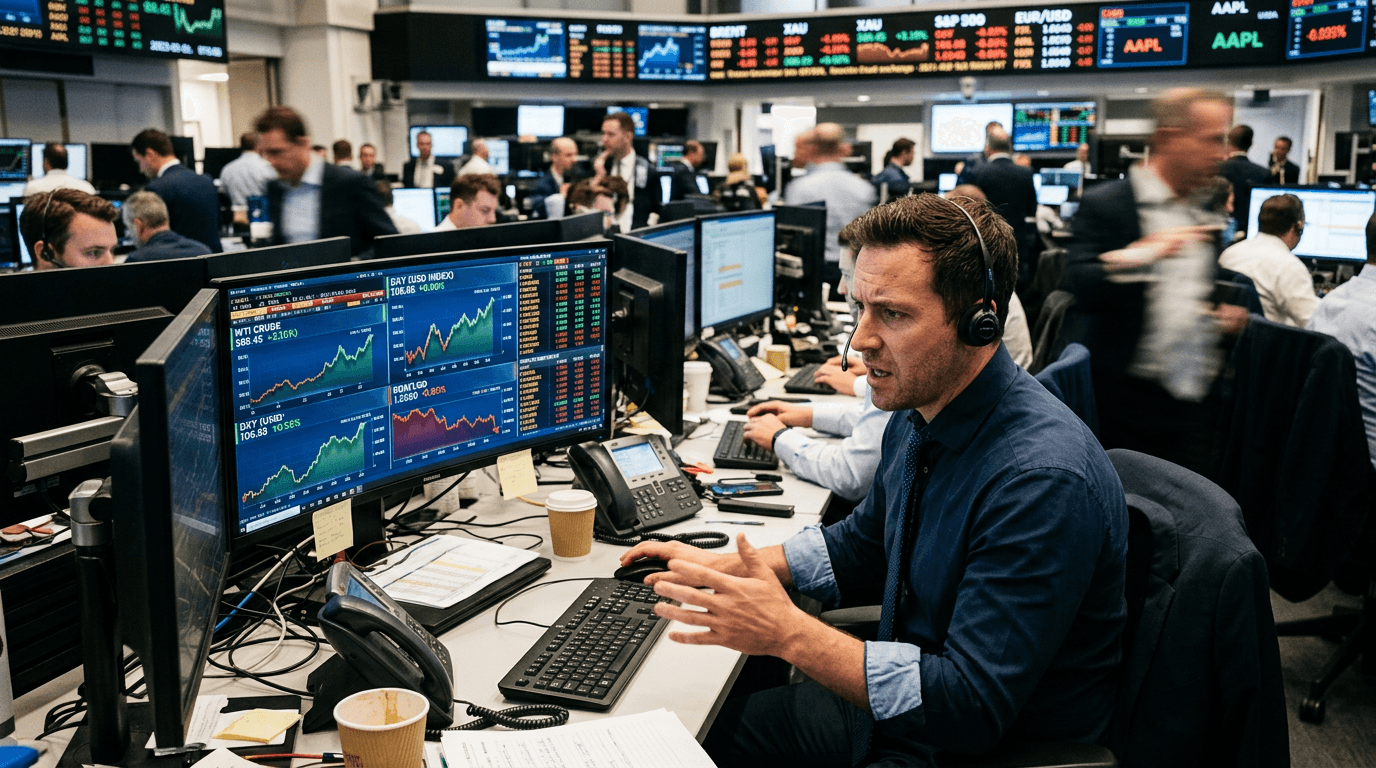
Safe-haven demand for the U.S. dollar has surged as renewed tensions in the Middle East and a sharp rise in oil prices push global markets back into risk-off mode.[1][5][6][8] In contrast to earlier hopes for de-escalation, fresh conflict headlines and signs of disrupted energy flows have helped drive the dollar toward one of its steepest weekly gains in over a year, while risk assets—from equities to high-yield credit—are repricing to reflect a more volatile and inflation-prone environment.[1][5][6][8][17]
Market Backdrop: The Dollar Reclaims Its Haven Role
In periods of rising geopolitical risk, investors typically gravitate toward assets perceived as stable, liquid and resilient under stress—and the U.S. dollar remains at the top of that list.[10][17] Recent sessions have seen the dollar index push toward the psychologically important 100 level and beyond, marking some of its strongest weekly and monthly gains since mid-2025.[1][5][16]
According to multiple sources, this move has come even as traditional safe havens like gold and government bonds deliver mixed signals, with some investors selling Bunds and Treasuries despite the risk backdrop.[8] That has reinforced the dollar’s role as the “default” refuge, helped by the depth of U.S. capital markets and the global dominance of dollar funding.[10]
Importantly, safe-haven flows are not the only driver. In several recent episodes, the dollar’s rally has coincided with firm U.S. data and lingering expectations that the Federal Reserve will keep rates higher for longer, adding a yield advantage on top of its haven appeal.[1][7][13][16] For traders, this blend of geopolitics and rate dynamics is a key reason why the dollar can move sharply even without major changes in Fed guidance.
Geopolitics, Oil And The Inflation Channel
Middle East conflicts matter to FX not just because they unsettle investors, but because they threaten energy supply routes and price stability.[6][8][9][11] Renewed tensions have pushed crude oil higher as markets price in the risk of disrupted shipping lanes and production, particularly around key chokepoints.[5][9]
Higher oil prices feed through the economy via several channels:
First, they raise input costs for businesses and transport, which can lift headline inflation and squeeze real incomes.[6][8] That complicates central bank decisions at a time when policymakers were hoping to normalize policy after prior tightening cycles.
Second, energy importers—especially in Europe and parts of Asia—may face deteriorating trade balances and weaker growth, putting downward pressure on their currencies relative to the dollar.[2][8][9] This helps reinforce the dollar’s strength as investors seek the perceived safety of U.S. assets.
Third, the combination of inflation fears and growth uncertainty tends to increase volatility across asset classes, leading to broader de-risking.[6][8][17] In these phases, positions in higher-beta currencies, cyclical equities and leveraged strategies are often cut, while dollar cash balances are increased.
Impact Across Fx, Energy Futures And Risk Assets
The ripple effects of safe-haven dollar demand and the oil surge can be seen across major FX pairs, energy futures and global indices.[2][6][8][11][16]
In forex, the euro, sterling and various Asian currencies have generally weakened against the dollar as investors unwind carry trades and reduce exposure to regions seen as more vulnerable to energy shocks.[2][8][9] Risk-sensitive currencies tied to global growth or commodities can be particularly volatile, with intraday swings amplified by thin liquidity during headline-heavy sessions.[8][16]
In energy markets, futures curves have adjusted to price higher near-term risk premia, with front-month contracts often moving faster than longer-dated maturities.[5][8][9] For traders, this environment can create opportunities in calendar spreads, volatility strategies and cross-asset plays linking oil to inflation breakevens or rate expectations.
In broader risk assets, equity indices have tended to trade with a defensive tone, with cyclicals and energy-intensive sectors underperforming while some commodity-linked names benefit from higher prices.[6][8][17] Credit spreads can widen as investors demand more compensation for geopolitical and macro risk, and volatility indices may remain elevated relative to their recent ranges.[8][17]
For SimFi participants, these cross-market moves are a valuable live case study in how a single catalyst—geopolitical tension—can propagate through FX, commodities and indices in a matter of hours.
How Traders Can Navigate Safe-haven Rallies
Safe-haven dollar spikes present both risk and opportunity. The key is to treat this as a structured macro regime, not just a series of isolated headlines.[16][17]
First, monitor core risk and dollar indicators in real time: the dollar index (DXY), front-end and 10-year U.S. yields, major oil benchmarks, and volatility measures in FX and equities.[2][5][7][16] Sharp, correlated moves across these gauges often signal regime shifts—such as a transition from “controlled tension” to “full risk-off”—that can reshape trade performance.
Second, build scenario frameworks around the conflict and policy path. For example, ask how major assets might react under three broad outcomes: further escalation with sustained oil disruption, a negotiated ceasefire, or a surprise dovish pivot from the Fed if growth slows.[2][4][8][16] Mapping potential reactions in key pairs (like EUR/USD, USD/JPY, and oil-linked currencies), indices, and energy futures helps traders avoid purely reactive decisions.
Third, manage leverage and concentration carefully. In periods of elevated geopolitical risk, correlations can change quickly, and historically defensive positions may behave unpredictably.[8] Position sizing, disciplined use of stops, and diversification across themes rather than single trades become critical.
Finally, remember that safe-haven rallies rarely persist indefinitely. As seen in prior episodes, easing tensions or clearer guidance from central banks can trigger sharp reversals as investors redeploy into risk assets and pare back dollar holdings.[3][9][16] Traders who plan for both the continuation and unwind of the haven bid are better placed to adjust rather than chase moves late.
Key Takeaways For Simulated And Live Traders
For traders using simulated environments, the current backdrop is an ideal laboratory for testing:
– Geopolitics-driven FX strategies, including dollar strength versus energy-sensitive currencies.[6][8][9][16] – Cross-asset trades linking oil, inflation expectations and rate-sensitive currencies.[8][11][13] – Risk management rules under headline risk, such as tightening risk limits around major news events.[16][17]
By studying how safe-haven flows develop, peak and eventually fade, traders can refine playbooks that remain useful across future crises—whether they stem from geopolitics, growth scares or policy shocks.