
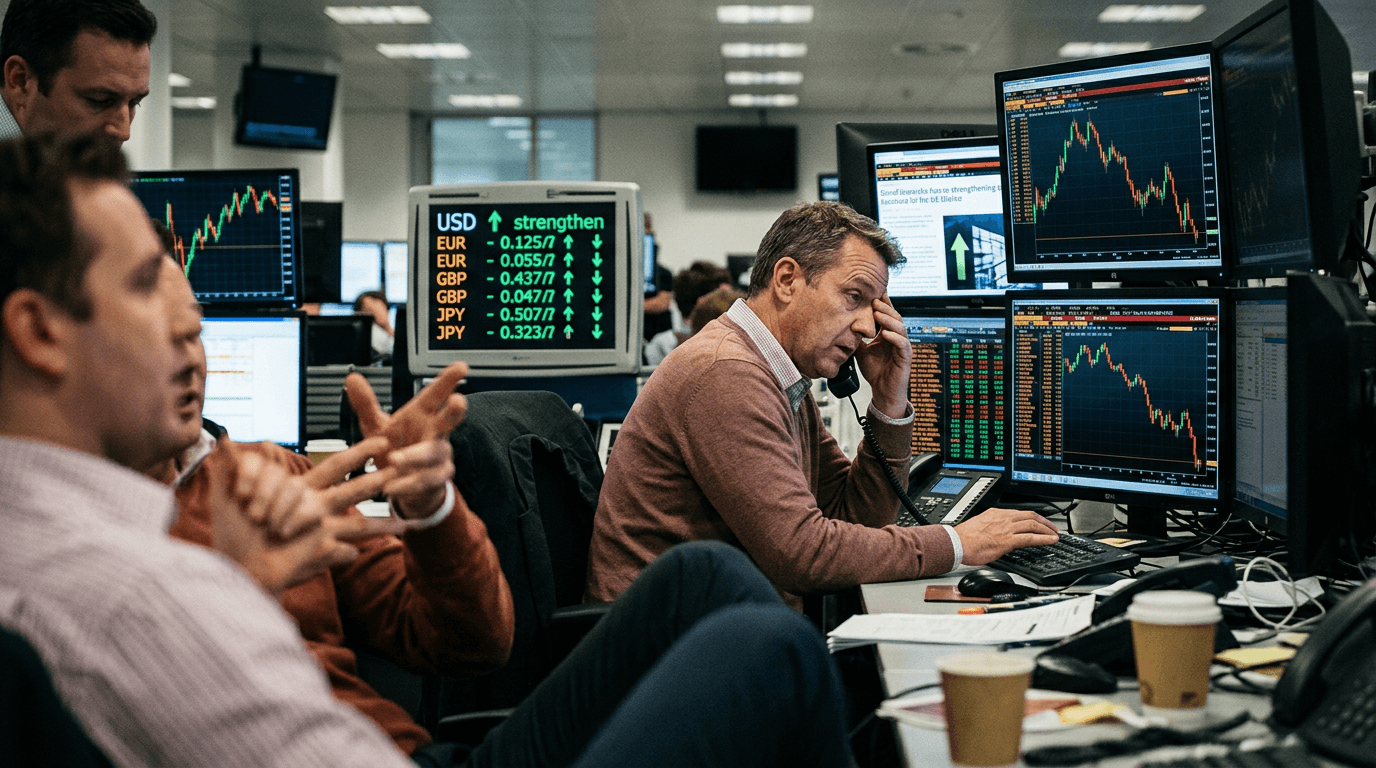
The US dollar has surged on a fresh wave of safe-haven demand as tensions in the Middle East escalate, with markets focused on the risk of wider conflict involving Iran.[1][3][6][8] As traders rush to reduce exposure to risk assets, major FX pairs like EUR/USD and GBP/USD are slipping, while USD/JPY is pressing toward multi‑decade highs despite mounting speculation about possible Japanese intervention.[4][5] At the same time, expectations for near‑term Federal Reserve easing are being scaled back, tightening global financial conditions and amplifying the dollar’s move.[2][4]
Safe-haven Flows And The Greenback
In periods of geopolitical stress, investors typically seek currencies and assets perceived as “safe havens,” and the US dollar remains at the center of that rotation.[1][3][6] Recent headlines around the Middle East conflict have reinforced the dollar’s role as a global reserve currency, a store of liquidity, and the primary unit for pricing commodities such as oil.[1][3][7] That combination makes the greenback an obvious destination when uncertainty spikes and market participants prioritize capital preservation over return.
Data from recent sessions underline how quickly safe-haven flows can lift the dollar index (DXY). The dollar index has climbed around 0.18% in a single day to roughly 99, adding to gains of more than 1% over the week as investors shun risk assets.[4] In some reports, the dollar is on track for its strongest monthly performance in nearly a year, with cumulative gains exceeding 2% as war risks build.[2] These are relatively modest moves compared with historic crises, but they are significant in the context of otherwise range‑bound FX markets.
Importantly, not all of the dollar’s strength is purely about “fear.” Rising expectations for US interest rates also play a role, with futures market pricing shifting from multiple cuts to the possibility of another hike or at least a longer period of restrictive policy.[2][7] That means the safe-haven narrative is interacting with a fundamental story of higher relative yields, creating a two‑pronged support for the dollar that can persist even if headlines temporarily calm.
PRESSURE ON EUR/USD, GBP/USD AND JPY
Against this backdrop, major FX pairs have come under steady pressure. The euro has slipped roughly 0.18% against the dollar, trading near 1.16, while the British pound is lower by about 0.1%, around 1.33.[4] Both currencies are facing a double challenge: risk‑off flows into the dollar and expectations that the European Central Bank and Bank of England may not be able to match the Fed’s policy stance if growth weakens. As a result, rallies in EUR/USD and GBP/USD are being sold, and ranges are tilting lower.
The yen’s behavior is more nuanced. Traditionally viewed as a safe-haven currency, the Japanese yen has weakened sharply against the US dollar, with USD/JPY hovering near 159.60 and repeatedly testing the psychologically important 160.00 level.[5] This puts the pair close to multi‑decade highs and in a zone where traders increasingly talk about the risk of official intervention by Japanese authorities to slow or reverse the move.[5]
Yet the yen has shown strength against other currencies, including some Asian and European peers, highlighting that safe-haven demand is not one‑dimensional.[5] In a world where US yields are materially higher than Japanese yields, the dollar can still dominate USD/JPY even as the yen benefits from risk aversion elsewhere. For traders, the takeaway is that “safe-haven” status must be considered alongside interest rate differentials and central bank reaction functions rather than in isolation.
Geopolitics, Fed Expectations And Financial Conditions
Geopolitical shocks often feed through to inflation and interest rate expectations, particularly when energy markets are involved. Concern that conflict in the Middle East could disrupt oil supply or raise risk premia in commodity markets has encouraged investors to reassess the path of US monetary policy.[1][2][7] Instead of the aggressive easing once priced in, futures now reflect a much lower probability of near-term rate cuts and, in some scenarios, a renewed chance of a hike if inflation remains stubborn.[2][4][7]
For example, estimates of a Federal Reserve rate cut at an upcoming meeting have fallen from nearly 46% to around 31% in just a week, underscoring how quickly expectations can shift when geopolitical risk tightens financial conditions.[4] Higher expected US rates support the dollar by increasing its yield advantage over other currencies and by making dollar funding more expensive globally. This combination of safe-haven flows and changing rate expectations can create a powerful feedback loop: tighter conditions pressure risk assets, which in turn generate more demand for the dollar.
Implications For Risk Assets
The ripple effects of a stronger dollar and elevated geopolitical risk are being felt across global markets. Equities in many regions have come under pressure as investors reduce exposure to cyclical sectors and high‑beta stocks, while credit spreads widen as funding costs rise.[1][4][6] In some episodes, even traditional safe-haven assets like gold and high‑grade government bonds experience periods of volatility as portfolios are rebalanced and margin calls force sales of otherwise defensive holdings.[4][6]
For commodity markets, a stronger dollar can be a headwind because most raw materials are priced in dollars. At the same time, conflict‑related supply fears can offset that effect, leading to complex price action, particularly in energy.[1][7] Traders working with simulated strategies need to recognize that such environments are prone to sudden gaps, sharp intraday swings, and breakdowns in usual correlations. Risk management and scenario planning become as important as directional views.
Practical Takeaways For Simulated Fx Traders
For participants on simulated finance platforms, this type of event‑driven move offers a valuable opportunity to study how macro shocks transmit through FX markets without real‑world capital at risk. One practical takeaway is the importance of monitoring both headline risk and market-implied expectations, such as Fed funds futures or probability tools that track the odds of rate changes.[2][4] When those expectations shift abruptly, major currency pairs often move in tandem, and strategies that assume stable central bank paths can be caught off guard.
Another takeaway is the need to respect key technical levels in stressed markets. The 160 area in USD/JPY, for example, is not just a number; it represents a region where previous intervention talk has surfaced and where positioning is often crowded.[5] In a simulated environment, traders can test how breakout strategies, mean‑reversion approaches, or hedging tactics perform around such levels, incorporating the possibility of policy surprises.
Finally, this episode underscores the value of multi‑asset thinking. A safe-haven bid into the dollar rarely happens in isolation: equities, bonds, commodities, and even cryptocurrencies can all react.[1][4][6] By building and back‑testing strategies that account for cross‑market signals—such as equity volatility, yield curve changes, or oil price moves—traders can develop a more robust framework for navigating future geopolitical shocks. The goal in simulation is not only to chase short‑term moves, but to understand the underlying dynamics well enough to adapt quickly when the next bout of risk aversion hits.