
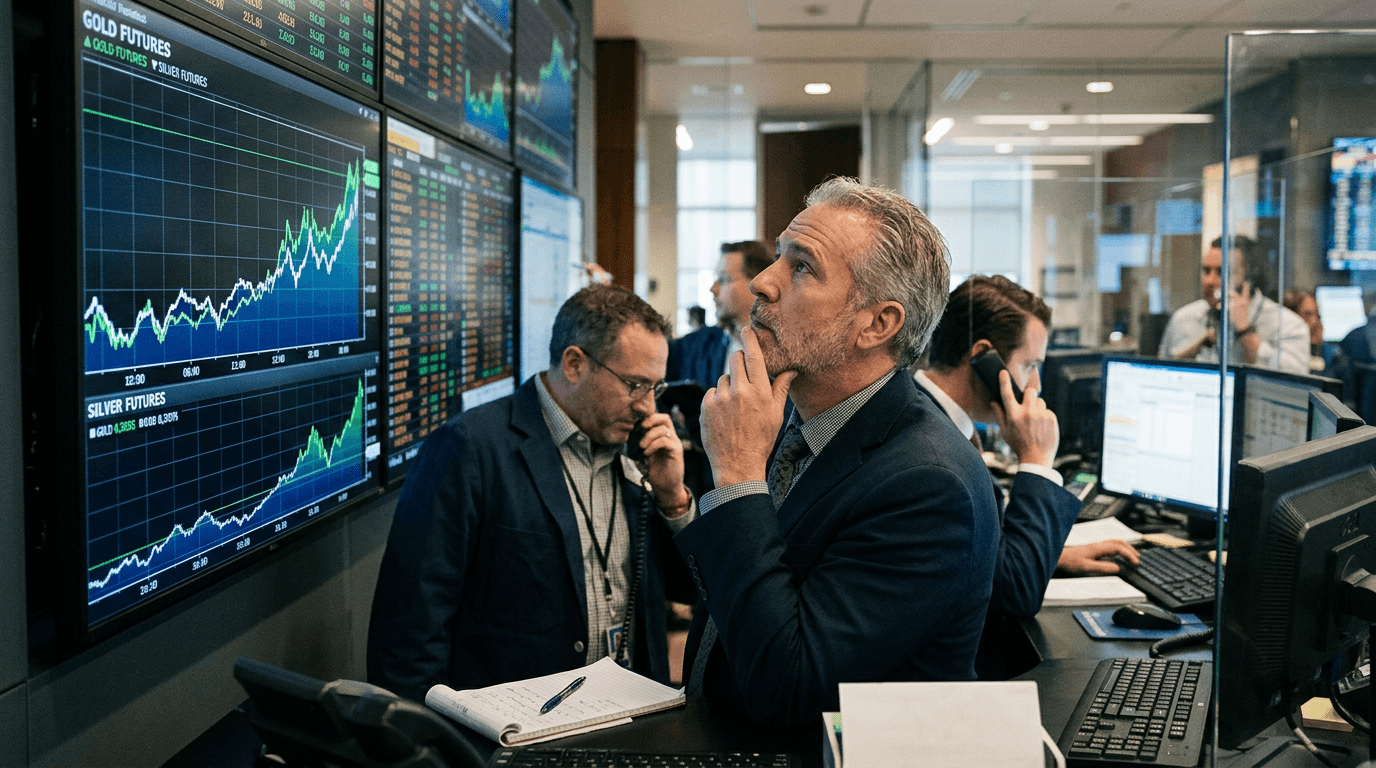
Safe-haven demand is back at the center of the precious metals story, with gold and silver climbing as investors hedge both geopolitical tensions and upcoming U.S. economic surprises.[4][6][9] Silver has recently surged above $84 per ounce as haven flows and speculative interest combined, while gold has held firm as the dollar paused its latest advance and traders positioned ahead of key U.S. jobs data amid persistent Middle East war risk.[4][6][9] For futures traders, these moves signal a clear shift toward risk aversion, even in the face of still-strong dollar and elevated yield dynamics.[4][9]
Safe-haven Flows In Focus
Safe-haven flows describe the rotation of capital out of risk assets like equities or high-yield credit into perceived stores of value when uncertainty spikes.[9][10] Gold has long been the primary recipient of these flows thanks to its role as a monetary asset and portfolio hedge, but in recent sessions silver has outperformed, jumping above $84 and seeing particularly volatile price action in futures markets.[4][6] This divergence reflects silver’s higher beta to precious metals trends and thinner liquidity, which can amplify moves when sentiment shifts sharply toward safety.[2][6]
The latest rally in bullion follows a period where higher interest rates and a stronger dollar had pressured gold, leading to profit-taking and a notable pullback before safe-haven inflows returned.[5][9] As U.S. yields have eased and the dollar has backed off multi-month highs, the opportunity cost of holding non-yielding assets like gold has fallen, reinforcing its appeal as a hedge just as geopolitical and data risks rise again.[4][8][9] In that environment, silver benefits from the same defensive narrative, but with added momentum from speculative traders who gravitate toward its larger percentage swings.[2][6]
War And Data Risks Driving The Move
The primary macro catalysts for the latest precious metals bid are twofold: ongoing conflict and instability in the Middle East, and the approach of key U.S. labor market releases that could reshape interest-rate expectations.[4][6][8] Military tensions and the risk of wider regional escalation have repeatedly driven gold back toward and above major price milestones such as the $5,000 per ounce level, as investors seek insurance against extreme tail scenarios.[3][8] Analysts continue to emphasize that gold’s safe-haven status remains intact, even after periods of pullback linked to shifting rate narratives around the Federal Reserve.[5][7]
At the same time, upcoming U.S. jobs data and other top-tier economic releases inject event risk into the market, particularly for rates and the dollar.[6][9] When traders cannot confidently predict how data will shape the path of policy, they often hedge by accumulating positions in assets that have historically performed well during policy and volatility shocks.[2][9] Safe-haven flows into gold and silver are thus not only a reaction to geopolitical headlines but also a pre-emptive move to cushion portfolios against the kind of surprise print that can reprice yields and the dollar in a single session.[2][9] This blend of war risk and data uncertainty is a classic recipe for elevated intraday swings in metals futures.
What It Means For Metals Futures Traders
For metals futures traders, the current backdrop carries several important implications that go beyond headline price levels. First, the combination of strong safe-haven demand and lingering dollar strength tends to produce choppy, two-way price action rather than a straight-line rally, as competing macro forces pull markets in different directions.[4][9] Silver’s move above $84, framed against a steadier but still supported gold price, illustrates how different contracts respond to the same narrative depending on their volatility profile and positioning.[4][6]
Second, heightened geopolitical risk and event-heavy macro calendars typically coincide with increased volume, wider bid–ask spreads at key data release times, and more frequent stop-driven moves in futures.[2][9] This environment rewards traders who understand how liquidity can thin around news and who adapt position sizing and leverage accordingly. It also underscores the value of scenario analysis: mapping out how gold and silver might react if jobs data come in hot versus soft, or if conflict headlines escalate versus de-escalate. Simulated finance platforms allow traders to rehearse these scenarios and see how their strategies might perform under different volatility regimes before committing real capital.
Practical Takeaways For Simulated And Live Traders
1) Watch the macro calendar as closely as the price chart. With U.S. jobs data looming, short-term futures strategies should be aligned to key release times, with clear rules for whether to hold, hedge, or step aside during the data window.[6][9]
2) Track the triangle of gold, silver, and the dollar. When gold and silver rise while the dollar is falling or stalling, the message is one of classic haven demand supported by easier financial conditions; if metals rally alongside a stronger dollar, risk aversion is more extreme and rallies may be more fragile.[4][9]
3) Monitor the gold–silver spread. Silver’s jump above $84 against a more measured gold move highlights how relative performance can offer clues about speculative versus purely defensive flows.[4][6] A rapidly widening spread may indicate that leverage and momentum are driving the move, suggesting the need for tighter risk controls.
4) Build and test scenarios in a simulated environment. Modeling trades around war-related headline risk and major data prints helps traders practice adjusting stops, taking partial profits, and scaling in or out of positions as volatility shifts. This is especially useful in metals futures, where price gaps and intraday spikes are common during periods of geopolitical tension.
5) Anchor risk management in volatility, not emotion. Elevated headlines can tempt traders into over-sizing positions or chasing moves late; using objective measures such as average true range, intraday high–low ranges, and margin requirements can keep risk discipline intact during emotionally charged markets.
Reading The Broader Risk Sentiment
Safe-haven flows into precious metals rarely occur in isolation; they are part of a broader asset allocation response to changing risk sentiment.[2][9][10] When gold recovers from a pullback and silver accelerates higher as investors rotate away from risk assets, it often coincides with pressure on equities, credit, and more cyclical commodities.[9][10] The fact that bullion is rebounding even while the dollar remains relatively strong sends a clear signal that investors are willing to pay up for protection, rather than simply following traditional inverse correlations.[4][9]
Researchers have noted that while gold is not a perfect shield—it can absorb volatility from both stock and energy markets—it remains a preferred refuge when confidence in political and macro stability deteriorates.[5][10] With central banks and institutional investors still allocating to gold and with expectations that the Federal Reserve may remain on hold for an extended period, the strategic case for metals as portfolio anchors remains intact even beyond the current headline cycle.[5][7] For traders and investors alike, the recent safe-haven bid is thus both a short-term story about war and data risk and a longer-term reminder that defensive assets have a durable role in risk management.
Conclusion
Safe-haven flows lifting gold and silver as investors hedge war and data risks underscore how quickly market narratives can pivot from growth to protection.[4][6][9] Silver’s surge above $84 and gold’s renewed support as the dollar pauses its advance illustrate the complex interplay between geopolitics, macro data, and financial conditions in shaping metals futures.[4][6] For traders operating in both simulated and live markets, the key is not simply to follow prices higher but to understand the drivers, manage volatility intelligently, and build strategies that can adapt as conditions evolve. In an environment where uncertainty is unlikely to disappear overnight, precious metals are once again reminding markets that preparation beats prediction—and that robust risk management is the most valuable hedge of all.