
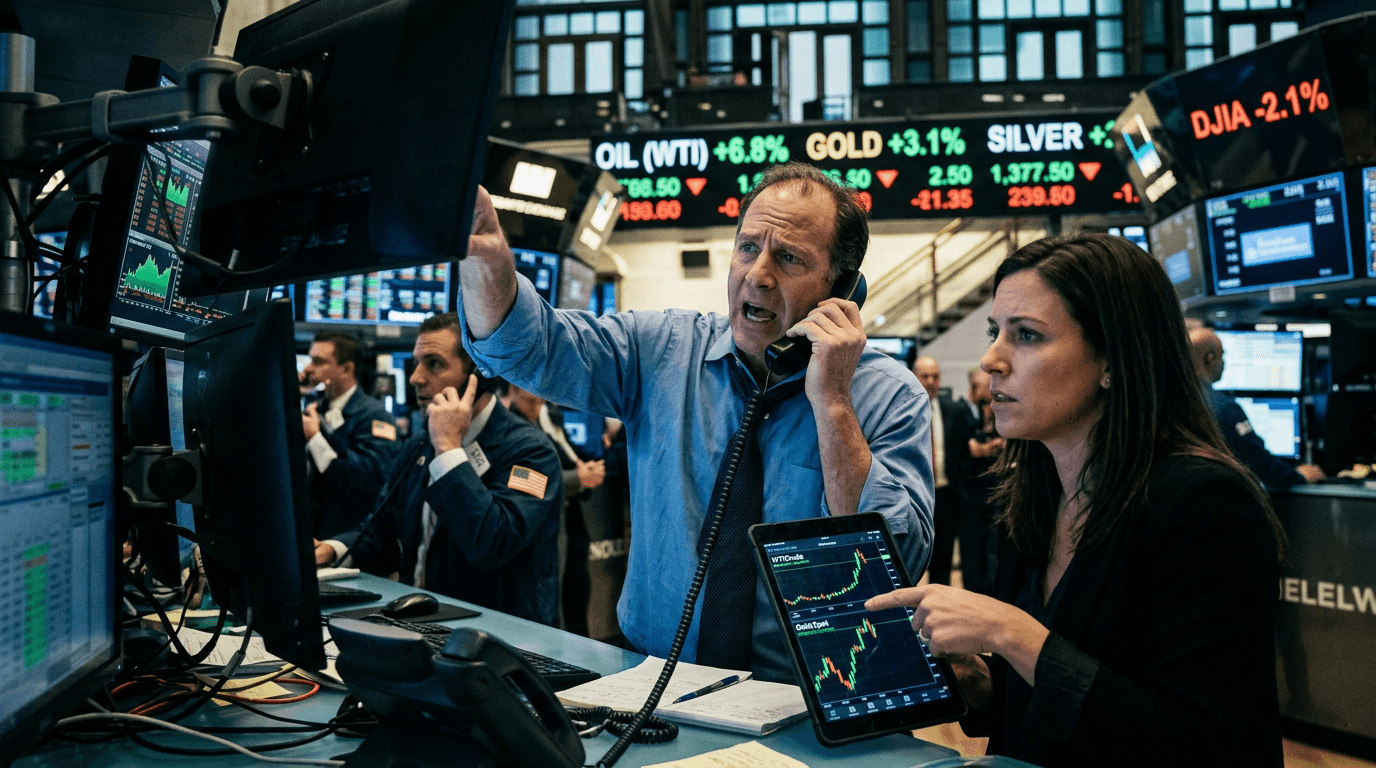
Oil and precious metals are back at the center of global market attention as escalating tensions with Iran ignite sharp moves across energy and metals futures. U.S. crude has jumped roughly 9% to its highest level since mid‑2024, while gold and silver are seeing robust safe‑haven flows even as gold heads for its first weekly decline in five weeks. For traders, this is a textbook example of how geopolitics, inflation expectations, and rate speculation can collide to create fast, asymmetric moves.
Market Reaction: Oil And Precious Metals
The most immediate impact of rising Middle East tensions is being felt in the oil market. With Iran at the heart of key shipping routes and regional supply dynamics, any hint of disruption to crude exports triggers a risk premium in prices. The recent 9% surge in U.S. crude reflects not just actual supply fears, but the market’s willingness to pay for insurance against future shocks.
Precious metals are reacting in parallel. Gold, long regarded as a safe‑haven asset during periods of geopolitical stress, has attracted strong inflows as investors rotate out of risk assets and into perceived stores of value. Silver, which straddles both industrial and monetary roles, has also benefited from the flight to safety, amplifying moves seen in gold and broadening the rally across the metals complex.
Interestingly, gold’s current price action shows that safe‑haven demand does not guarantee a straight line higher. Despite intense inflows, the metal is on track for its first weekly decline in five weeks, highlighting the push‑and‑pull between profit‑taking, positioning, and shifting expectations for growth and rates. The result: elevated volatility in both energy and metals futures, with intraday ranges widening and liquidity pockets becoming more visible.
Geopolitics, Inflation And Rate Expectations
Why do moves in oil and gold matter so much beyond the commodities space? Because they feed directly into inflation and, by extension, central bank policy expectations. Higher oil prices translate into more expensive fuel, transportation, and eventually goods and services. Even if core inflation remains anchored, persistently elevated energy prices can keep headline inflation sticky and complicate the path for rate cuts.
In this environment, gold benefits through two key channels. First, as a safe haven, it attracts flows from investors reducing exposure to equities, high‑yield credit, and risk‑sensitive currencies. Second, as an inflation hedge, it offers a way to preserve real purchasing power if higher energy costs erode the value of cash and fixed‑income returns.
At the same time, gold’s upside is partly constrained by shifting expectations around interest rates. If traders believe central banks will delay or reduce the scale of future rate cuts due to renewed inflation risks, real yields may remain higher than previously anticipated. Higher real yields can dampen demand for non‑yielding assets like gold, creating a delicate balance between safe‑haven and macro‑driven flows.
For macro‑sensitive traders, this intersection of geopolitics, inflation, and rates is where the opportunity lies. Oil and gold are not moving in isolation; they are reshaping the narrative around growth, policy, and risk appetite across asset classes from equities to FX.
Safe-havens Compared: Gold, Silver And Beyond
While gold often takes the spotlight, silver’s behavior in this environment offers important clues. Silver typically reacts to both safe‑haven demand and industrial trends. When geopolitical stress drives broad risk‑off sentiment, silver can rally alongside gold. However, its performance is more sensitive to the outlook for manufacturing, technology demand, and global growth.
In periods when safe‑haven flows dominate but growth concerns linger, gold may outperform silver as investors prioritize pure defensive assets over those tied to industrial cycles. For traders, monitoring the gold–silver ratio can provide a quick gauge of whether the market is pricing primarily fear (favoring gold) or a blend of fear and optimism about future demand (supporting silver).
Safe‑haven behavior also extends beyond metals. The U.S. dollar, high‑quality sovereign bonds, and certain defensive sectors can all attract capital when geopolitical risks rise. Comparing moves across these assets helps traders assess whether the market reaction is concentrated (commodities only) or broad‑based (multi‑asset risk‑off), which has direct implications for positioning and hedging strategies.
Trading Implications For Futures And Simulated Finance
For futures traders, the recent moves in oil and precious metals underscore the importance of scenario planning. Geopolitical headlines can produce price gaps, sharp intraday swings, and rapid changes in implied volatility. Having predefined playbooks for escalation, de‑escalation, and prolonged stalemate scenarios can make the difference between reactive trading and disciplined execution.
In an escalation scenario, traders might anticipate sustained risk premiums in crude, elevated volatility in energy futures, and continued support for gold and silver. A de‑escalation or ceasefire could see some of that premium unwind, leading to mean‑reversion trades in oil and potential corrections in metals as safe‑haven flows moderate. A prolonged stalemate may keep prices range‑bound but volatility elevated, favoring options strategies and relative‑value trades.
Simulated finance platforms offer a powerful environment to test these playbooks without capital at risk. Traders can:
- Back‑test gold–oil relationships across past conflict episodes
- Explore hedging strategies that combine energy, metals, and FX
- Stress‑test portfolios against shocks to inflation expectations and rate paths
- Refine risk management rules for gap risk and news‑driven volatility
By experimenting in a simulated setting, traders build confidence in their frameworks before deploying them in live markets, improving both risk control and execution discipline.
Practical Takeaways For Traders
Several practical lessons emerge from the latest bout of Middle East‑driven volatility:
First, treat geopolitics as a recurring, not exceptional, driver of markets. Conflict‑related headlines may be unpredictable, but the way core assets react—oil higher on supply fears, gold stronger on safe‑haven demand, risk assets under pressure—is relatively consistent. Building a systematic approach to reading and trading these patterns is crucial.
Second, focus on cross‑asset confirmation. If oil is surging but gold is lagging, the market may be pricing a narrower supply shock rather than broad risk aversion. If both oil and gold are moving sharply, and the dollar and bond yields are also reacting, the message is that the macro backdrop is shifting in a more profound way.
Third, prioritize risk management over prediction. Fast markets around geopolitical events can punish over‑leveraged positions and tight stops. Position sizing, scenario planning, and clear rules on trading around major news releases become more important than calling the exact top or bottom.
Finally, think in terms of portfolio construction, not single trades. Combining safe‑haven assets like gold with cyclical exposures, and using oil both as a return driver and an inflation signal, can create more resilient strategies. In simulated environments, traders can test how different portfolios behave under stress and refine their allocation to withstand future shocks.
In the current episode, safe‑haven demand and Middle East tensions have reminded markets how quickly the narrative can pivot—and how closely energy and metals are intertwined with inflation, policy, and risk sentiment. For traders willing to learn from these moves, the opportunity is not just in capturing the short‑term swings, but in building playbooks that will be ready for the next geopolitical shock.