
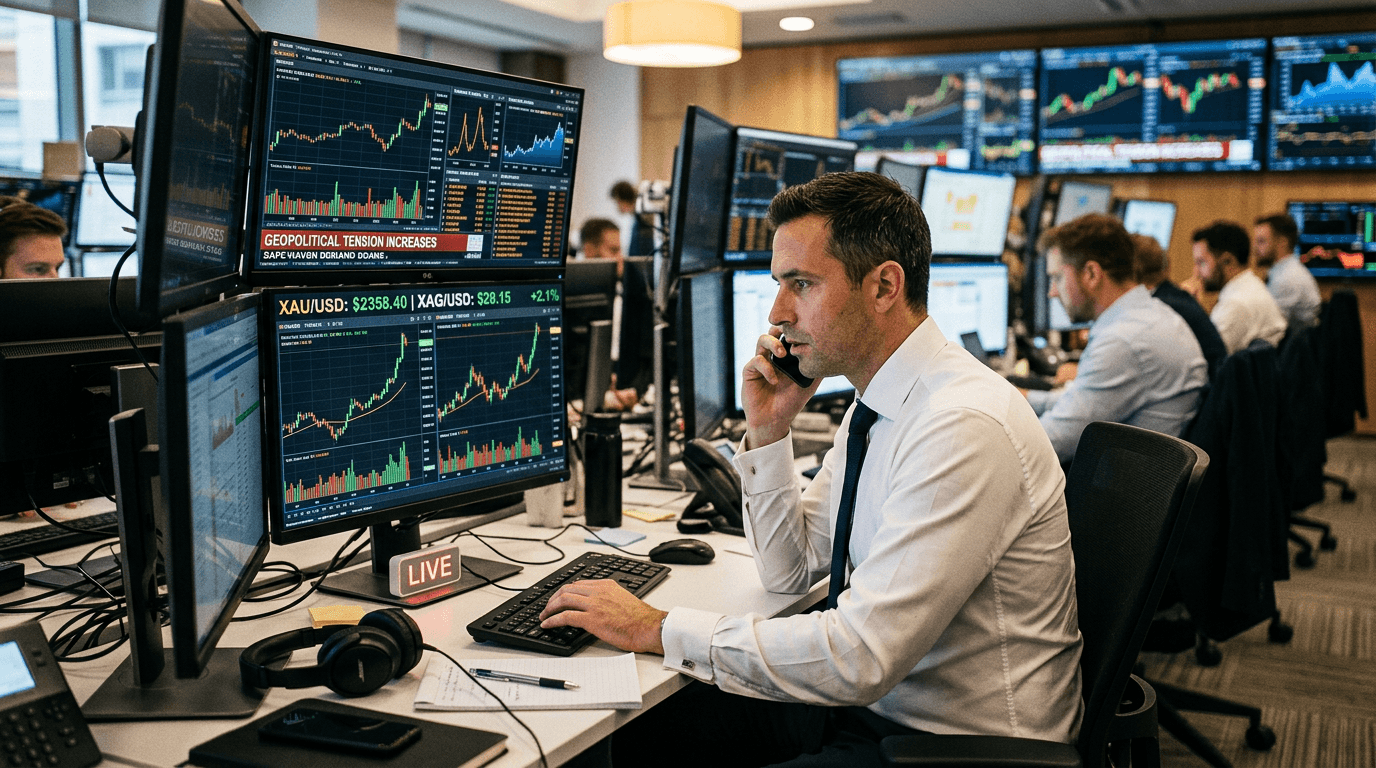
Safe-haven demand has pushed precious metals back into the spotlight as traders juggle a potent mix of Middle East tensions, a key U.S. Nonfarm Payrolls (NFP) release and uncertainty over the Federal Reserve’s next move[1][7][9]. Gold and silver are holding firm, and intraday swings in XAU/USD and XAG/USD have widened as markets constantly reprice both geopolitical risk and the interest-rate path[4][7][13]. For traders on SimFi platforms like E8 Markets, this environment creates a rich—but demanding—backdrop for testing strategies, positioning and risk management in a realistic, high-volatility regime.
Safe-haven Flows Back In Focus
In periods of stress, capital tends to migrate toward assets perceived as stores of value, and gold remains the primary barometer of that shift[1][9][13]. Recent headlines show investors rotating into bullion as violence and diplomatic uncertainty across the Middle East challenge already fragile energy routes and inflation expectations[1][9]. Silver has participated as well, with sharp rallies that reflect both its defensive appeal and its link to industrial demand, making XAG/USD particularly sensitive to macro headlines[1][4][5]. These flows are not limited to metals: the U.S. dollar and Japanese yen have also drawn safe-haven bids, reinforcing cross-asset correlations between FX, gold and oil during risk-off episodes[7][9]. The key takeaway is that precious metals are trading as part of a broader safety trade, not in isolation.
How Nfp And Fed Expectations Drive Metals Volatility
U.S. labor data, especially NFP, remains one of the most market-moving releases for interest-rate expectations, which in turn drive the opportunity cost of holding non-yielding assets like gold and silver[7][8][10]. Strong jobs numbers tend to push yields and the dollar higher, challenging safe-haven inflows and sometimes triggering abrupt reversals in XAU/USD even when geopolitical tensions are elevated[8][10]. Conversely, a weaker NFP print can revive rate-cut expectations and reinforce the bid in precious metals, particularly if it arrives against a backdrop of persistent conflict and elevated energy prices[1][7][9]. Recent episodes have shown that gold can rally on Middle East headlines, then give back gains once markets refocus on a robust labor market and a more hawkish Fed path[8][10]. For traders, the implication is clear: data surprises can temporarily override geopolitics, creating two-way volatility that punishes anyone anchored to a single narrative.
GEOPOLITICAL RISK: WHY THE MIDDLE EAST MATTERS FOR GOLD AND SILVER
The Middle East remains a critical hub for global energy supply, so any escalation in conflict quickly feeds into expectations for oil prices, inflation and central bank policy[1][5][12]. News of strikes, disruptions or failed ceasefires has repeatedly triggered sharp spikes in safe-haven demand, pushing gold to fresh highs and driving silver into levels not seen in over a decade[4][5][12]. These moves are amplified by algorithmic and headline-driven trading, where automated systems respond instantly to keywords associated with war risk, sanctions and energy routes[1][13]. At the same time, investors are weighing the durability of these shocks: if the conflict broadens or becomes entrenched, markets may build a more permanent geopolitical premium into precious metals pricing[1][9][13]. Traders should view each headline through the chain of transmission—war risk to energy flows, energy to inflation, inflation to rates—and then assess how that chain affects XAU/USD, XAG/USD and correlated assets like oil and commodity-linked FX[1][7].
TRADING XAU/USD AND XAG/USD IN A HIGH-VOLATILITY REGIME
With safe-haven flows, NFP and Middle East risk all in play, gold and silver pairs have shifted into a high-volatility regime characterized by frequent intraday reversals and wider spreads between key technical levels[6][10][13]. Analysts are watching psychological markers and recent highs in gold as reference points, while silver’s faster, more leveraged price action often overshoots in both directions[5][6]. Options markets reflect this uncertainty through elevated implied volatility and active positioning in both calls and puts, signaling that traders are hedging for large moves rather than directional conviction alone[4][8][10]. In spot and CFD trading, this translates into greater slippage risk around data releases and headlines, making execution quality and pre-planned entry and exit levels critical[6][7]. A practical takeaway: treat sessions that combine major data with geopolitical risk as special events, with tighter risk limits, wider expected ranges and clear scenarios for both upside and downside surprises.
Practical Simfi Playbook For E8 Markets Traders
SimFi environments like E8 Markets allow traders to stress-test their approach to gold and silver without capital at risk, which is particularly valuable when real markets are driven by overlapping macro and geopolitical themes[1][7]. One effective exercise is to build scenario trees around NFP and Middle East developments: strong, neutral and weak labor outcomes combined with escalation, de-escalation or status quo on the geopolitical front[7][9]. Traders can predefine how they would adjust XAU/USD and XAG/USD exposure in each scenario, including position sizing, maximum loss per idea and conditions for stepping aside instead of trading[7][8]. A second exercise is to practice trading around scheduled releases by simulating narrower time windows—such as the 30 minutes before and after NFP—using stricter rules on leverage and stop placement[7][10]. Finally, SimFi can help traders explore correlations: running parallel positions or paper strategies in gold, silver, safe-haven FX and oil to see how different shocks propagate across the complex over time[1][7][9]. The goal is not to predict every headline, but to build a playbook that remains robust when data and geopolitics collide.
Conclusion: Prepare For Data, Position For Risk
Gold and silver are currently supported by safe-haven flows, but their path is being continually reshaped by U.S. labor data, Fed expectations and the evolving situation in the Middle East[1][7][9]. This combination keeps volatility in XAU/USD and XAG/USD elevated, generates two-way risk and challenges simplistic “buy and hold safe haven” assumptions[4][8][13]. Traders who thrive in this environment are those who respect both macro calendars and geopolitical risk, map the transmission channels from war to energy and policy, and integrate that analysis into disciplined position sizing and exit rules[1][7][9]. For E8 Markets users, the current backdrop is an opportunity to rehearse high-stress market conditions, refine strategy design and build the confidence to navigate real-world turbulence when it arises. Safe-haven assets may be in demand, but it is preparation—not panic—that ultimately determines trading outcomes.