
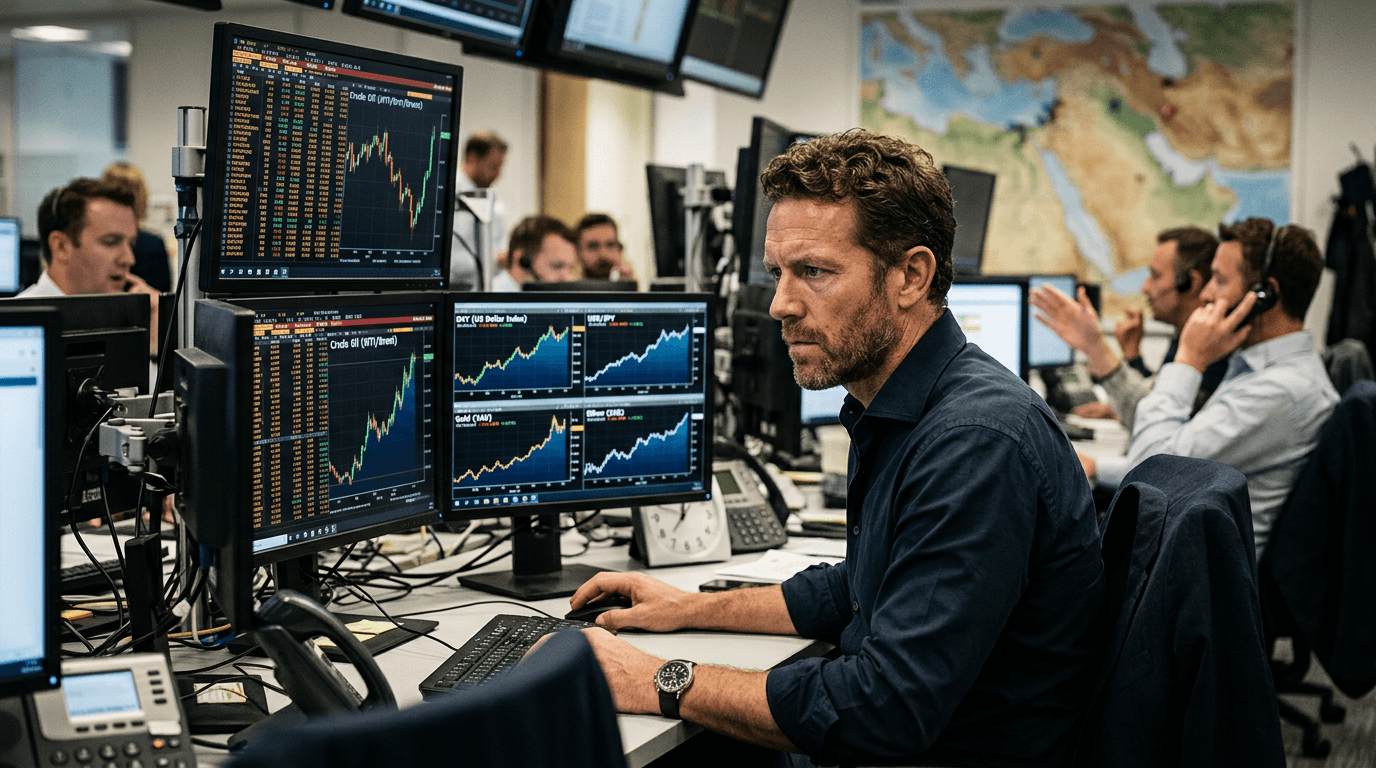
Heightened conflict in the Middle East, particularly involving Iran, is once again reminding traders that geopolitics can move markets faster than fundamentals. Safe-haven assets such as the US dollar, Japanese yen and precious metals are attracting inflows, while oil prices have rebounded above the USD 79 mark on renewed supply fears.[4][6] The result is a jump in volatility across FX and commodities as investors rapidly reprice risk, growth prospects and the future path of interest rates.[4][8]
Safe-haven Flows Back In Focus
In periods of geopolitical stress, capital usually gravitates toward assets perceived as more stable or liquid. Right now, that means the US dollar, the yen, and gold and silver are back in demand as classic safe havens.[4][6][8] The dollar index has firmed against major peers as investors seek the relative security of US assets and deep dollar liquidity, even as some analysts question the long‑term resilience of dollar-denominated holdings under prolonged conflict.[7][12]
The yen and Swiss franc have also seen episodic strength alongside gold, especially immediately after major headlines such as strikes or airspace closures.[3][9] However, recent episodes show that the yen’s safe-haven role is more conditional than many retail traders assume, as Japan’s heavy reliance on Middle Eastern energy imports and ultra-loose monetary policy can undermine its defensive appeal when oil spikes and rate differentials widen.[1][6][10]
Precious metals, particularly gold, remain the purest expression of geopolitical risk. Gold tends to benefit from both risk-off sentiment and concerns about inflation, making it a key hedge when conflict threatens supply routes and central-bank credibility.[3][4][6] Silver, while more industrial, often follows gold’s lead in high-stress environments, adding another layer of opportunity and risk for traders.
Oil Shocks, Inflation Fears And Central Bank Uncertainty
The Middle East remains a critical hub for global energy flows, so any threat to production or transport immediately feeds into the oil market. Recent headlines have pushed benchmark crude back above USD 79, with some episodes seeing much sharper spikes on fears around chokepoints like the Strait of Hormuz.[3][4][9] For markets, the issue is not just the price of oil today, but what sustained elevated prices could mean for inflation over the coming quarters.
Higher energy costs tend to lift headline inflation, complicating the already delicate balancing act for major central banks.[4][8] If inflation expectations rise again, policymakers may have to keep rates higher for longer or delay cuts that markets had begun to price in, extending restrictive financial conditions. That uncertainty around the “rate path” is itself a volatility driver: FX pairs and commodities reprice not only the conflict risk, but shifting assumptions about future yields and growth.
Currencies of large net energy importers, such as the euro area and parts of Asia, typically come under pressure when oil rises, as trade balances deteriorate and domestic inflation risks increase.[5][6] By contrast, producers and commodity-linked economies can show relative resilience, though the impact is rarely straightforward: in extreme risk-off episodes, even fundamentally supported currencies can weaken as global investors simply cut exposure to anything perceived as high beta or pro-cyclical.[5][6]
How Fx Pairs Are Repricing Geopolitical Risk
The current environment is a textbook case of how one regional shock can cascade through multiple FX channels simultaneously: oil prices, global risk sentiment, and interest-rate expectations.[6] FX pairs linked to oil, such as USD/CAD and USD/NOK, are particularly sensitive. Rising crude prices often support the Canadian dollar and Norwegian krone, as higher export revenues improve terms of trade, but those gains can be muted or reversed if risk aversion becomes extreme and the US dollar’s safe-haven bid dominates.[5][6]
Commodity currencies like AUD and NZD sit in the crossfire of risk sentiment and trade dynamics. Australia benefits from energy and resource exports, yet in periods of acute stress, capital tends to exit higher-yield, pro-growth currencies first, pushing pairs like AUD/USD lower despite supportive fundamentals.[5][6] This “risk-off penalty” is a recurring pattern that traders on both live and simulated platforms should understand.
Emerging-market FX, including Middle Eastern and broader EM currencies, is typically among the hardest hit. Rising oil prices, global risk aversion, and tighter dollar liquidity can combine to weaken EM currencies as investors demand higher risk premia or pull capital entirely.[3][13] Meanwhile, major pairs such as EUR/USD and GBP/USD have slipped as safe-haven dollar demand rises and energy-driven inflation risks weigh on European growth prospects.[8][11]
Even USD/JPY, long viewed as a go-to risk-off trade for some retail traders, has behaved differently in this cycle. The pair has climbed toward historically high levels as a firmer US dollar and wide rate differentials overshadow any defensive bid for the yen.[4][6][10] The takeaway: safe-haven labels are useful, but they are not guarantees; the macro backdrop and policy settings matter.
Practical Trading Takeaways For Simulated And Live Markets
For traders, whether on a SimFi platform like E8 Markets or in live markets, the current backdrop is an opportunity to practice disciplined trading under real-world stress conditions without losing sight of risk management. One of the first steps in such an environment is actively reducing position sizes. When headlines can move markets multiple standard deviations in minutes, trading at 50–70% of your usual size and capping risk per trade around 1% of equity can materially improve survival odds.[6]
Correlation awareness is equally critical. The Middle East conflict is not just moving one or two instruments; it is pushing oil, safe-haven FX, EM currencies, and precious metals through the same underlying channels.[4][6][7] A portfolio long USD across several pairs, long gold, and short equities may be less diversified than it looks if all those trades are essentially the same expression of “risk-off and higher inflation.” Mapping your exposure by theme, rather than instrument, helps avoid unintended concentration.
Scenario planning adds another layer of robustness. Traders can build simple frameworks around three broad paths: continued escalation, drawn-out stalemate, or credible de-escalation.[4][5][7] Each scenario implies different trajectories for oil, inflation expectations, central-bank policy and safe-haven demand. Practicing how your strategies would adapt—through position sizing, pair selection, and time horizon—on a simulated account can make you more prepared when markets shift in real time.
Navigating Volatility With Discipline
The renewed Middle East conflict underscores how fast global markets can transition from complacency to fear. Safe-haven flows into the US dollar, yen and precious metals, alongside a rebound in oil prices and inflation worries, are reshaping FX and commodity pricing in ways that reward preparation and punish overconfidence.[4][6][8] For traders, the edge does not come from predicting every headline, but from understanding the transmission channels and managing risk with clear, tested rules.
By focusing on correlations, rate expectations, and the evolving balance between growth and inflation, traders can move beyond reactive decisions and instead build scenarios that guide their positioning. Simulated environments offer a powerful sandbox to rehearse these responses without financial damage, turning volatile episodes into learning accelerators rather than account killers. In a world where geopolitical risk is unlikely to disappear, that combination of education, practice and discipline is a key asset—whatever the next headline brings.