
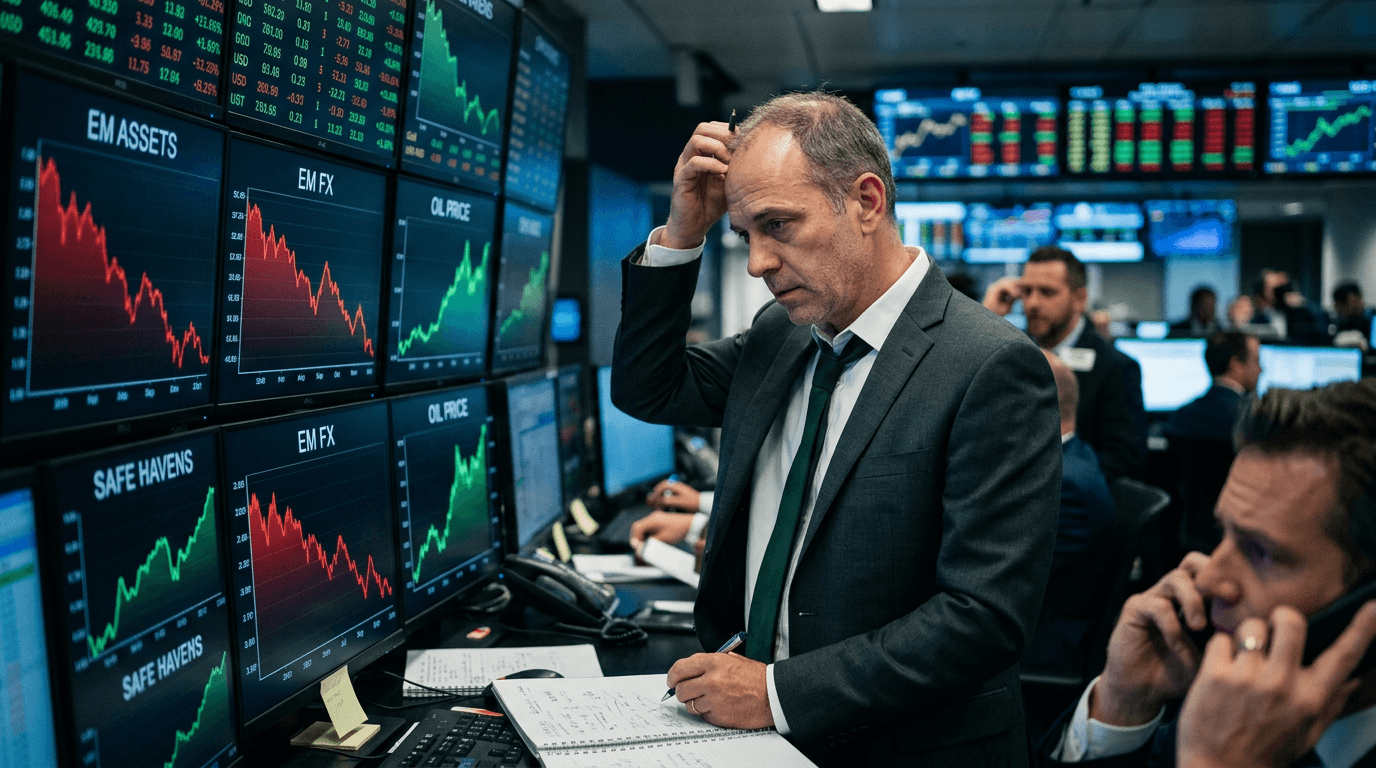
Global markets have snapped into a classic “risk-off” regime as the Middle East–Iran conflict escalates, sending investors toward safe-haven assets, lifting energy prices, and putting emerging markets and risk-sensitive currencies under pressure.[1][3] What started as headline risk has quickly morphed into broad repricing of geopolitical risk across asset classes, with volatility picking up in oil, EM equities, bonds, and FX.[1][8] For traders and investors, understanding these cross-asset links is critical to navigating the current environment.
MARKETS IN “HAVEN-FIRST” MODE
As tensions involving Iran, Israel and the United States have intensified, the dominant market response has been a shift to a “haven-first” mindset.[1][3] In early Asian trading, flows into traditional safe assets pushed the US dollar and Swiss franc higher against major currencies, while equities came under pressure.[1] Government bonds, particularly US Treasuries, initially benefited from a flight to quality as investors sought security.[1][3]
Gold and other classic havens saw early inflows, but their performance has been more mixed than textbook models might suggest.[3][8] Analysts note that high starting valuations and shifting central bank expectations have limited gold’s ability to hold gains, with prices stalling or even dipping after the initial spike.[3][8] This pattern is a reminder that “safe haven” is a relative concept: it depends not just on geopolitical headlines, but also on positioning, valuation, and monetary policy narratives.
Defensive equity sectors such as energy, utilities, and real estate have outperformed more cyclical areas, while consumer discretionary and travel-related stocks struggled under the weight of higher energy costs and weaker sentiment.[1] Macro and multi-asset managers have increasingly emphasized capital preservation, preferring liquid, high-quality assets and shortening risk exposures until there is more clarity on the trajectory of the conflict.[1][3]
Oil Price Shock And Supply Routes
The most immediate and visible channel of transmission has been the energy market.[3][8] Crude prices have surged on fears of supply disruption, particularly around the Strait of Hormuz, the critical chokepoint through which a significant share of global seaborne oil flows.[1][4][8] Reports of Iranian attacks on commercial shipping and sharply higher insurance premiums have effectively constrained traffic, raising the perceived risk premia embedded in oil benchmarks.[4][8]
This disruption is not just about crude barrels; it is also affecting global shipping networks and supply chains for key commodities and industrial inputs.[4] From fertilisers in East Africa to sulphur used in mining, higher transport costs and delays are feeding into broader inflationary pressures.[4] European natural gas benchmarks have also recorded extreme moves, with some measures up more than 60% over a single week in response to the conflict.[8]
Higher oil and gas prices complicate the macro outlook by simultaneously lifting headline inflation and weighing on growth, particularly in energy-importing economies.[3] That, in turn, puts central banks in a difficult position: tighten policy to contain inflation risks, or ease to support growth and financial conditions. Analysts expect further volatility around energy-linked data and central bank communications as markets reassess the path for rates and the durability of the inflation slowdown.[3]
Emerging Markets And Fx Under Pressure
Emerging market assets have been among the main casualties of the risk-off shift. Global EM bond funds recorded net outflows of around USD 1.1 billion in a recent week, reflecting investors’ desire to reduce exposure to higher-risk credits amid heightened geopolitical uncertainty.[2] Emerging market equity funds have seen steep declines and accelerated outflows, particularly from regions seen as most exposed to the Middle East trade and energy shock.[4]
This pressure has spilled over into EM FX, where currencies with twin deficits, high external financing needs, or close trade ties to the region have underperformed.[2][4] Higher US dollar funding costs and wider risk premia have made it more expensive for EM sovereigns and corporates to roll debt, further reinforcing the sell-off in local markets.[2]
Beyond pure financial channels, the conflict is aggravating humanitarian and economic strains in several Middle Eastern economies, including Iran and Lebanon, through displacement, infrastructure damage, and disruptions to essential services.[4][7] These realities reinforce concerns around fiscal sustainability, social stability, and longer-term growth, all of which are key components in investors’ EM risk assessment.[4][7]
For portfolio allocators, the result is a classic de-risking pattern: reducing EM equity and credit exposure, shortening duration, and favouring higher-quality issuers and more resilient currencies until the geopolitical backdrop stabilises.[2][3] In simulated trading environments, this period offers an opportunity to test how different EM portfolios behave under stress and to evaluate hedging strategies using FX, options and commodities.
Safe-haven Fx And The Dollar Dilemma
Safe-haven currencies have seen strong demand, but the picture is more nuanced than simply “buy USD and CHF.”[1][2][8] The US dollar initially strengthened as investors sought liquidity and perceived safety in dollar assets, particularly Treasuries.[1][3] However, analysts warn that a prolonged conflict could erode confidence in US dollar-denominated assets, especially if the US becomes more deeply involved militarily or fiscally.[2]
This has led some investors to diversify their haven exposure across multiple currencies and assets, including the Swiss franc, Japanese yen, and select Asian financial centres viewed as relatively insulated from the conflict.[1][6][9] At the same time, the Swiss National Bank’s hints at potential intervention and gold’s uneven performance have raised questions about how “safe” traditional havens really are in a world of high valuations and unconventional monetary policies.[8]
The result is a more fragmented haven landscape: rather than one dominant refuge, flows are being spread across currencies, short-duration high-quality bonds, and selective commodity exposures.[1][3][8] For FX traders, this environment rewards careful analysis of relative fundamentals, positioning, and central bank reaction functions, rather than assuming that past haven behaviour will necessarily repeat.
How Traders Can Navigate The Volatility
For active traders and investors, the key is to treat the Middle East–Iran conflict as both a source of risk and a test case for robust portfolio construction. First, scenario analysis becomes essential: mapping out paths for oil prices, risk sentiment, and policy responses can help identify where portfolios are most vulnerable.[3][4] Stress-testing EM exposures, leveraged positions, and FX carry trades against sustained risk-off conditions is a practical starting point.
Second, think in terms of correlations. In the current regime, higher oil prices, weaker EM FX, and stronger havens tend to travel together, but those relationships can change as the conflict and policy backdrop evolve.[3][8] Monitoring how assets co-move in real time allows traders to adjust hedges and position sizing more dynamically.
Third, liquidity and risk management matter more than ever. In periods of geopolitical stress, bid–ask spreads can widen, and price gaps around news can be significant. Using simulated finance platforms to rehearse trade execution, stop-loss placement, and diversification strategies can strengthen decision-making before capital is put at risk.
Finally, avoid overreacting to every headline. While the near-term market impact is undeniably significant, some research still suggests the direct economic effects may be limited if the conflict remains relatively short-lived.[3] Balancing tactical adjustments with a disciplined long-term strategy can help traders avoid whipsawing their portfolios in response to short-term noise.