
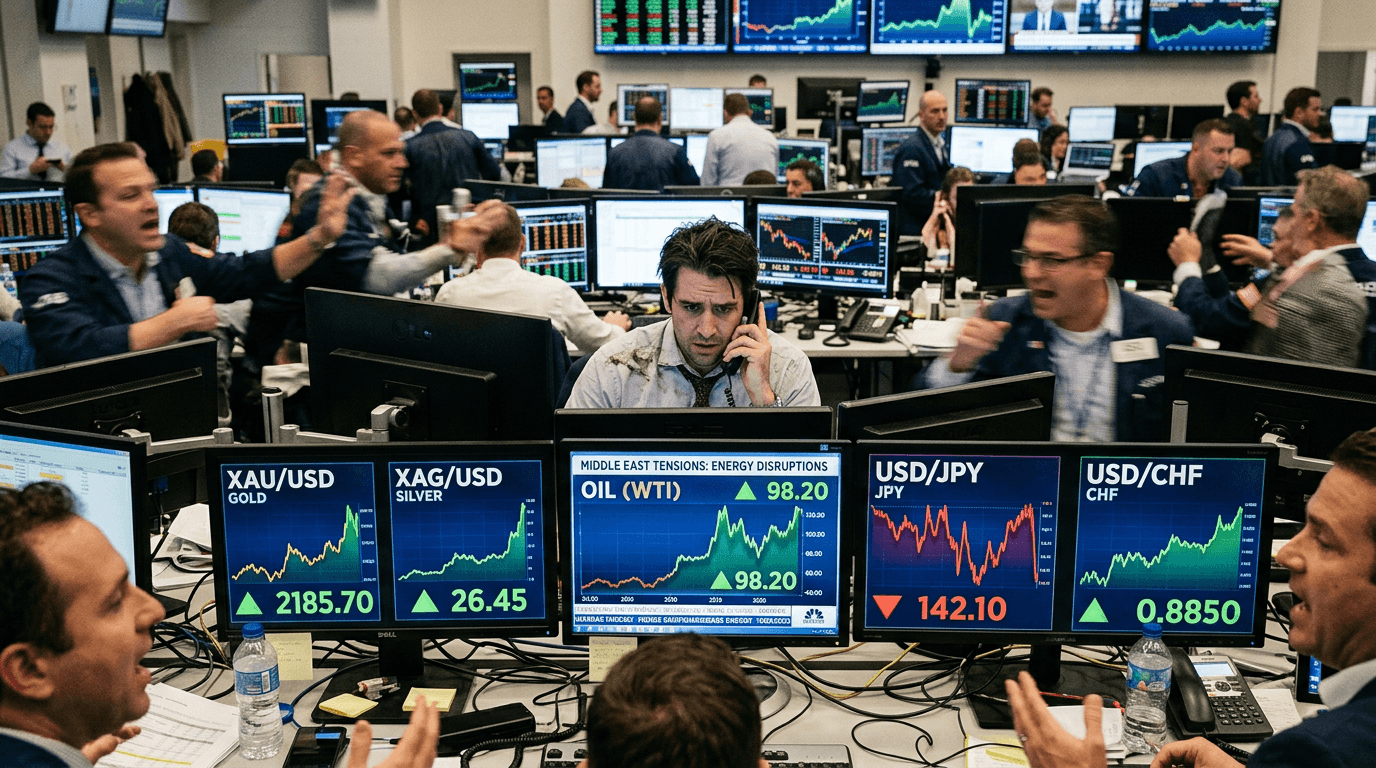
Safe-haven assets are back in the spotlight as the war in the Middle East rattles global markets, disrupts energy flows, and drives oil prices sharply higher.[2][3] Gold and silver have surged on renewed risk aversion, while traditional safe-haven currencies like the Japanese yen (JPY) and Swiss franc (CHF) are finding support as investors reassess geopolitical and inflation risks.[2][4] At the same time, the rebound in WTI crude above $79 is feeding into FX via stronger commodity-linked currencies and shifting expectations for central bank policy paths.[3]
Market Backdrop: Safe-haven Flows Reshape Risk Landscape
The immediate catalyst for the latest market moves is the escalation of conflict in the Middle East, which raises concerns about the security of critical energy supply routes and infrastructure.[1][2] When geopolitical risk rises, investors typically reduce exposure to high-beta assets such as equities and high-yield credit and rotate into instruments historically perceived as stores of value or defensive plays.[2][3]
This dynamic is clearly visible in precious metals. Gold prices have risen more than 1% in recent sessions as safe-haven demand returns, reversing earlier pullbacks.[2][5] Silver, often more volatile than gold, has surged to levels not seen in over a decade, reflecting both its haven appeal and its role as an industrial metal sensitive to broader commodity sentiment.[1][3]
Simultaneously, risk-sensitive currencies and assets tied closely to global growth expectations tend to underperform, while capital flows into perceived “safe” currencies like JPY and CHF increase. That combination—strong precious metals, firm safe-haven FX, and softer risk assets—is a classic market response to geopolitical shock.
Gold And Silver: Classic Havens Back In Focus
Gold’s role as a safe-haven asset rests on three pillars: its status as a store of value, its historical resilience during crises, and its independence from any single government’s credit risk.[2][4] In the current environment, all three are in play. Heightened conflict risk has boosted demand for gold as a hedge against tail events, while lingering inflation concerns and questions over future central bank policy add a macro layer to the story.[3][6]
In recent months, gold had already been in a strong uptrend, posting double-digit percentage gains year-to-date and setting repeated record highs amid global political and economic instability.[4][6] The Middle East war is reinforcing that trend by attracting additional flows from investors seeking to diversify away from traditional financial assets and currency risk.[2][4]
Silver’s move is especially notable. Prices have spiked to their highest levels in more than a decade, a reflection of both safe-haven inflows and its leverage to industrial demand and the broader commodities complex.[1][3] For traders, silver often acts as a “high beta” version of gold: it can outperform in risk-off rallies but also correct more sharply when sentiment stabilizes.
From a practical perspective, this environment favors strategies that recognize gold and silver as cross-asset signals, not just standalone trades. Watching how precious metals react to headlines can help traders gauge the depth of risk aversion and adjust exposure in equities, credit, and FX accordingly.
Oil Spike, Energy Flows, And Commodity Currencies
The conflict’s direct impact on energy flows is another major driver of recent market moves.[1][2] Disruption risk to Middle Eastern production and transport routes has pushed WTI crude back above $79 per barrel, reversing prior declines and reigniting concerns about input costs across the global economy.[3]
Higher oil prices feed into markets in several ways. First, they raise inflation expectations, particularly in energy-importing economies, complicating the calculus for central banks already balancing sticky inflation against signs of slowing growth.[3][5] Second, they tend to support commodity-linked currencies such as the Canadian dollar (CAD), Norwegian krone (NOK), and in some contexts the Australian dollar (AUD), as higher resource revenues improve terms of trade.
For traders, the renewed oil strength is a reminder that energy remains a key macro driver. Cross-asset relationships—oil vs. inflation breakevens, oil vs. commodity FX, oil vs. airline and transport equities—may all tighten as crude becomes more central to the narrative again. Scenario testing around different oil price paths (for example, sustained prices above $85 vs. a quick retracement) can help quantify potential impacts on portfolios and simulated strategies.
Safe-haven Fx: Jpy, Chf, And Central Bank Implications
On the currency side, JPY and CHF are once again behaving like classic safe havens, benefiting from capital flows seeking lower risk and high liquidity.[2][4] Historically, periods of geopolitical tension see investors unwind carry trades and reduce exposure to higher-yielding emerging market currencies, reallocating into the yen and franc given their deep markets and perceived stability.
However, today’s FX landscape is more complex than in past cycles. The U.S. dollar has also attracted safe-haven demand, and at times its strength has partially limited gold’s upside by making the metal more expensive for non-dollar buyers.[5] In recent sessions, dollar moves have been mixed—periods of strength on risk aversion interspersed with pullbacks as rate expectations evolve.[4][5]
Central banks are watching this mix of safe-haven flows, commodity strength, and inflation risk closely. Higher energy prices can delay rate-cut cycles or even prompt a more hawkish tone if inflation proves stickier than expected.[3][5] At the same time, excessive currency volatility—especially in emerging markets—may encourage policymakers to emphasize financial stability in their communications.
For traders focused on simulated or live FX strategies, this environment favors a disciplined approach to risk management: - Monitor implied volatility and adjust position sizing as volatility rises. - Consider diversification across havens (gold, JPY, CHF) rather than relying on a single asset. - Track central bank commentary for shifts in reaction functions tied to energy and geopolitical risk.
Practical Takeaways For Traders And Simulated Investors
The current episode offers several concrete lessons for traders working in both live markets and simulated finance environments:
First, cross-asset awareness is essential. Gold, silver, oil, JPY, CHF, and commodity FX are all reacting to the same underlying driver—geopolitical risk—but in different ways and at different speeds.[2][3] Building or testing strategies that incorporate these linkages can improve robustness and help avoid overexposure to a single narrative.
Second, geopolitical shocks tend to arrive suddenly but can have long tails. The war’s final outcome, and its full impact on energy flows and inflation, remains highly uncertain.[3][6] In a simulated environment, it can be particularly valuable to model multiple paths: a quick de-escalation, a prolonged stalemate, and further escalation affecting broader trade routes. Each scenario may imply different performance for havens, risk assets, and policy expectations.
Third, safe-haven rallies often coexist with central bank repricing. As oil rises and inflation concerns resurface, rate-cut timelines may be pushed back, altering yield differentials across currencies.[3][5] That makes it important to complement geopolitical analysis with careful monitoring of economic data and policy signals.
Finally, episodes like this underline the importance of disciplined risk management. Volatility can create opportunity but also magnify losses for overleveraged or poorly diversified positions. Using simulated platforms to stress-test portfolios, refine stop-loss strategies, and experiment with cross-asset hedges before committing capital can be a powerful way to turn turbulent markets into a learning advantage.