
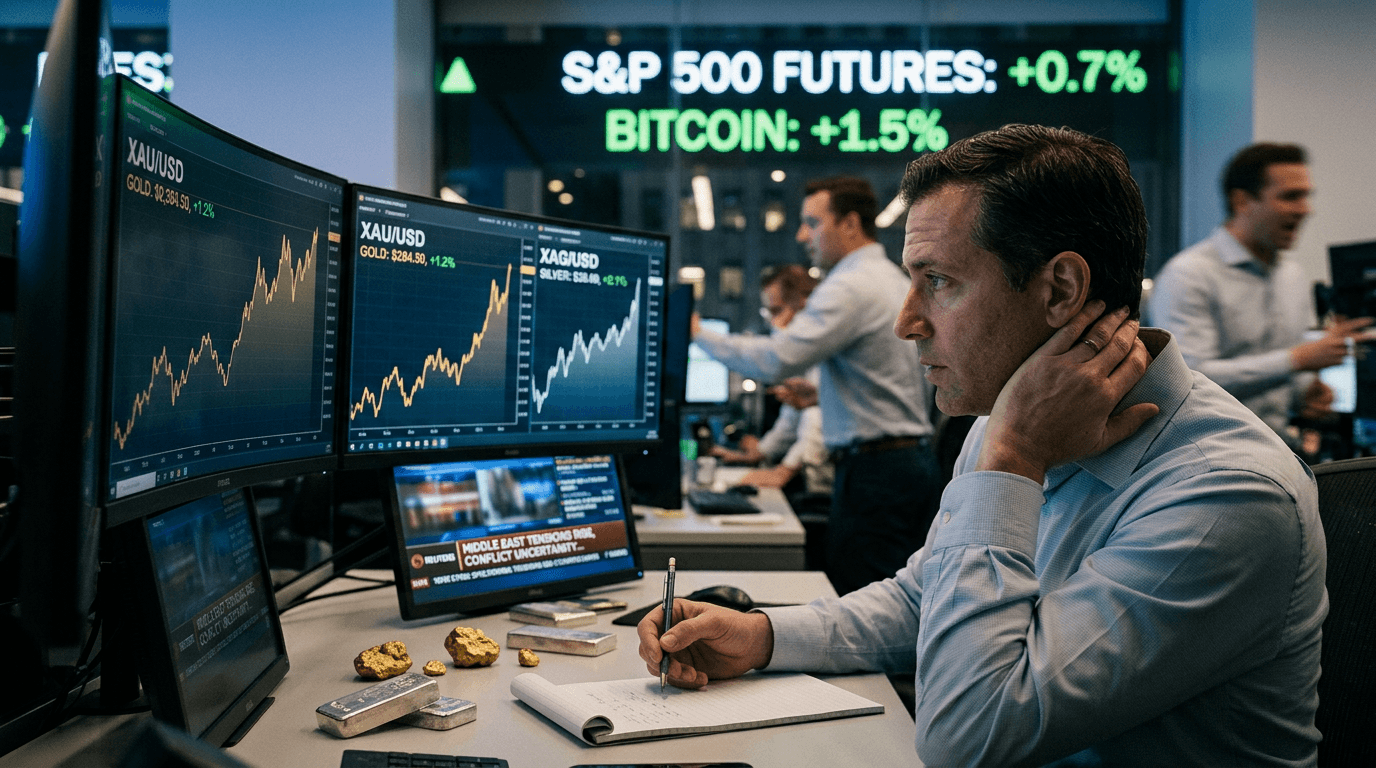
Safe-haven demand is once again in the driver’s seat for precious metals, with gold and silver extending recent gains even as broader risk markets show signs of stabilizing. At the same time, S&P 500 futures and major cryptocurrencies such as Bitcoin and Ethereum are rebounding, pointing to an unusual mix of fear and optimism that traders need to understand and navigate carefully.
Safe-haven Flows Back Into Precious Metals
Gold’s latest rally is tightly linked to mounting tensions in the Middle East, which have pushed investors toward classic defensive assets.[8] Recent data show spot gold up around 2% in a single session, rebounding from its lowest level in more than a week as geopolitical risks dominated the narrative.[8] Futures prices near the $5,200 per ounce region underscore how elevated the metal remains relative to pre-conflict levels.[8][9]
Silver has participated even more aggressively in the move, gaining over 5% in one session after an 8% slide the day before, and trading in the $83–$86 per ounce band.[8][9] That volatility reflects silver’s dual identity: part safe haven, part industrial metal, and therefore more sensitive to both risk sentiment and growth expectations.[9] In cross-asset terms, gold and silver are signaling that geopolitical uncertainty is far from resolved, even if other markets are beginning to lean back toward risk.
From a technical perspective, gold is pressing into resistance zones around $5,200–$5,250, with a broader record area above $5,600.[9] On the downside, traders are watching support in the $5,000–$5,100 region, levels that have repeatedly attracted buyers when headlines have calmed.[9] Silver’s technical picture is similarly well-defined, with resistance around $87.50–$90 and support near $83–$81.[9] For SimFi traders, these levels provide clear reference points for constructing simulated hedges and directional plays.
Equity Futures Signal Improving Risk Sentiment
While precious metals flash caution, U.S. equity futures are quietly telling a different story. S&P 500 futures have rebounded toward key resistance zones, suggesting that investors are willing to re-engage with growth and earnings prospects despite ongoing geopolitical risks. This kind of price action typically reflects incremental confidence that the conflict, while serious, may be contained enough not to derail the broader economic outlook.
In practice, this means risk appetite is returning—but selectively. Defensive sectors, quality large caps, and companies with strong balance sheets often lead in such rebounds, while more speculative names lag until confidence solidifies. For traders, the S&P’s move toward resistance is a reminder to distinguish between a tactical bounce and a structural bull trend. SimFi environments are well suited for testing scenarios like “range-bound index futures with elevated volatility” versus “breakout into new highs” and assessing how different strategies perform under each.
This divergence between gold and equities is not unusual. Historical patterns show that during periods of heightened geopolitical risk, it is possible for safe-haven assets to remain bid while equities grind higher, particularly if monetary policy expectations or economic data remain supportive.[13] Short-term spikes in gold are common during conflicts, but sustained multi-month rallies usually require a broader backdrop of inflation or central bank shifts.[13] Equity futures rebounding as gold holds firm is a classic sign of markets pricing geopolitical risk as serious, but not yet systemic.
Cryptocurrencies Join The Rebound
Major cryptocurrencies are also participating in the risk-on leg of this cross-asset story. Bitcoin and Ethereum are holding above important technical levels, with price action described as constructive and momentum indicators pointing to renewed buyer interest. While we lack precise spot figures in the referenced reports, the message is clear: crypto is behaving more like a high-beta risk asset than a safe haven in this phase.
This matters because crypto’s role in market regimes is still evolving. At times of extreme monetary uncertainty, Bitcoin can attract “digital gold” flows; at other times, it trades more like a tech proxy, closely correlated with growth stocks and speculative sentiment. In the current move, the rebound in crypto alongside S&P futures reinforces the idea that traders are tentatively rotating back into higher-risk assets, even as they keep some capital parked in gold and silver.
For SimFi users, this presents an opportunity to experiment with multi-asset portfolios that combine index futures, crypto exposures, and precious metals. Simulated strategies can explore questions such as: How does a crypto-heavy portfolio behave when geopolitical headlines worsen but central bank policy remains steady? How effective is gold as a hedge when Bitcoin is trading like a risk asset rather than “digital gold”? Testing these relationships in a risk-free environment is invaluable before committing capital in live markets.
What This Cross-asset Move Tells Us
Taken together, the current pattern—gold and silver strong, S&P 500 futures and crypto rebounding—suggests a nuanced market regime rather than a simple “risk-on” or “risk-off” label. Investors appear to be hedging geopolitical tail risks with precious metals while simultaneously expressing cautious optimism about growth and liquidity through equities and digital assets.[8][9][13]
One way to interpret this is as a barbell in sentiment: capital flows into safe havens to insure against adverse outcomes, while risk exposure is maintained or selectively increased to capture upside if the conflict stabilizes and economic data remain resilient. Market commentary around gold’s 20% appreciation this year and repeated record highs reinforces the idea that geopolitical tensions are stacking on top of existing macro concerns.[2] At the same time, the resilience of risk assets indicates that investors are not yet pricing a severe global shock.
For traders, the key takeaway is that single-asset narratives are incomplete. Gold’s rally does not automatically mean equities must fall; crypto’s rebound does not imply geopolitical risks have disappeared. Understanding how these markets co-move is essential for building robust strategies, whether directional, hedging, or relative value.
Looking Ahead
Looking forward, the evolution of the Middle East conflict will remain central to gold and silver’s trajectory, with fresh escalation likely to trigger sharp rallies and any diplomatic progress inviting consolidation.[9] However, as research on precious metals repeatedly shows, lasting bull markets in gold and silver usually require more than headlines—they tend to coincide with sustained inflation pressures, shifts in central bank policy, or broader financial stress.[13]
For S&P 500 futures and cryptocurrencies, the next test will be whether prices can break through current resistance levels and hold gains on the back of earnings, macro data, or clearer policy signals. A failure at resistance could keep markets range-bound, with gold and silver acting as ongoing insurance. A clean breakout, especially if accompanied by calmer geopolitical news, might see some rotation out of safe havens and into higher-beta assets.
In a SimFi context, this is a prime environment to practice cross-asset thinking: designing simulated portfolios that balance defense and offense, experimenting with hedging ratios between gold and equity futures, or testing how crypto exposure changes portfolio volatility under different headline scenarios. By treating this episode as a live case study, traders can sharpen their understanding of how risk sentiment travels across metals, equities, and digital assets—and be better prepared when the next regime shift arrives.