
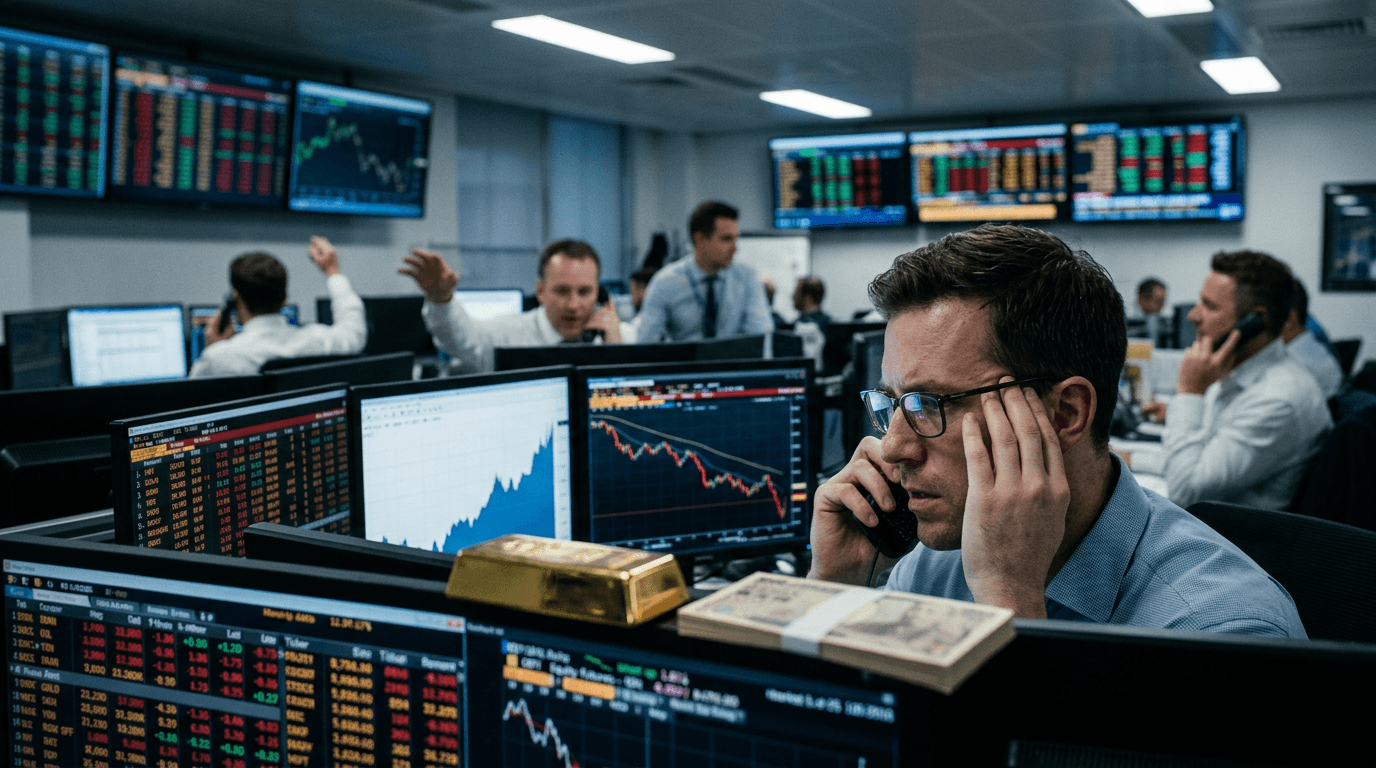
Fresh escalation signals in the Middle East and renewed concerns around Iran have pushed markets back into risk-off mode, sending safe‑haven assets like the Japanese yen and gold higher while weighing on risk‑sensitive currencies and equity index futures.[1][2][3] For traders, this is a textbook reminder that geopolitics can reprice risk in minutes and that understanding safe‑haven flows is essential to navigating turbulent markets.
WHAT SAFE‑HAVEN FLOWS ARE TELLING US
When headlines hint at wider conflict or policy miscalculation, markets quickly reprice the probability of tail risks—energy supply shocks, trade disruptions, or even broader military escalation.[1][3] In that environment, capital tends to rotate out of growth‑sensitive assets and into perceived safe havens such as gold, the yen, the Swiss franc, and the US dollar.[1][4][5]
Gold’s behavior in these episodes is particularly instructive. During recent U.S.–Israeli strikes on Iranian targets, spot gold jumped more than 1% intraday, reversing prior losses as traders rushed to hedge geopolitical uncertainty.[3] Similar patterns have emerged throughout the latest Middle East conflict, with gold extending gains as fears of a prolonged regional war grew.[1][3]
The key takeaway: when geopolitical risk rises suddenly, safe‑haven flows are often less about detailed scenario analysis and more about investors buying time—seeking liquid, trusted stores of value while they reassess the landscape.[1][4] That instinctive flight to safety is what just lifted both the yen and gold, even as the macro backdrop remains complex.
WHY YEN AND GOLD REACT TO MIDDLE EAST AND IRAN RISK
The Japanese yen has long been viewed as a classic safe‑haven currency, partly because of Japan’s large net foreign asset position and the tendency of investors to unwind yen-funded carry trades when volatility spikes.[2][4] In practice, that often means bouts of geopolitical stress trigger short‑term yen strength as leveraged positions are reduced and capital repatriates.
This time, however, the yen is rallying intraday from historically weak levels, with USD/JPY having traded near 160 as markets focus on wide interest rate differentials and Japan’s energy import dependence.[2] Elevated oil prices driven by Middle East tensions can hurt Japan’s trade balance, complicating the yen’s traditional safe‑haven role even as risk‑off positioning still provides it with tactical support.[2][4]
Gold, by contrast, does not depend on a single economy’s fundamentals. It is a non‑yielding asset with no default risk, which makes it attractive when investors worry about war, financial stress, or deep recession.[1][3] During recent episodes of Middle East and Iran-related escalation, spot gold has climbed sharply as traders positioned for potential supply shocks, higher risk premiums, and the possibility that central banks might be constrained if inflation resurfaces via energy prices.[1][3]
Practical takeaway: yen moves around geopolitical shocks can be more nuanced and sensitive to local fundamentals, while gold tends to respond more directly to the overall level of global uncertainty.
Ripple Effects Across Fx, Commodities, And Index Futures
Safe‑haven flows rarely happen in isolation. As investors buy yen and gold, they often simultaneously reduce exposure to risk‑sensitive currencies such as commodity‑linked and high‑yielding FX, along with equity markets and cyclical sectors.[1][3][5] That helps explain why renewed Middle East and Iran risk is weighing on risk‑sensitive currencies and global equity futures as traders de‑risk portfolios and hedge downside scenarios.
In FX, this often shows up as pressure on higher‑beta currencies and emerging market FX, particularly for countries heavily reliant on imported energy or external financing. While each episode is different, the pattern of “sell growth, buy safety” tends to repeat when geopolitical headlines escalate.
In futures markets, equity index contracts typically gap lower or struggle to hold gains as implied volatility rises and risk premia are repriced. At the same time, commodity futures can diverge: energy contracts may spike on supply concerns, while industrial metals can soften if traders start to price weaker global growth. Gold futures, meanwhile, usually attract fresh long interest as both tactical traders and longer‑horizon investors seek portfolio hedges.[1][3]
Takeaway for traders: when you see safe‑haven assets bid on geopolitical risk, assume the move will cascade across FX, commodities, and index futures, and adjust your risk and correlation assumptions accordingly.
How Traders Can Navigate Geopolitical Shocks
For both new and experienced traders, the latest safe‑haven rotation offers several practical lessons:
First, build a structured “risk‑event” playbook. Geopolitical shocks are, by definition, unpredictable, but your reaction does not have to be. Define in advance how you will adjust position sizes, leverage, and hedges when volatility jumps or when safe havens like gold and the yen spike on headline risk.[1][4]
Second, respect liquidity and gaps. Safe‑haven flows often intensify during thin liquidity—overnight sessions or around key news drops—leading to sharp moves in FX and futures. Having predefined stop‑loss levels, avoiding excessive leverage, and understanding margin requirements in volatile conditions becomes critical.
Third, think in scenarios rather than single forecasts. Markets will reassess probabilities as new information emerges about the Middle East and Iran. Consider best‑case, base‑case, and worst‑case paths for energy prices, global growth, and central bank responses, and stress‑test how each scenario might affect your portfolio across different asset classes.
Finally, use simulated environments to practice. Platforms in the simulated finance (SimFi) space allow traders to test safe‑haven strategies—such as long gold vs. short equity futures, or tactical long JPY during risk‑off bouts—without real capital at stake. Practicing how you react to sudden news, slippage, and fast‑moving correlations can significantly improve your live‑market discipline.
What To Watch Next
Safe‑haven flows into yen and gold are a signal, not a conclusion. Going forward, traders should watch several key dimensions:
- Geopolitical trajectory: Any signs of de‑escalation in the Middle East or diplomatic progress with Iran could unwind part of the safe‑haven bid, while further military strikes or disruptions to energy infrastructure would likely reinforce it.[1][3]
- Energy prices and inflation expectations: A sustained rise in oil prices would add a second‑order macro channel, pressuring energy‑importing economies and potentially complicating central bank efforts to manage inflation and growth.
- Central bank communication: If policymakers start framing geopolitical risk as a material factor in their outlooks—particularly in relation to inflation, financial conditions, or currency volatility—it could amplify market moves in rates, FX, and gold.
- The yen’s policy backdrop: Japan’s monetary policy stance and tolerance for further yen weakness will influence how effectively the currency can perform its safe‑haven role in future episodes.[2][4] Intervention risks and rate‑path expectations are especially relevant around extreme FX levels.
The overarching message for traders is clear: geopolitics is not an isolated storyline—it is a powerful driver of cross‑asset pricing. Renewed Middle East and Iran risk has once again lifted the yen and gold while pressuring risk assets, illustrating how quickly capital can rotate when uncertainty rises.[1][2][3][5] Understanding these dynamics, and preparing for them in advance, can turn chaotic headline‑driven markets into more manageable trading opportunities.