
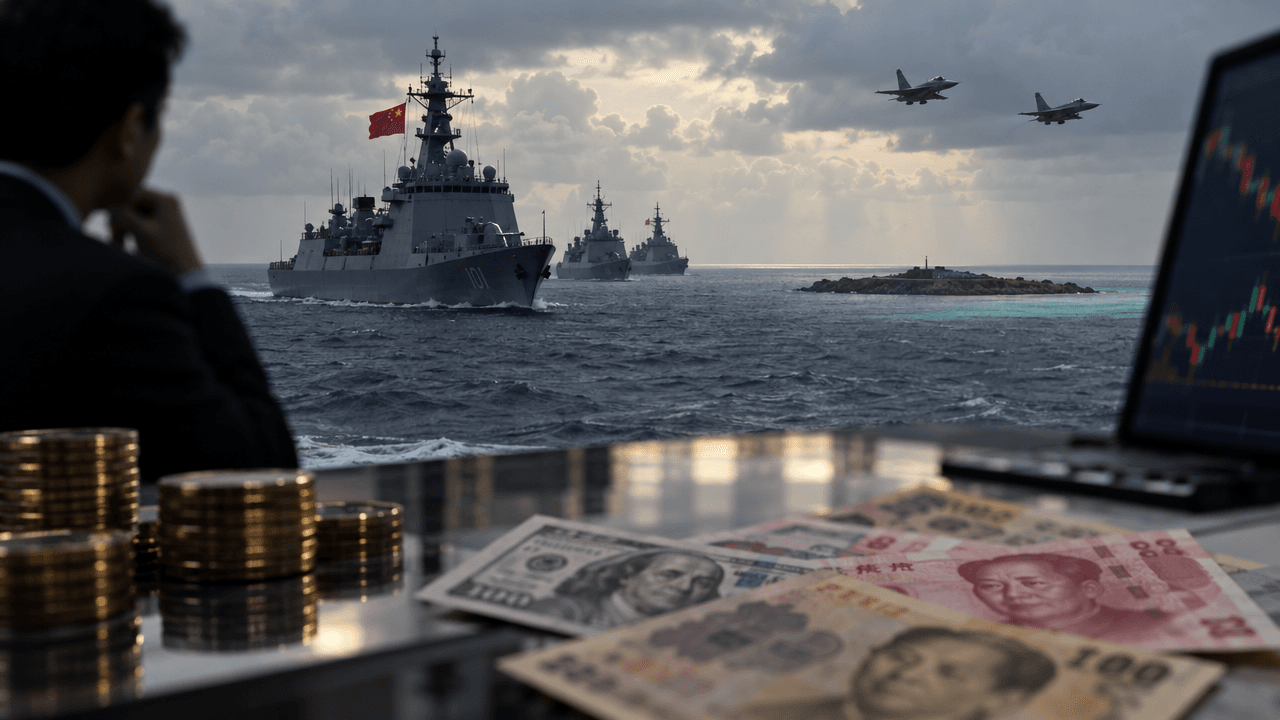
China’s latest joint naval and air exercises around Scarborough Shoal underline how quickly a local maritime dispute can evolve into a regional risk event with global market implications[1][3][5]. For traders watching Asian currencies, regional equities, energy, and safe-haven assets, this development is another reminder that geopolitics remains a critical driver of short-term volatility and medium-term risk pricing.
Geopolitical Flashpoint: What Is At Stake
Scarborough Shoal is a small but strategically significant feature in the South China Sea, claimed by both China and the Philippines and lying close to key regional shipping lanes[1][2][3]. China refers to the area as Huangyan Dao, while the Philippines calls it Panatag or Bajo de Masinloc, reflecting deeply entrenched sovereignty positions on both sides[2][3][12]. The shoal has been a recurring source of tension since at least 2012, with coast guard standoffs, fishing rights disputes, and periodic confrontations involving vessels from both countries[4][8][9][15].
China’s military has now conducted joint naval and air training exercises in the waters and airspace surrounding Scarborough Shoal, framed as efforts to safeguard territorial sovereignty and maritime rights[3][5][6]. The People’s Liberation Army Southern Theater Command described the drills as combat readiness training, aimed at enhancing capabilities against perceived threats from “certain countries” that it claims are undermining regional stability[5][6][10]. Parallel statements from China’s coast guard have referenced law-enforcement patrols, including boarding operations, interdiction, and forced towing, underscoring a more assertive posture at sea[4][8][9].
What The Latest Drills Signal
Reports indicate that the exercises tested the ability to coordinate air and sea operations and deploy rapid reinforcements around the shoal[2][10][12]. This suggests a focus not just on deterrence, but on operational readiness for sustained maritime and aerial presence in contested waters[1][3][10]. By staging drills in what it calls its territorial sea and airspace, China is reinforcing its narrative of “indisputable sovereignty” while physically demonstrating control around the feature[1][8][15].
For the Philippines, these activities come amid warnings that its security and maritime rights remain under threat despite broader U.S.–China efforts to manage tensions[8][15]. Manila has repeatedly protested Chinese structures and patrols in the area, urging their removal and citing the 2016 arbitral ruling that rejected extensive Chinese claims in the South China Sea[4][8][15]. While both sides have avoided open military conflict, the pattern of drills, patrols, and confrontations raises the risk of an incident that could draw in allies and elevate geopolitical risk premia across Asian assets.
Market Channels: How Risk Flows Into Prices
Geopolitical events of this kind typically transmit to markets through several channels: currency risk premia, equity sentiment, energy pricing, and safe-haven flows. In foreign exchange, traders often express geopolitical concerns via higher implied volatility in regional pairs such as USD/CNH, USD/JPY, and USD/SGD, and through risk-off positioning in emerging Asian currencies. Heightened tensions in the South China Sea can push investors to demand higher yields or discounts to hold risk-sensitive assets tied to the region.
Asian equity markets, particularly in sectors exposed to trade, shipping, and defense, are vulnerable to swings in sentiment when headlines suggest potential escalation. Maritime disputes near key sea lanes can add perceived tail risk to supply chains, even if actual disruptions remain unlikely in the short term, prompting portfolio de-risking. At the same time, defense-related names and cybersecurity firms sometimes see tactical inflows as investors look for hedges aligned with geopolitical themes.
Energy markets are another key conduit. While Scarborough Shoal itself is not a major energy hub, any tension in the South China Sea raises questions about the security of sea lanes used for oil and gas shipments. Traders may price in small risk premia on crude and LNG benchmarks, particularly if rhetoric begins to reference blockades, “grey-zone” tactics, or more aggressive naval deployments. Safe-haven assets such as gold, the U.S. dollar, and long-dated U.S. Treasuries often benefit from risk-off flows in scenarios where regional conflict probabilities are perceived to rise.
Trading Implications And Practical Risk Management
For active traders, the immediate implications revolve around gap risk when markets reopen, headline sensitivity, and the possibility of regime shifts in volatility. Short-dated options structures on Asian FX and indices can reprice quickly if investors anticipate further drills, diplomatic protests, or sanctions threats. These moves may be amplified by algorithmic trading strategies that react to news feeds and social media signals referencing “escalation” or “confrontation.”
Practical steps for risk management include stress-testing portfolios for spikes in volatility and sudden moves in correlation between Asian risk assets and global safe havens. Traders can model scenarios in which regional equities drop a few percent, Asian currencies weaken, and gold rallies modestly, then assess margin impact and liquidity needs. Adjusting position sizing, using options for downside protection, and avoiding excessive leverage into event risk windows are all sensible responses.
For discretionary traders, maintaining a structured “geopolitics playbook” is increasingly important. This should map specific events—such as military drills, legal rulings, or sanctions announcements—to expected moves in key instruments and levels where positioning would be adjusted. Having that framework in place before headlines hit reduces emotional decision-making and helps distinguish noise from genuine regime change.
Using Simulated Finance To Prepare For Geopolitical Shocks
Simulated finance (SimFi) environments provide a controlled way to rehearse trading responses to geopolitical events like the Scarborough Shoal drills without risking capital. Traders can run scenario-based simulations where news of new exercises triggers shifts in implied volatility, index levels, and FX rates, then test how their strategies perform. This is especially valuable for newer participants who may not yet have lived through significant geopolitical stress episodes.
In a SimFi setting, traders can experiment with different hedging approaches—such as buying volatility, rotating into defensives, or using spread trades between regional and global indices—and compare outcomes across multiple simulated stress paths. They can also practise reading and prioritising news flow, distinguishing between routine drills and developments that genuinely alter the probability of conflict or policy change. Over time, this builds the muscle memory needed to respond calmly and systematically when real-world headlines break.
Conclusion: Turning Geopolitical Risk Into Structured Insight
China’s exercises around Scarborough Shoal are part of a broader pattern of South China Sea activity that keeps geopolitical risk firmly embedded in the pricing of Asian assets[1][3][5][10][14]. For traders, the challenge is less about predicting political decisions and more about understanding how such events filter into currencies, equities, energy, and safe havens. By building scenario frameworks, reinforcing risk discipline, and using simulated environments to practise responses, market participants can transform episodic geopolitical shocks into manageable, structured sources of risk and opportunity.