
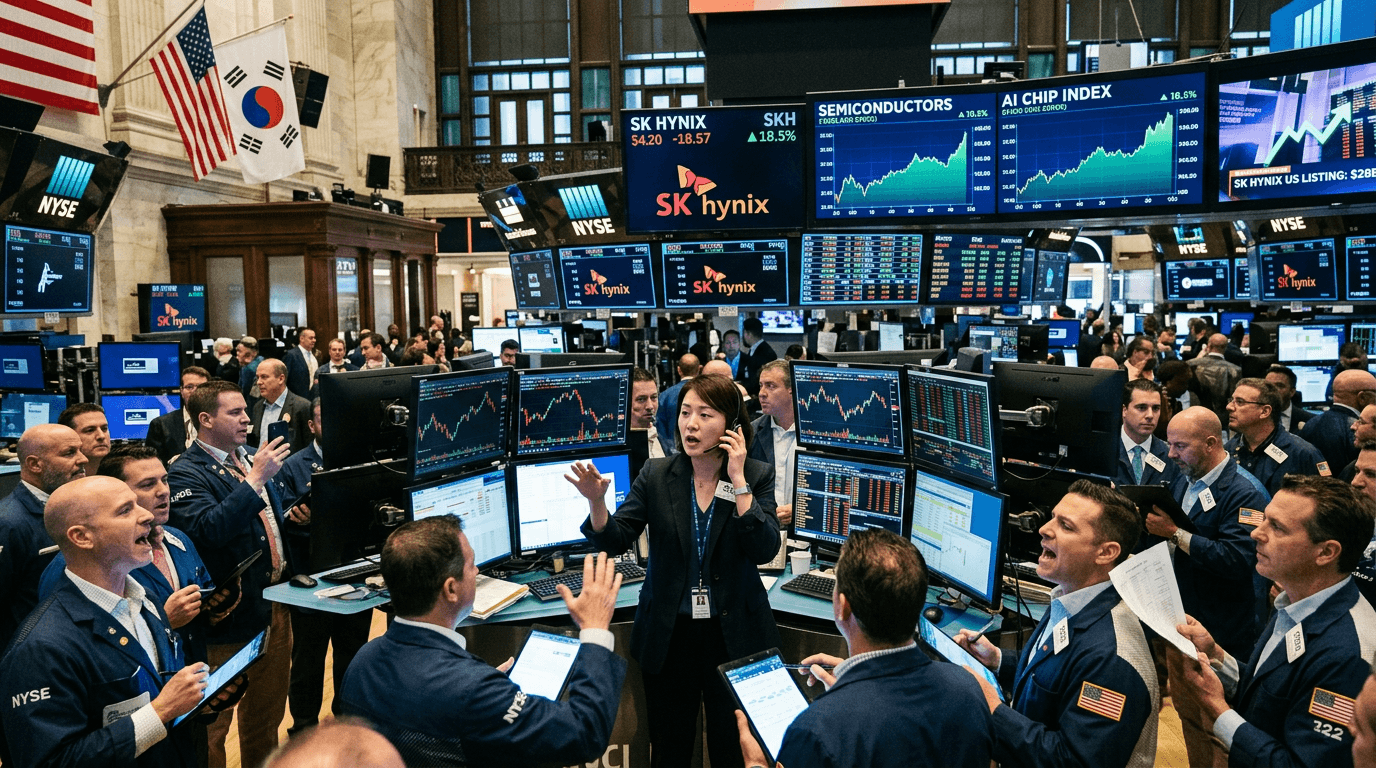
The oversubscription of SK Hynix’s planned $28 billion US listing is more than a single-company milestone; it is a real-time signal of how investors are repricing the entire AI‑chip ecosystem. Demand reportedly running multiple times above the available shares shows that institutional capital still wants more exposure to the hardware powering generative AI, even after a multi‑year rally in semiconductors.
Ai-chip Ipos Enter A New Phase
For years, AI equity stories were dominated by hyperscalers and GPU designers. SK Hynix’s American Depositary Receipt (ADR) deal marks a shift toward what many investors view as the “picks-and-shovels” layer of the AI boom: memory and infrastructure.
With an expected raise of roughly $28 billion, the Nasdaq listing ranks among the largest global equity sales of the decade and is set to be one of the biggest US debuts by a foreign issuer, behind only SpaceX’s recent IPO. Oversubscription forced underwriters to close the book early, a telling sign that demand for AI‑linked exposure is far from saturated.
This scale matters because mega-IPOs tend to become benchmark holdings in both active and passive portfolios. Once SK Hynix trades in the US, global managers who benchmark against major tech and chip indices will be pressured to decide quickly whether to include the new ADR in their AI baskets, potentially reshuffling flows around existing leaders.
Sk Hynix As A Pure Play On Ai Memory
SK Hynix is not just another chip name; it is a leading supplier of high‑bandwidth memory (HBM), the stacked DRAM used in virtually every major AI accelerator. HBM capacity has struggled to keep up with demand from GPU vendors and cloud providers, resulting in shortages and giving suppliers unusual pricing power.
By listing directly in the US, SK Hynix is providing global investors with a cleaner, more targeted way to express a view on AI memory than owning broad Korean equity exposure. The ADR structure (with multiple ADSs representing one Seoul‑listed share) allows US‑based funds to trade the name without dealing with foreign market frictions.
Another factor driving enthusiasm is valuation. Analysts have noted that SK Hynix’s implied earnings multiple, based on its Seoul listing, is materially lower than US peers like Micron, despite exposure to the same HBM upcycle. For investors worried they “missed” the AI rally in GPUs, a discounted memory leader linked to AI workloads looks compelling.
Cornerstone interest from long‑term growth managers and tech‑focused hedge funds reinforces this narrative. Institutional buyers are effectively signaling that they see the HBM crunch as a multi‑year theme, not a short‑term dislocation.
How Global Equity Flows Are Shifting
A $28 billion oversubscribed deal does not happen in isolation; it pulls capital from somewhere. Ahead of pricing, several flow dynamics are likely:
First, Korean equity flows can temporarily bifurcate. Domestic and global investors who previously accessed SK Hynix only via the Seoul listing now have to decide whether to rotate part of that exposure into the US ADR. In practice, that can mean selling or underweighting the local share to participate in the US bookbuild.
Second, US tech benchmarks may see pre‑emptive repositioning. Portfolio managers anticipating the ADR’s eventual inclusion in major indices may trim marginal AI names to create room for SK Hynix, especially in concentrated strategies. That can dampen momentum in smaller AI beneficiaries while supporting liquidity in large‑cap chip stocks that serve as funding sources.
Third, ADR markets broadly benefit. An oversubscribed, high‑profile foreign listing strengthens the case for US ADRs as the preferred access route to global tech stories. That can attract more capital into existing Asian chip ADRs and encourage other hardware vendors to consider similar deals, reinforcing the US as the central venue for AI‑chip trade.
For traders, these flow shifts can create relative‑value opportunities. Spread relationships between SK Hynix’s Seoul line and the US ADR, or between SK Hynix and peers like Micron and Samsung, may temporarily dislocate as different investor bases rebalance.
Implications For Index Futures And Derivatives
Because SK Hynix sits at the intersection of Korean equities, US tech, and global semiconductor indices, its listing has direct implications for futures and derivatives traders.
Futures tied to chip and AI indices may see elevated basis volatility as index committees and large managers anticipate eventual inclusion. Traders who specialize in index arbitrage will watch how semiconductor baskets reweight around the listing, particularly if the ADR becomes a top‑10 constituent by market cap.
At the single‑stock level, options markets are likely to price in high uncertainty around initial trading as investors debate how sustainable HBM margins and AI demand will be. That can spill over into implied volatility in related names: GPU designers, other memory makers, and AI infrastructure ETFs.
For simulated trading environments, this kind of event is ideal for stress‑testing strategies. It compresses valuation debate, macro sentiment about AI, and real‑world liquidity dynamics into a tight timeframe around pricing and first trade.
Practical Takeaways For Traders And Simfi Users
For traders and SimFi participants, SK Hynix’s US IPO offers several actionable lessons:
1) Follow the capital, not just the headlines. Oversubscription tells you that real money wants AI‑chip exposure, but you need to see where that money is being sourced. Track relative performance across Korean indices, US semiconductor benchmarks, and AI‑themed ETFs before and after pricing to understand the rotation.
2) Watch valuation convergence. If SK Hynix’s US ADR initially trades at a discount or premium to its Seoul listing or to peers like Micron, that spread is a potential trading edge. In simulation environments, you can model scenarios where valuation gaps close quickly versus slowly and see how different strategies perform.
3) Plan for volatility around key dates. Roadshow milestones, final pricing, and the first trading session often bring sudden swings. On a SimFi platform, you can rehearse how your portfolio or strategy would behave under rapid order‑book imbalances, wide bid‑ask spreads, and intraday halts.
4) Think beyond one stock. The bigger story is AI‑chip market structure: who controls critical components, how capacity ramps, and how antitrust or cyclical risks might change the narrative. Scenario‑testing memory price corrections, capacity expansions, or regulatory shocks can help you avoid over‑confidence in any single AI hardware theme.
For both beginners and experienced traders, this IPO is a case study in how a single, oversubscribed deal can rewire flows across borders, asset classes, and trading styles. Whether you are allocating capital in live markets or testing ideas in a simulated environment, paying attention to how AI‑chip optimism translates into concrete order flow can sharpen your edge in the next phase of the semiconductor cycle.