
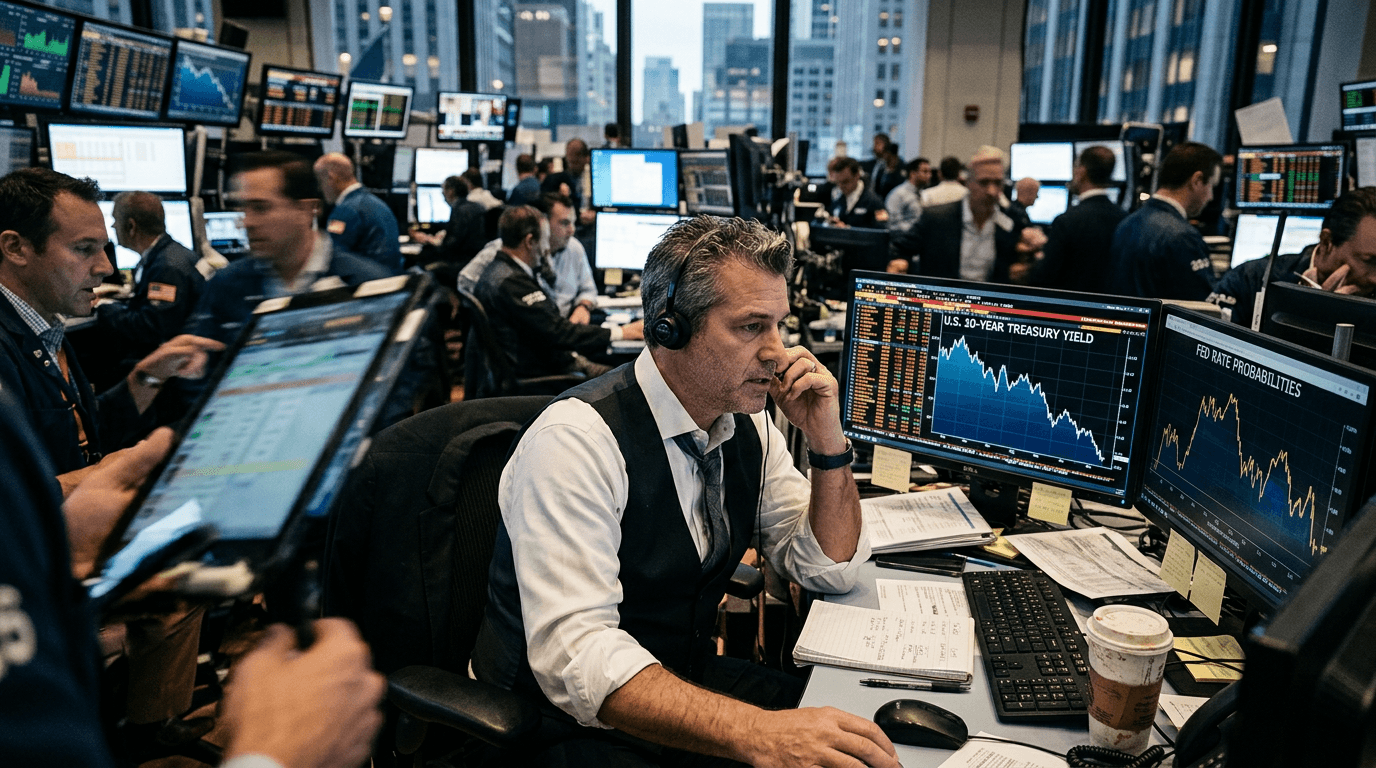
Treasury markets are in a reflective mood after a softer-than-expected U.S. payrolls report nudged yields off recent highs and prompted traders to reassess how aggressive the Federal Reserve will be on future rate moves. Softer labor data has taken some heat out of the “higher-for-longer” narrative, leaving the dollar’s earlier rally to consolidate and putting upcoming Fed minutes firmly in focus as markets search for clearer guidance on the rate path.
SOFT PAYROLLS COOL U.S. YIELDS
To understand why a weak jobs print pulls Treasury yields lower, it helps to recall what usually happens when payrolls surprise on the upside. Historically, stronger-than-expected nonfarm payrolls have pushed longer-term yields higher as investors price in a more resilient economy and a Fed that can keep policy tight for longer.[2][6] In past episodes, a solid beat on job creation has driven the 10-year yield up and prompted traders to reduce expectations for rate cuts.[2][3][6]
The opposite dynamic tends to unfold when payrolls disappoint. Underwhelming employment figures increase concerns about slower growth or even recession, making safer assets like Treasuries more attractive.[5] As investors rotate away from riskier equities and into government bonds, demand for Treasuries rises, pushing their prices higher and their yields lower.[5] Because bond coupons are fixed, a higher market price mechanically reduces the yield, which is calculated as interest payment divided by price.[5]
Weaker data can also dampen inflation expectations, another key driver of long-term rates.[5] If markets believe slower hiring will eventually cool wage growth and overall demand, they may anticipate less inflation pressure, which further boosts the appeal of longer-dated Treasuries and reinforces the move lower in yields.[5]
What Lower Yields Signal About The Fed
Moves in Treasury yields after payrolls are ultimately about the Fed’s reaction function. Strong job growth, especially when accompanied by low unemployment, supports the case for keeping policy restrictive and has historically been associated with higher yields as traders shave back expectations for cuts.[2][6] Research on employment surprises shows that nonfarm payrolls have often been positively correlated with changes in the 10-year yield, reflecting this link between jobs data and rate expectations.[6]
When the data turn soft, the calculus changes. A weaker labor market reduces the urgency to lean against inflation with aggressive hikes and can strengthen the case for a sooner or steeper easing cycle, particularly if inflation is already trending lower. That is why futures pricing often shifts “less hawkish” after disappointing payrolls, with fewer hikes or more cuts being priced into the forward curve.
This sets the stage for the upcoming Fed minutes to be a key event. Traders will parse the minutes for clues on how policymakers balance a cooling labor market against their inflation objectives, and whether the Committee views recent softness as a temporary wobble or the start of a more pronounced slowdown. Any language suggesting the Fed is more comfortable with the inflation trajectory, or more concerned about labor weakness, could validate the recent move lower in yields. Conversely, if the minutes emphasize upside inflation risks and downplay labor softness, markets may need to reprice in a more hawkish stance, pushing yields back higher.
Ripple Effects Across Fx, Equities And Futures
Treasury yields do not move in isolation; their shifts ripple across currencies, equity indices, and rate futures. For the dollar, lower yields typically narrow interest rate differentials versus other major economies, reducing the carry that has supported the currency. Episodes of softer yields and a softer dollar around key data or policy events are common, as seen when gold has rallied on declines in yields and a weakening dollar while markets watched U.S. jobs data.[8] In the current environment, the dollar’s previous rally is consolidating as traders reassess how much more policy support it can expect.
Equity markets face a nuanced trade-off. On one hand, lower yields are generally supportive for longer-duration assets such as growth and technology stocks, since discount rates fall and future earnings become more valuable. On the other hand, soft payrolls raise questions about the underlying strength of the economy and corporate profits. The net effect often depends on whether investors interpret the data as “Goldilocks” (cooling but not collapsing) or as an early warning of more serious weakness.
Rate futures sit at the center of the repricing. Shorter maturities, which are most sensitive to the Fed’s near-term decisions, can move sharply as traders adjust the timing and probability of cuts. Past strong payrolls have driven front-end yields such as the 2-year higher, as markets priced out some easing.[2] After a soft report, the reverse can happen: implied rates in futures drift lower, consistent with a Fed that may eventually pivot to a more accommodative stance. Longer-dated contracts adjust as investors reassess the entire path of policy over several years.
How Traders Can Navigate The Fed Minutes
For active traders and those honing their skills in simulated environments, this combination of soft payrolls and looming Fed minutes is a textbook macro event to study. A few practical focal points:
First, watch how the minutes frame the labor market. Does the Committee emphasize still-tight conditions, or does it acknowledge accumulating signs of cooling? Language here will inform whether the soft payrolls are viewed as noise or part of a trend.
Second, examine the discussion of inflation and financial conditions. If policymakers express confidence that inflation is converging toward target and highlight tighter financial conditions as doing some of the Fed’s work, that leans dovish relative to a minutes set that stresses persistent inflation pressures and the need to keep rates elevated.
Third, focus on any clues about the distribution of views within the Committee. A widening gap between hawks and doves can increase volatility as markets try to infer which camp will dominate future decisions. More unified messaging reduces uncertainty but can still shift the curve if the consensus has evolved.
In terms of trading strategy, this is an environment where scenario analysis is essential. One scenario is a hawkish surprise, where minutes push back against the market’s less-hawkish pricing, sending yields and the dollar higher and pressuring rate-sensitive equities. Another is a dovish tilt, which could extend the pullback in yields, weigh on the dollar, and support risk assets. Testing both outcomes through simulated trades in Treasuries, FX pairs, and index futures can help traders build intuition about how cross-asset relationships behave around major macro events.
Conclusion
Soft U.S. payrolls have given Treasury yields a reason to pause and retreat from recent highs, reminding markets that the path of monetary policy is inseparable from the health of the labor market.[5][6] As futures pricing nudges toward a less hawkish stance and the dollar’s rally consolidates, attention now turns to the Fed minutes for confirmation—or contradiction—of this shift.
For traders, the key is understanding how a single data point fits into the broader macro narrative. Payrolls influence yields, yields reshape FX and equity dynamics, and Fed communication ultimately anchors expectations. By studying these linkages and preparing for multiple outcomes around the minutes, market participants can better navigate the evolving rate path—and improve their ability to trade, whether with real capital or in a simulated environment designed to mirror these real-world dynamics.