
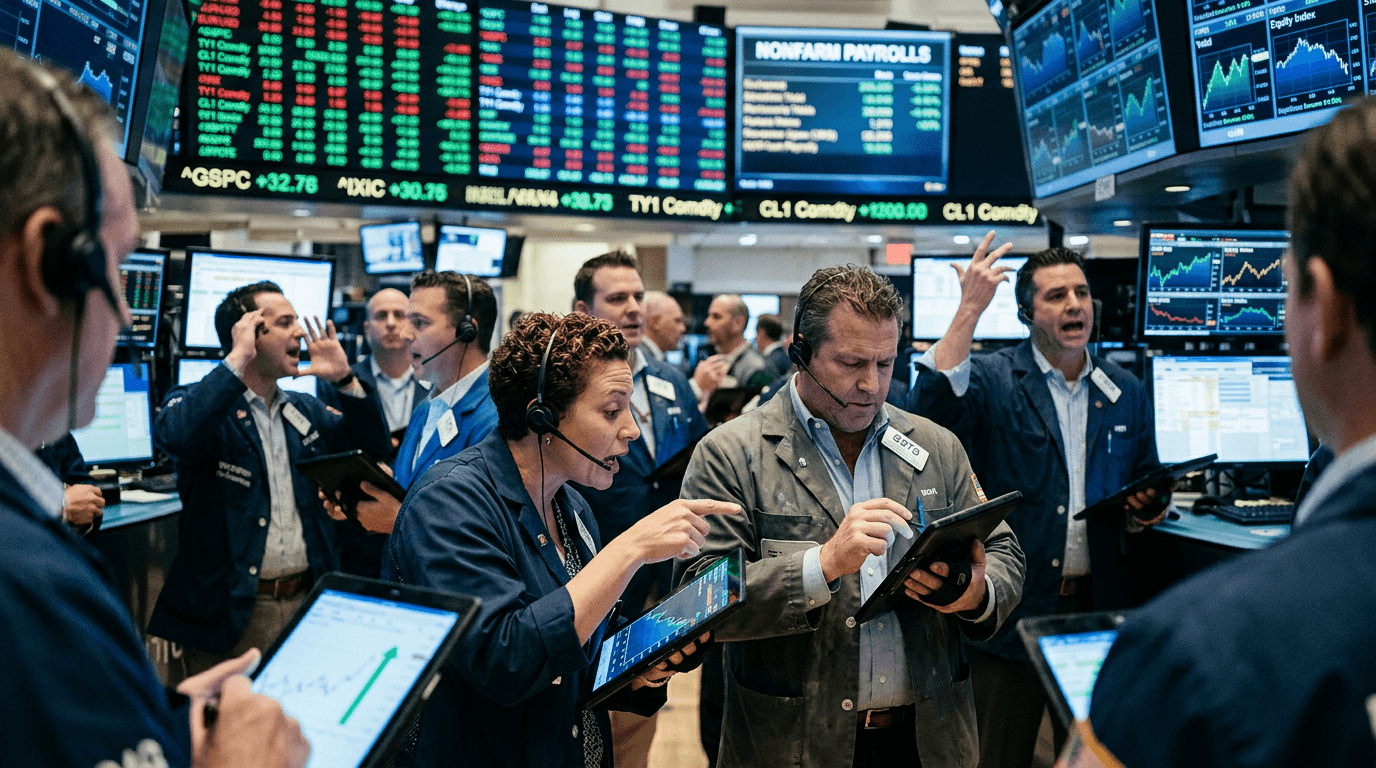
Markets were primed for another solid U.S. jobs report, but the latest nonfarm payrolls release fell well short of expectations, setting off a chain reaction across FX, rates, and equity futures. Softer hiring pushed the dollar index lower, lifted EUR/USD and GBP/USD, and led traders to price in a more dovish Federal Reserve path as rate‑cut bets for this year rose sharply.
What The Latest Jobs Numbers Tell Us
Nonfarm payrolls rose by roughly 57,000 jobs in June, a fraction of the prior month’s revised gain and well below consensus forecasts of around 110,000.[2][14] That gap between expectations and reality is what made this print “disappointing” from a market perspective, even though the economy is still adding jobs rather than shedding them.
The unemployment rate edged up to about 4.2%, signaling that labor market slack is slowly increasing after an extended period of very tight conditions.[14] Wage growth remains crucial, but the combination of slower job creation and a mild uptick in unemployment suggests demand for labor is cooling.
For traders, the key takeaway is not just the headline number, but the trend: after months of resilient employment gains, an unexpectedly weak print hints that the Fed’s aggressive tightening campaign is finally weighing more clearly on hiring. That shift in narrative is what drives repricing across asset classes.
Why A Soft Nfp Weakens The Dollar
Nonfarm payrolls are one of the most dollar‑sensitive data releases because they sit at the core of the Federal Reserve’s dual mandate: maximum employment and price stability.[15][19] Strong job growth typically supports higher interest rate expectations, which in turn boosts the dollar as global capital seeks higher yields in U.S. assets.
When payrolls undershoot forecasts by a wide margin, the opposite dynamic tends to unfold. With a weaker jobs print, traders see less need for restrictive policy and begin to price in earlier or deeper rate cuts. Lower expected U.S. yields reduce the dollar’s appeal relative to other currencies, pushing the dollar index (DXY) lower.
That is exactly what played out after this release: the dollar softened, while major pairs like EUR/USD and GBP/USD ticked higher as markets reassessed the Fed path.[2][17] In effect, disappointing jobs data narrowed interest rate differentials in favor of Europe and the UK, even if only modestly, and FX markets reacted accordingly.
Rate-cut Bets: How Markets Reprice The Fed Path
The most important downstream effect of a surprise NFP miss is how it reshapes expectations for the Fed’s next moves. Before the data, futures markets were leaning toward a “higher for longer” stance, with rate cuts seen as limited and pushed into the future. After the release, traders quickly increased the implied probability of one or more cuts this year.
Money market futures and OIS (overnight indexed swap) curves typically show this repricing in real time. A weak payrolls number leads to:
- Higher odds of an earlier first cut
- More cumulative cuts priced over the next 12–18 months
- Lower yields, especially at the front end of the Treasury curve
In this case, Treasury futures rallied as yields fell, reflecting the market’s view that the Fed can afford to ease sooner if the labor market is losing momentum.[2][14] For rate‑sensitive sectors and growth stocks, this can be supportive in the short term, even as it raises questions about the underlying strength of the economy.
Market Reaction Across Asset Classes
NFP rarely moves just one market. The latest release triggered a broad cross‑asset response:
- FX: The dollar index eased, while EUR/USD and GBP/USD moved higher as traders rotated out of the dollar and into currencies perceived to have relatively firmer rate paths in the near term.[2][17]
- Rates: Treasury futures rose, particularly in shorter maturities, pricing in lower future policy rates. This flattening or bull‑steepening of the curve is a classic “dovish data” signature.
- Equities: Index futures initially pushed higher on the prospect of easier policy—lower discount rates can justify higher valuations—though the sustainability of that move depends on whether investors read the data as “soft landing” or the start of something more worrying.
For active traders, the key is to track how these moves evolve across the session. FX often reacts within seconds of the release, while rates and equities can see secondary waves of positioning as analysts digest details like revisions and wage growth.
How Traders Can Navigate Nfp Surprises
Nonfarm payrolls days are high‑volatility environments where preparation matters as much as execution. A few practical principles can help traders turn data into opportunity rather than noise:
Know the consensus and the risk ranges Go into the release knowing the median forecast, the range of analyst expectations, and the recent trend. A miss of 20–30k jobs might be noise; a miss of 50k or more, especially against a strong prior month, is more likely to trigger repricing in FX and rates.[2][11]
Build scenarios, not a single prediction Instead of trying to “guess the number,” build scenarios: strong beat, in‑line, modest miss, and large miss. Map out expected reactions in DXY, EUR/USD, GBP/USD, front‑end Treasury yields, and equity index futures for each scenario. This reduces emotional decision‑making when the headline hits.
Focus on the narrative, not just the print Markets respond to what the data means for the trajectory of policy, not just the one‑month change in payrolls. If a weak print fits into an emerging pattern of slower employment growth and cooling inflation, it carries more weight for the Fed’s reaction function than a one‑off disappointment.
Practice in a risk‑free environment For newer traders, NFP is one of the hardest events to trade live because of speed and slippage. Simulated Finance platforms like E8 Markets allow traders to experience the volatility, test execution strategies, and refine risk management without putting capital at risk. That practice can make a critical difference when trading around real data.
Align position sizing with volatility Spread your risk across instruments and avoid oversized positions into the release. NFP can trigger sharp whipsaws, especially if revisions or wage data surprise in the opposite direction of the headline. Small, well‑hedged positions often survive the noise better than aggressive directional bets.
Conclusion
The latest U.S. nonfarm payrolls report delivered a clear message to markets: the labor engine that has powered the post‑pandemic expansion is cooling faster than expected. In response, the dollar weakened, rate‑cut expectations rose, and traders reassessed the Fed’s likely path across FX, rates, and equities.
For market participants, the opportunity lies in understanding how a single data point ripples through pricing, and in building robust frameworks and simulated experience to navigate that volatility. Whether the Fed ultimately delivers the cuts now being priced in will depend on the next few months of data—but with this NFP surprise, the balance of risks has shifted meaningfully toward a more dovish outlook.