
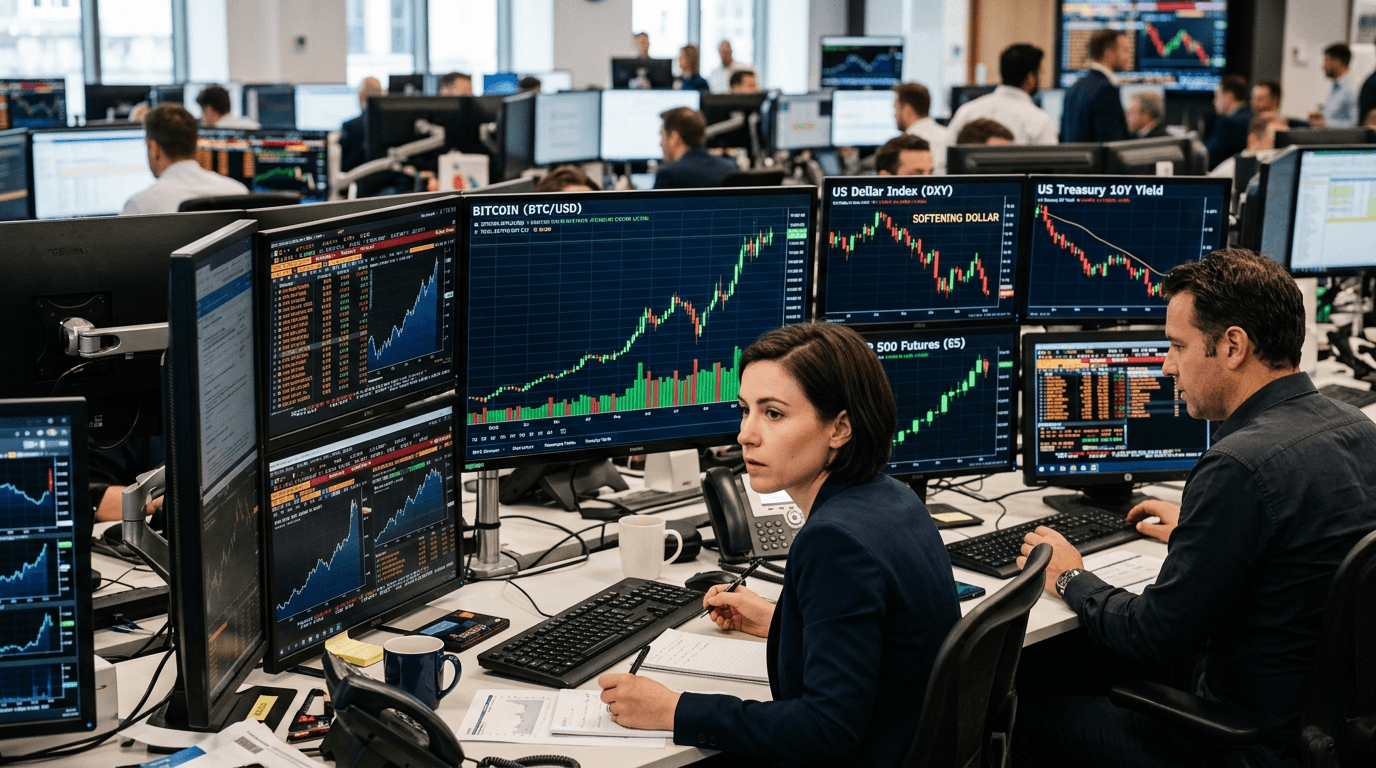
A softer U.S. dollar and a calmer Treasury market have given risk assets a welcome tailwind, with Bitcoin reclaiming key levels alongside a broader rebound in equities and other pro‑growth trades.[1][8][13] For active traders, this shift is less about a single rally and more about how currency moves, bond yields, and policy decisions reset the playing field across forex, equity futures, and crypto.[9][11][14]
Macro Backdrop: Softer Dollar, Calmer Bonds
The immediate catalyst has been the U.S. Treasury’s decision to expand its buyback program for long‑dated government bonds, effectively doubling the size of liquidity support operations from around $2 billion to at least $4 billion per auction.[2][3][9] By stepping in as a larger buyer of 10‑ to 30‑year Treasuries, authorities have helped pull long‑term yields down from multi‑decade highs that were unsettling global markets.[6][9][15]
As yields retreated from a 19‑year peak above roughly 5.3% on the 30‑year to closer to 5.2%, bond volatility cooled and stress in the Treasury market eased.[9][13][15] That stabilization, even if partial and temporary, is crucial because Treasuries sit at the core of global pricing for everything from mortgages to corporate credit spreads.
At the same time, the U.S. dollar has softened as buyback news and easing safe‑haven demand reduced demand for dollar assets.[1][11][14] The dollar index slipped toward multi‑month lows, reflecting both lower long‑end yields and a modest shift toward risk‑on positioning.[11][13][14] When the dollar weakens while yields stop spiking higher, it creates a more forgiving backdrop for risk assets globally.
Why This Matters For Risk Assets And Crypto
Historically, high and rising real yields plus a strong dollar are a tough combination for stocks, emerging markets, and crypto.[14] Elevated yields raise the discount rate applied to future cash flows and speculative narratives, while a firm dollar tightens global liquidity and pressures dollar‑funded borrowers.
The recent shift reverses part of that pressure. With long‑term yields off their extremes and the dollar under modest downside pressure, risk assets have responded quickly.[9][13][14] Bitcoin has moved back above key round numbers, with spot prices pushing through the 70,000 area and, at times, trading north of 80,000 as momentum returned to the sector.[1][8][13] Gold has rallied alongside Bitcoin, signaling a renewed “hard asset” or “debasement” trade, where investors hedge perceived fiscal and currency risks by rotating into scarce assets.[5][7][10]
That pairing of rising Bitcoin and gold, still‑elevated but stabilizing yields, and a softer dollar points to growing concern about the long‑term fiscal path and purchasing power of fiat currencies.[5][7] It is less about exuberant growth expectations and more about investors seeking alternatives to traditional stores of value and duration risk. For crypto traders, this is a powerful narrative driver because it reframes Bitcoin not just as a risk asset, but as a macro hedge within a broader portfolio.[5][8]
Trading Implications Across Forex, Equity Futures, And Crypto
For forex traders, a softer dollar in the context of Treasury support often favors high‑beta and carry currencies versus the U.S. dollar, especially where local inflation expectations are contained.[11][14] Pairs like EUR/USD or AUD/USD may become more sensitive to incremental data on inflation and growth, as traders gauge whether the dollar’s pullback is a short‑term positioning adjustment or the start of a more durable trend.
In equity futures, lower long‑term yields typically support growth and tech sectors that are more sensitive to discount‑rate assumptions, as well as high‑quality cyclicals tied to the global cycle. Stabilizing bond markets reduce the odds of a disorderly “VaR shock” where leveraged investors are forced to de‑risk aggressively, which in turn helps index futures hold key support levels.[4][6][15]
In crypto, liquidity and sentiment are paramount. Bitcoin’s 20%‑plus weekly gains during periods of dollar softness and bond‑market support highlight how quickly capital rotates back into the space when macro headwinds ease.[1][5][13] Altcoins and DeFi tokens often lag initially but can outperform later as traders reach further out on the risk curve once Bitcoin’s move looks more established.
Practical takeaways for active traders include
1) Track long‑term yields and the dollar index together; a falling dollar plus stable or easing yields is typically supportive for crypto and high‑beta equities.[9][11][14] 2) Use key Bitcoin levels (round numbers and prior highs) as risk markers for broader crypto sentiment.[1][8][13] 3) Align forex and equity futures positioning with the dominant macro theme—whether the market is trading “debasement/hedge” or “growth/reflation.”[5][7][10]
USING SIMULATED MARKETS TO PRACTICE MACRO‑DRIVEN STRATEGIES
In a macro‑sensitive tape like this, execution and risk management matter as much as the trade idea. Simulated finance (SimFi) environments allow traders to stress‑test strategies that link bond yields, the dollar, and crypto without risking real capital.
Traders can, for example, design and practice:
- A correlation‑based strategy that goes long Bitcoin and gold when the dollar index breaks below a key moving average and 10‑year yields move lower on policy headlines.
- A cross‑asset mean‑reversion setup that fades extreme spread moves between Bitcoin and high‑beta tech futures, anchored on changes in long‑term yields.
- A volatility‑adjusted position sizing framework that automatically scales crypto exposure up or down based on realized Treasury and FX volatility.
By rehearsing these ideas in a simulated environment, traders can refine entry rules, stop‑loss placement, and position‑sizing logic before deploying similar structures in live markets. This is especially useful when macro catalysts, such as bond‑market interventions or policy signals, can trigger rapid repricing across asset classes.
Key Risks And Scenarios To Watch
While the current mix of a softer dollar and bond‑market support is constructive for risk assets, it is not risk‑free. Treasury buybacks can calm markets tactically, but they do not fully resolve concerns about U.S. fiscal sustainability or long‑term inflation credibility.[2][6] If investors perceive the measures as a stopgap rather than a durable solution, yields could resume climbing, potentially in a more disorderly fashion.[2][4][6]
Several scenarios deserve close attention
1) Re‑acceleration in inflation data that forces markets to reprice the path of policy rates higher, pushing real yields and the dollar up again. 2) Signs that Treasury support is scaled back or ineffective, leading to renewed volatility in long‑dated bonds and cross‑asset de‑risking.[4][6] 3) A shift in narrative from “debasement hedge” to “growth scare,” where weaker data and rising unemployment start to pressure both risk assets and cyclical commodities, even if yields fall.
For traders, staying flexible is key. A macro backdrop that currently supports Bitcoin and other risk assets can flip quickly if either inflation or fiscal worries dominate the narrative. Scenario planning, tested and refined in SimFi, helps traders map out how portfolios might behave under different combinations of yields, dollar strength, and risk sentiment.
Conclusion
The combination of a softer U.S. dollar and bond‑market stabilization has opened a more supportive window for risk assets, with Bitcoin and gold at the center of a renewed hard‑asset narrative.[1][5][7][13] Treasury buybacks have eased immediate pressure in long‑dated bonds, pulled yields back from extremes, and encouraged a shift toward risk‑on positioning across global markets.[2][9][11][15]
For traders in forex, equity futures, and crypto, the lesson is clear: macro conditions are not background noise—they are the framework within which every trade lives or dies. Understanding how policy actions ripple through yields, currencies, and digital assets, and practicing those linkages in a simulated environment, can be a powerful edge the next time the dollar swings or the bond market flashes stress.