
The U.S. dollar’s latest pullback is a textbook example of how macro data can quickly reshape currency trends, rate expectations, and trading opportunities. Softer U.S. inflation has taken some heat out of the Federal Reserve’s policy outlook, pushing the dollar toward a one‑month low and breathing life into risk assets across FX and futures tied to U.S. rates.[2][12] For traders, understanding this dynamic is essential to navigating the next phase of the cycle.
What The Latest Inflation Data Shows
June’s inflation data signaled a meaningful cooling in price pressures, both on the consumer and producer side.[2][12] U.S. consumer inflation slowed to 3.5% year‑on‑year in June, down from 4.2% in May and below market forecasts of 3.8%.[12][11] That is the first annual slowdown in five months and marks a clear step down from the recent peak in price growth.[12]
On a month‑on‑month basis, headline CPI fell by 0.4%, the first decline since April 2020, largely driven by falling energy and gasoline prices.[2][12] Energy costs dropped 5.7% on the month, with gasoline down 9.7%, offsetting modest increases in shelter and food.[12] Beneath the headline figure, core inflation – which strips out volatile food and energy – eased to 2.6% year‑on‑year from 2.9%, also below expectations.[12]
Producer prices told a similar story. The Producer Price Index (PPI) for final demand fell 0.3% in June after a revised 0.6% increase in May, reinforcing the picture of easing pipeline inflation pressures.[2] Taken together, these prints suggest that the inflation scare which had worried markets earlier in the year is losing momentum.[2][12]
Why A Softer Inflation Print Weighs On The Dollar
For the dollar, inflation matters primarily because it shapes the Fed’s reaction function. Hotter inflation tends to push rate expectations higher, making U.S. yields more attractive and supporting the currency. Softer inflation does the opposite: it reduces the perceived need for further tightening and can eventually pave the way toward a more neutral or even accommodative stance.[2][12]
After the latest CPI and PPI data, markets increasingly believe the Fed can remain patient on additional rate hikes.[2] A Reuters poll already shows a strong majority of economists expecting the Fed to hold its key rate unchanged for the rest of 2026.[3] With inflation now moving closer to the Fed’s comfort zone, there is less justification for another round of aggressive tightening.
This shift in expectations has been visible in the dollar index, which tracks the currency against six major peers. The index softened to around 100.79, and recently posted its biggest daily decline in nearly two weeks after hitting its highest level since early July.[2] The euro stabilized near $1.14, sterling gained toward $1.34, and dollar‑yen held around 162, illustrating a broad but measured easing in dollar strength rather than a disorderly sell‑off.[2]
As U.S. yields and rate‑hike bets drift lower, investors have more incentive to rotate into higher‑yielding or more cyclical currencies and to add exposure to risk assets more broadly.[2][7] That rotation naturally caps the dollar’s upside and can keep it hovering near local lows as long as the data narrative remains supportive.
Implications For Fx And Rate Futures Traders
For FX traders, the key takeaway is that macro narratives around inflation and policy can quickly flip the dominant theme in currency markets. During periods of persistent inflation and hawkish Fed rhetoric, “strong dollar” trades – long USD against low‑yielders – tend to outperform. When inflation cools and the Fed appears comfortable staying on hold, those trades can lose momentum or even reverse.[2][3][12]
In practical terms, this environment tends to favor:
- Relative‑value trades, such as long euro or sterling versus the dollar, when European or UK data are stable and U.S. inflation is soft.[2]
- Selective carry trades, where investors seek yield in currencies backed by central banks that are less dovish than the Fed, or whose rate‑cut cycles are expected to be slower.
- More active use of options, as traders hedge the risk that a single data surprise – for example, a hotter‑than‑expected next CPI print – could snap the dollar back higher.
Rate futures traders see the impact even more directly. Softer inflation typically leads to lower implied probabilities of future hikes and can pull forward expectations for eventual cuts, even if the Fed’s official communication remains cautious.[2][3] Positioning in fed funds futures and Treasury futures will often adjust quickly to new inflation data, creating short‑term opportunities around data releases and Fed meetings.
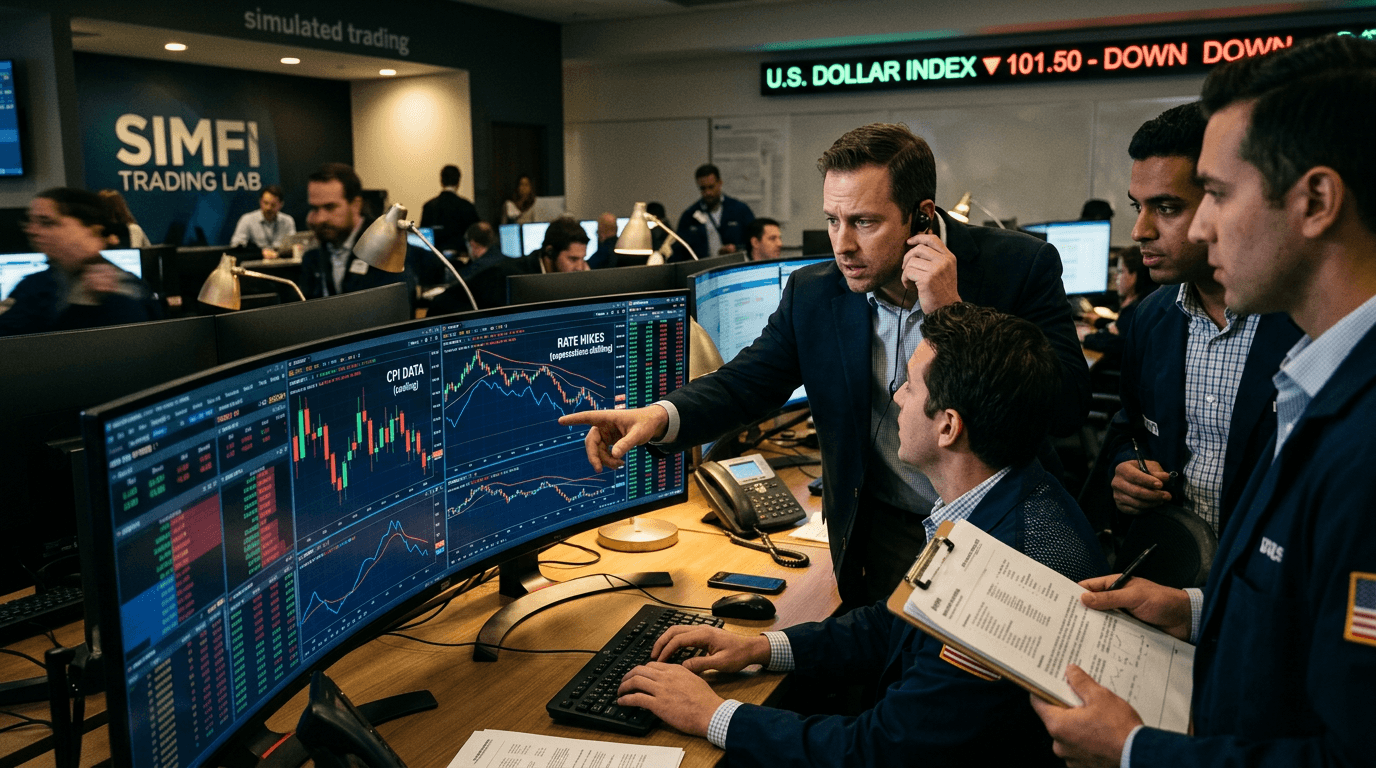
For those trading in a simulated environment, this is an ideal case study in how a single data point interacts with expectations, positioning, and price action.
HOW SIMULATED FINANCE TRADERS CAN TURN THIS INTO A LEARNING OPPORTUNITY
On a SimFi platform, traders can use this episode to build and test macro‑driven strategies without capital at risk. The goal is not merely to predict the next inflation print, but to understand how different scenarios might affect the dollar, yields, and cross‑asset correlations.[12][2]
Here are three practical exercises
- Scenario building: Construct at least three inflation paths (continued cooling, stabilization, re‑acceleration) and map how you expect the dollar index, EUR/USD, and USD/JPY to react under each.[2][12]
- Policy mapping: Tie each scenario to a plausible Fed response using the economists’ consensus as a baseline – for example, rates on hold through year‑end unless inflation meaningfully re‑accelerates.[3]
- Strategy testing: Backtest simple rules, such as “buy dollar on upside inflation surprise; sell dollar on downside surprise,” using historical CPI/PPI releases to see how often the logic holds and where it breaks down.[2][8]
Because SimFi allows rapid iteration, traders can refine these frameworks over time, learning how to integrate data releases, central‑bank communication, and market reactions into a coherent trading approach.
What To Watch Next
Softer inflation has eased immediate pressure on the dollar, but the story is far from over. Inflation is still above the Fed’s longer‑run 2% target, and energy prices remain sensitive to geopolitical developments, meaning future prints can surprise in either direction.[12] Markets are now finely tuned to every major macro release – from the next CPI and PPI reports to labor market data and Fed speeches – for confirmation that the disinflation trend is durable.[2][12]
For traders, the most important discipline is to stay data‑dependent rather than narrative‑dependent. When inflation cools, it is tempting to extrapolate a straight line lower and position aggressively against the dollar. History suggests that inflation paths are often bumpy, and central banks may react asymmetrically to upside versus downside surprises.
By tracking how each new data point shifts rate expectations, yield curves, and FX levels – in live or simulated markets – traders can turn episodes like the current dollar dip into structured learning experiences. The dollar hovering near a one‑month low is not just a headline; it is a real‑time lesson in how macro fundamentals, monetary policy, and market psychology intersect.