
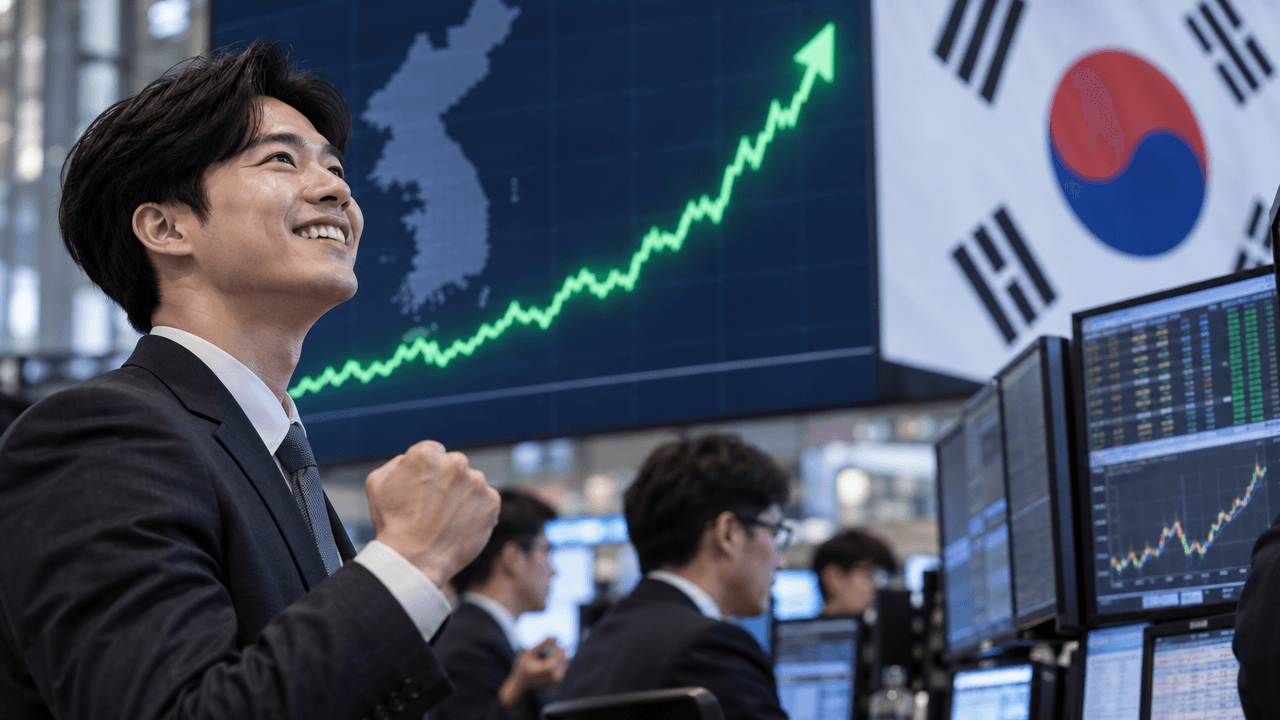
South Korean stocks staged a powerful rebound on Wednesday as semiconductor exporters and technology companies regained investor support. The KOSPI rose more than 3% after falling to a six-month closing low in the previous session, highlighting how quickly sentiment can shift in markets tied closely to artificial intelligence investment. The rally was supported by strong semiconductor export figures, renewed confidence in AI infrastructure demand, and better-than-expected results from a major U.S. AI server maker. [1][2]
The move offers an important lesson for traders: a sharp selloff does not always signal a lasting change in market fundamentals. In sectors driven by powerful long-term themes, such as semiconductors and cloud computing, prices can reverse rapidly when new evidence reduces fears about slowing demand.
The Rebound In Context
The KOSPI had suffered a steep decline during the prior session as investors questioned whether enormous spending on AI data centers could continue at its current pace. Concerns focused on the gap between the scale of technology companies’ infrastructure investments and the speed at which those investments might produce revenue and profits.
On Wednesday, however, the benchmark index recovered strongly. Reports showed the KOSPI gaining 3.03% during the rebound, while later trading data indicated a 3.29% advance to close at 5,735.66. The rally was significant enough for the Korea Exchange to activate a buy-side sidecar, temporarily pausing program buying after KOSPI 200 futures rose more than 5%. [1][2]
A sidecar is a market-stabilization mechanism designed to temporarily slow automated trading when futures prices move sharply. Its activation does not guarantee that an uptrend will continue, but it demonstrates the intensity of the buying response and the degree to which semiconductor shares influenced the broader market.
Why Semiconductors Led The Rally
South Korea is home to two of the world’s most important memory-chip manufacturers, Samsung Electronics and SK hynix. Their products are essential to smartphones, computers, servers, and increasingly sophisticated AI systems. As companies build larger data centers, demand for high-performance memory and related components has become a central part of the AI investment story.
The latest export data reinforced that story. South Korea’s exports more than doubled year over year during the first 20 days of October, reaching $61.6 billion, while semiconductor shipments jumped 222.5%. The figures offered fresh evidence that global AI infrastructure spending is translating into real demand for Korean technology products. [5][11]
Samsung Electronics shares rose 5.67%, while SK hynix gained 5.81%, according to market reports. [12] Because these companies carry substantial weight in the KOSPI, their performance can influence the direction of the entire index. A rally in the largest chipmakers also tends to improve sentiment toward suppliers, equipment manufacturers, and technology shares across Asia.
Ai Optimism Returns
The rebound was not based solely on export data. Investor confidence also improved after better-than-expected earnings from U.S. AI server maker Super Micro Computer helped ease concerns about whether data-center spending was becoming excessive. The results suggested that demand for the equipment supporting AI applications may remain strong, at least for now. [2]
This distinction matters. Investors are not simply asking whether companies are spending money on AI. They are asking whether that spending is generating enough revenue, productivity, and competitive advantage to justify continued investment.
Positive earnings from companies directly exposed to AI infrastructure can temporarily answer that question in the market’s favor. They can also encourage investors to rotate back into chipmakers after a period of profit-taking. Still, optimism remains sensitive to upcoming results from major cloud and technology companies, whose capital expenditure plans will help determine whether the current investment cycle is sustainable.
Regional And Global Market Effects
South Korea’s rebound may provide a positive impulse for regional equity futures and technology shares. Asian markets are deeply connected through supply chains, and a recovery in Korean chipmakers can lift sentiment toward Japanese equipment producers, Taiwanese semiconductor companies, and other firms supplying the global technology industry.
U.S. equity-index futures also moved higher alongside Asian shares as strong technology earnings revived interest in the AI trade. [13] For traders, this creates a potential feedback loop: stronger technology shares improve risk appetite, improved risk appetite supports semiconductor stocks, and semiconductor gains reinforce expectations for continued AI investment.
However, correlation should not be confused with certainty. A strong session in Seoul does not eliminate concerns about valuation, interest rates, currency movements, or the possibility that technology companies could reduce capital spending. Investors should treat the rebound as evidence of renewed confidence, not proof that downside risks have disappeared.
Practical Takeaways For Traders
First, monitor confirmation rather than reacting to a single price surge. Follow semiconductor export data, company earnings, memory-chip pricing, and capital expenditure plans from major cloud providers.
Second, distinguish between index strength and market breadth. If only a few large chipmakers are rising, the rally may be more vulnerable than one supported by banks, industrial companies, consumer shares, and smaller technology firms.
Third, watch volatility around earnings announcements. AI-related stocks can move sharply when companies provide new guidance on demand, margins, or data-center investment.
Finally, manage exposure carefully after a large rebound. Buying into a fast-moving rally can create unfavorable risk if prices reverse. Defined entry levels, position sizing, and predetermined exit points are especially important in a market shaped by rapidly changing expectations.
South Korea’s stock-market rebound shows that the AI investment debate remains one of the most powerful forces in global equities. Strong exports and encouraging technology earnings have temporarily shifted the balance toward optimism, helping semiconductor shares recover and giving regional markets a lift.
The next test will be whether the data continues to support the narrative. If chip demand remains strong and AI infrastructure spending produces measurable returns, the rebound could develop into a broader recovery. If earnings fail to justify current investment levels, investors may quickly return to caution. For now, the message is clear: in semiconductor markets, fundamentals and sentiment can change direction quickly, and disciplined traders must track both.