
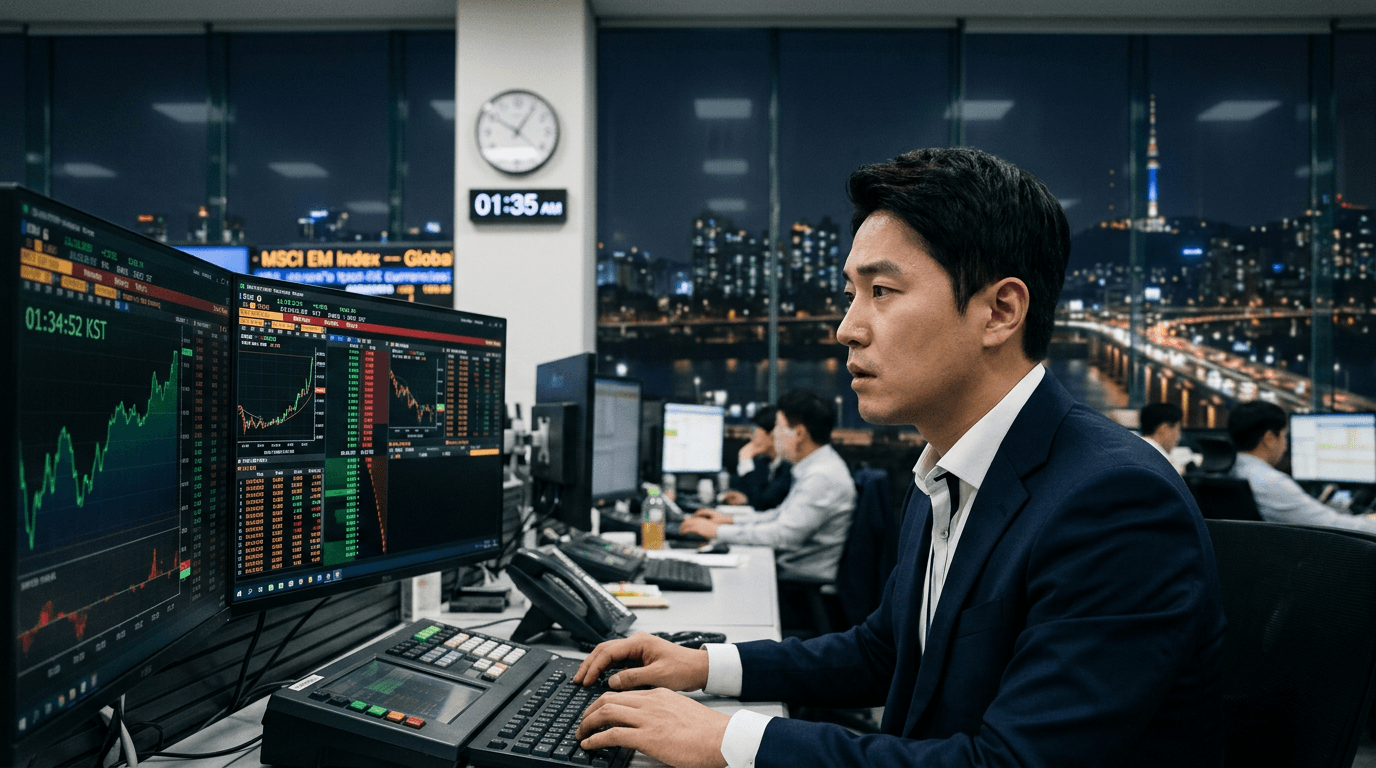
South Korea’s foreign exchange market has just taken a decisive step toward the global big leagues. By launching around-the-clock trading in the onshore won-dollar market, policymakers are reshaping how international investors access Korean assets and how traders will interact with Asia’s fourth-largest economy’s currency for years to come.[1][2] This is not just a tweak in trading hours; it is a structural reform designed to align Korea with developed-market norms and unlock new flows of capital.[1]
Globalising The Korean Won
Until now, onshore trading in the Korean won was tightly constrained, with the main session closing in the mid-afternoon local time and leaving global investors reliant on offshore non-deliverable forwards (NDFs) or limited liquidity windows.[4] The new regime changes that by allowing spot dollar-won trading to run almost continuously from 6 a.m. Monday to 6 a.m. Saturday local time, covering virtually the full global trading week.[2][4]
In practice, this means that major market centers like London and New York can now access the onshore won market during their own business hours, instead of being forced to operate within a narrow Asian window.[1] The overnight session will be supported by designated domestic lenders and registered international banks, ensuring that liquidity is not confined to Seoul-based dealers.[1] To complement the time extension, Korea has also eased market access requirements for foreign investors, lowering administrative barriers that previously discouraged some institutions from active participation.[1]
For the Korean authorities, the goal is clear: broaden currency convertibility, improve transparency, and demonstrate that the won can trade as freely as other major developed currencies.[2] For traders and asset managers, this opens the door to more flexible hedging, more responsive risk management, and potentially tighter pricing between onshore and offshore markets.
How 24-hour Onshore Trading Works
The new system effectively turns Korea’s FX market into a near 24/5 platform while still retaining some local safeguards.[2][4] Trading begins at 6 a.m. on Monday and runs uninterrupted through 6 a.m. on Saturday, with activity continuing even on public holidays, excluding weekends and New Year’s Day.[4] This mirrors the operational rhythm of major global FX centers, where currencies trade continuously across time zones.
The architecture behind the change matters as much as the headline. Overnight liquidity relies on a mix of local and global banks that are officially registered to participate in the domestic FX market.[1] In other words, the Korean authorities retain a controlled gatekeeping function, even as they open the door much wider.
At the same time, there is an enhanced monitoring effort on the official side. Reports from Sejong describe a dedicated room where finance ministry officials watch every tick in the won, tracking price swings and volumes to assess when intervention might be needed.[5][6] This is a reflection of Korea’s history: scarred by the 1997 Asian financial crisis, policymakers are determined to avoid excessive volatility even as they embrace a more open market.[6]
Early trading days under the new regime have reportedly seen below-average volumes, suggesting that market participants are still testing the waters and adapting to new workflows.[7] That is typical of structural shifts; the real impact tends to unfold over months and years, as habits, systems, and strategies adjust.
Why Developed-market Status Matters
The deeper motivation behind this FX reform is index inclusion. For years, MSCI has cited restrictions in Korea’s foreign exchange market as a key obstacle to reclassifying the country from emerging-market to developed-market status.[1] Long trading hours, easier access, and more transparent rules were among the measures encouraged to improve accessibility for international investors.[1]
An upgrade to MSCI’s Developed Markets Index would be more than symbolic. It could trigger significant passive and active inflows from global funds that track or benchmark against developed-market indices. That, in turn, would deepen liquidity across Korean equities, bonds, and derivatives, potentially lowering funding costs for Korean corporates and the government.
From a portfolio construction perspective, reclassification can force a reshuffling of weights in global portfolios. Emerging-market funds might gradually reduce Korea exposures, while developed-market mandates increase them. This transition usually plays out over time, but it can create meaningful demand for FX hedging and tactical position-taking as managers realign their benchmarks.
For the won itself, greater inclusion and accessibility mean it is likely to be more integrated into global risk-on and risk-off dynamics. The currency has recently traded at a 17-year low and was the worst performer in Asia in the first half of the year, highlighting how sensitive it can be to global growth concerns and capital flows.[5][6] A more open, liquid market may make those swings more transparent—and possibly more pronounced—in the short term, even if long-term liquidity and efficiency improve.
Implications For Fx Traders And Portfolio Flows
Around-the-clock onshore trading alters the playbook for both FX specialists and multi-asset investors. For traders, the most immediate impact is the ability to trade spot KRW in response to events as they happen, rather than waiting for the next Asian session. US data releases, European central bank decisions, or geopolitical headlines that historically moved the won via offshore instruments can now be expressed directly in the onshore market.[1][2]
This flexibility can improve hedging precision. Korean exporters, global investors in Korean equities, and macro funds can adjust FX exposures closer to real time, reducing slippage between risk events and hedge executions. Over time, the expanded hours may also narrow the gap between onshore spot and offshore NDF pricing, reducing arbitrage opportunities but improving overall market efficiency.
However, traders need to be mindful of the volatility profile. With the won already under pressure and authorities closely monitoring price action from their “box” in Sejong, intervention risk remains a key consideration.[5][6] A more accessible market does not imply a hands-off approach; instead, it suggests a more sophisticated balance between openness and oversight.
For portfolio flows, the change is a signaling device. It tells global investors that Korea is serious about aligning its infrastructure with developed-market standards. That can encourage long-horizon capital, such as pension funds and sovereign wealth funds, to consider deeper allocations to Korean assets once operational and regulatory comfort increases.
How Simulated Trading Can Help You Adapt
For traders using simulated finance platforms, this reform is a prime opportunity to experiment with new strategies in a risk-free environment. Near 24-hour access to the onshore won creates fresh scenarios for time-zone arbitrage, event-driven trading, and dynamic hedging. Simulated trading allows you to test how KRW behaves during different sessions—Asia, Europe, and US—and how liquidity and spreads evolve overnight.
You can build and backtest strategies that
- React to major global data releases with direct KRW exposure instead of proxies.
- Compare performance between trading only in the traditional Asian window versus engaging in full-week, around-the-clock sessions.
- Model intervention risk and volatility clusters using historical stress periods, including episodes like the won’s recent 17-year low.[5][6]
By practicing in a simulated environment, traders can refine execution plans, position sizing, and risk controls before committing real capital. As Korea’s FX landscape becomes more complex and globally integrated, this preparation can be a material edge.
Conclusion
South Korea’s move to launch 24-hour onshore won trading is a landmark step in its journey toward developed-market status. It expands access, modernizes infrastructure, and sends a clear signal that the won is ready for a “global leap” into the ranks of more freely traded currencies.[2][4] For policymakers, the challenge will be managing volatility without undermining openness. For traders and investors, the opportunity lies in understanding how this new structure reshapes liquidity, price discovery, and portfolio flows—and in using both live and simulated markets to adapt quickly and intelligently.