
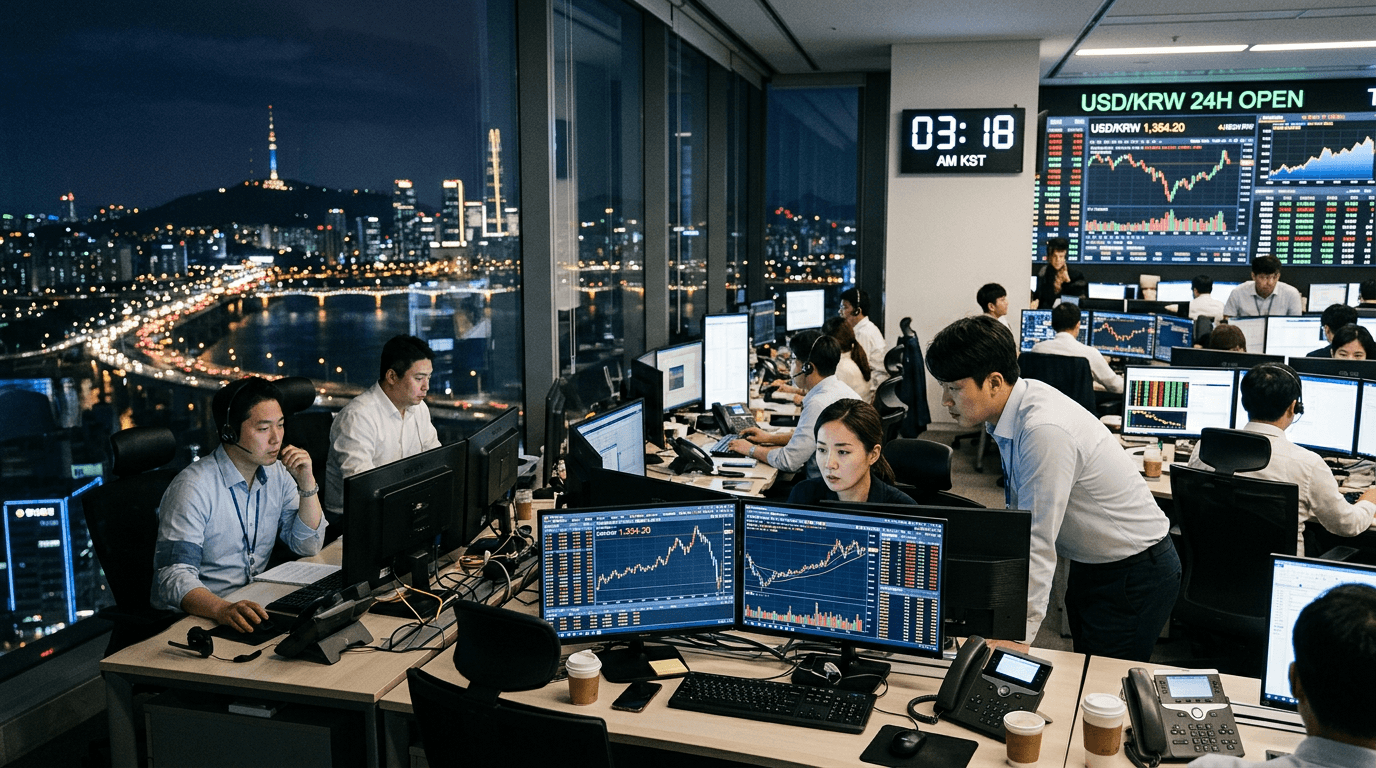
South Korea’s decision to launch 24‑hour onshore trading in the dollar‑won (USD/KRW) marks one of the most important structural shifts in Asian foreign exchange markets in years.[1][2] By extending spot trading through the entire week, policymakers are targeting greater currency convertibility and laying the groundwork for a bid to upgrade the country to developed‑market status in MSCI indices.[1][2] For traders, this is not just a local policy tweak—it is a change that could reshape liquidity patterns, volatility, and capital flows across the region.[6]
Globalizing The Korean Won
Until now, Korea’s onshore FX market operated in a relatively tight window, reflecting long‑standing capital controls designed to protect financial stability.[2] The new regime opens spot USD/KRW trading from 6 a.m. Monday to 6 a.m. Saturday Seoul time, effectively delivering continuous weekday trading.[2][5] Trading will even be available on Korean public holidays, with only weekends and January 1 excluded.[5][8] This is widely described by officials as a “starting point for the won’s global leap,” underscoring a strategic goal: elevate the won from a domestically focused currency to one more firmly integrated into global portfolios.[2][5]
At the same time, the won has been under pressure, with a cumulative decline of more than 6% year‑to‑date before the launch of the 24‑hour system.[1] As of the launch period, USD/KRW is trading around 1,530 won per dollar, reflecting a weaker local currency and heightened sensitivity to global dollar trends.[3][4][6] Opening the market around the clock is intended to make price discovery more efficient and reduce the disconnect that can arise between offshore trading (such as NDFs) and the onshore market when Korea is closed.
What Changes In The Fx Market
Practically, the move means that market participants can execute spot USD/KRW trades in the onshore market in sync with major global sessions—including London and New York—rather than relying solely on offshore instruments when Korea is closed.[2][5] Liquidity, which used to cluster heavily during the local trading day, is expected to spread more evenly across time zones, improving access for global investors and corporate hedgers.
One important nuance is that while trading is available 24 hours, settlement for onshore transactions still occurs during standard Korean business hours, typically between 9 a.m. and 3:30 p.m. Seoul time.[8] This keeps operational risk contained while still allowing price formation and hedging throughout the global day. For banks, funds, and corporates with exposure to Korea, this means more flexibility in managing intraday risk—especially around global data releases, central bank decisions, or geopolitical headlines that previously hit when the onshore won market was closed.
For traders, the immediate impact will be felt in intraday volatility patterns. Historically, many moves in USD/KRW were compressed into the local session; now, price action can respond continuously to cross‑market flows. Over time, the onshore 24‑hour market may reduce reliance on offshore non‑deliverable forwards (NDFs), as more participants can transact directly in the spot market.
Msci Upgrade And Capital Flows
The policy is explicitly tied to South Korea’s ambition to secure an upgrade to developed‑market status in MSCI’s global equity indices.[1][2] One of the key criteria for such an upgrade is the ease of currency trading and capital mobility for foreign investors, particularly large asset managers benchmarked to MSCI indexes. By broadening won convertibility and making FX access more seamless, Korea is addressing a long‑standing friction point for international investors.
An MSCI upgrade would be more than a symbolic milestone. Reclassification to developed‑market status can trigger benchmark‑driven inflows as passive and active funds rebalance their portfolios to match new index weights. While the exact timing and scale are uncertain, structural changes like 24‑hour FX trading are part of a broader package that could materially alter flows in the won, regional FX markets, and related equity and bond futures.[6] Greater foreign participation in Korean equities and bonds typically increases hedging demand in USD/KRW, deepening liquidity and potentially tightening bid‑ask spreads.
There is also a regional dimension. As Korea moves to a more open FX regime, it may encourage neighboring markets to re‑evaluate their own currency frameworks. For cross‑asset traders, this could mean new correlations and regime shifts in how Asian currencies trade against the dollar, especially during overlapping sessions with the won.
Implications For Traders And Simulated Finance
For discretionary and systematic traders alike, a 24‑hour onshore USD/KRW market opens new strategy windows. Intraday mean‑reversion or breakout strategies that were previously constrained by market closures can now operate across the full global day, aligning with the way major G10 FX pairs trade. Liquidity pockets will likely emerge around key global events, creating both opportunity and risk.
From a risk‑management perspective, continuous trading reduces the “gap risk” that arises when news breaks while the onshore market is closed and prices adjust sharply at the next open. With round‑the‑clock trading, positions can be managed more dynamically, and hedges can be adjusted in real time.
For Simulated Finance (SimFi) platforms and traders using simulation environments, this shift is particularly valuable. A 24‑hour onshore market improves the realism of USD/KRW backtesting and live simulation, allowing strategies to be designed and tested around true continuous price action rather than approximations based on offshore NDF data. SimFi traders can explore:
- Cross‑session arbitrage between USD/KRW and other Asian FX pairs
- Volatility‑targeting strategies that respond to changing liquidity profiles
- Event‑driven trading around global macro releases that impact the won
Key Takeaways For Your Strategy
First, treat South Korea’s move as a structural, not just tactical, change. Round‑the‑clock onshore USD/KRW trading is the most significant relaxation of Korean FX controls in decades and signals a long‑term policy direction toward greater openness.[1][2] This suggests that further liberalization steps—whether in derivatives access, capital flows, or market infrastructure—may follow.
Second, expect an evolution in how USD/KRW trades relative to major FX pairs. As liquidity improves in London and New York hours, correlations with other dollar pairs could strengthen, and spreads may compress, making USD/KRW more attractive for multi‑currency strategies. At the same time, local factors—Korean monetary policy, fiscal developments, and geopolitical risk—will continue to drive idiosyncratic moves that can create alpha for informed traders.
Third, prepare for the potential MSCI upgrade scenario. While not guaranteed, Korea’s policy changes are clearly engineered to meet index providers’ requirements.[1][2] If an upgrade occurs, benchmark‑driven inflows could amplify trends in Korean equities, bonds, and the won, with knock‑on effects in futures and options markets.[6] Building scenarios into your simulations—such as phased inflow shocks or volatility spikes around announcement dates—can help stress‑test strategies ahead of time.
Finally, use this transition period to refine your approach to Asian FX. With the won stepping more firmly onto the global stage, it becomes more than a niche regional trade; it is increasingly a core currency for active global macro, multi‑asset, and carry strategies. For traders operating in SimFi environments, now is an ideal time to experiment with USD/KRW as a central piece of your playbook, alongside traditional majors.