
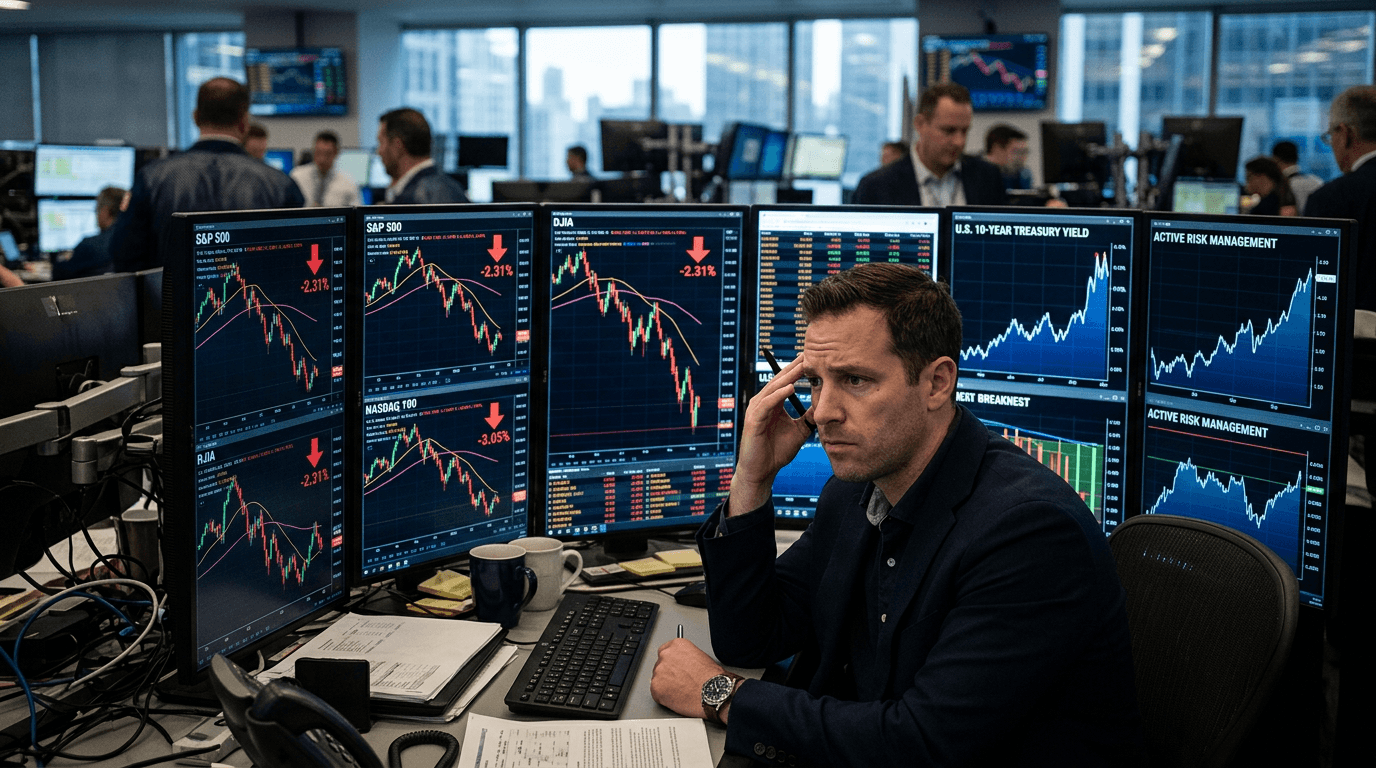
Major U.S. equity indices are trading lower as investors confront the reality of higher-for-longer interest rates and elevated bond yields, putting renewed pressure on risk assets and growth-sensitive sectors.[4][9][11][15] The S&P 500, Dow Jones Industrial Average and Nasdaq Composite have all slipped into the red, signaling a broad risk-off tone as markets reassess inflation, policy expectations and valuation across the board.[4][9][15]
Markets Under Pressure
Recent sessions have seen the major U.S. benchmarks weaken in tandem with a grind higher in Treasury yields, as inflation readings continue to hover above the Federal Reserve’s 2% target.[9][11][15] Higher yields on government bonds are forcing investors to revisit the trade-off between equities and fixed income, particularly in segments where valuations were predicated on low discount rates and abundant liquidity.[4][11][15]
This environment is classic “bad news is bad news” for stocks: firm inflation keeps the Fed on alert, while stronger data can paradoxically fuel expectations that policy rates must stay restrictive for longer.[11][15] Equity markets are responding by marking down prices, widening risk premia and expressing caution through lower index levels, weaker futures and increased volatility in rate-sensitive names.[4][9][15]
Why Higher Rates Weigh On Equities
To understand why higher yields matter so much, it helps to revisit how stocks are priced. In simple terms, an equity’s value reflects the present value of expected future cash flows. When interest rates and bond yields rise, the discount rate used in these models increases, mechanically reducing the present value of those future earnings.
Growth stocks, particularly in technology and innovation-heavy indices like the Nasdaq, are most exposed because a large portion of their expected profits lies far in the future.[4][15] When the rate used to discount those distant cash flows rises, the impact on valuation is disproportionately large, leading to sharper drawdowns in high-duration assets.
At the same time, elevated bond yields make fixed income relatively more attractive. Investors who previously accepted equity risk to generate return now see competitive yields in Treasuries and high-grade credit, prompting rotation out of stocks and into bonds.[4][11] This “crowding out” effect is especially visible when benchmark yields move decisively higher, compressing equity multiples and flattening appetite for speculative risk.
Sector Rotation And Safe-haven Flows
Indices may be broadly lower, but the pain is not evenly distributed. Rate-sensitive sectors such as technology, consumer discretionary and real estate typically underperform when yields rise, given their dependence on cheap financing and long-duration growth narratives.[4][15] In contrast, more defensive segments—utilities, staples, healthcare—often see relative support as investors seek earnings stability and lower cyclical exposure.
Financials can occupy a nuanced position in this rotation. On one hand, higher yields can improve net interest margins for banks. On the other, concerns about credit quality, tighter financial conditions and potential policy missteps can cap enthusiasm and keep sector performance mixed.
Beyond equities, the risk-off tone often spills into foreign exchange, where safe-haven currencies and the U.S. dollar tend to attract inflows as global investors seek shelter from volatility.[15] Elevated yields on U.S. assets can reinforce dollar strength, creating feedback loops for multinational earnings, commodity prices and emerging-market risk appetite.
Futures markets provide another lens on sentiment. Declines in index futures overnight or intraday can signal hedging activity by institutional players, risk reduction ahead of data releases, or momentum strategies leaning into downside trends.[4][13][15] For traders, these shifts can influence intraday liquidity, gap risk at the open and the behavior of systematic flows.
Implications For Active Traders And Simulated Finance
For active traders and those using SimFi platforms, a higher-rate, higher-yield environment is a powerful live laboratory for understanding macro–market linkages. Rather than viewing the latest drop in the S&P 500 or Nasdaq as an isolated event, it is useful to frame it within a broader regime: persistent inflation, restrictive central bank policy, and a repricing of risk across asset classes.[9][11][15]
Risk management becomes paramount in this context. Elevated yields and policy uncertainty can translate into fatter tails in price distributions, meaning bigger moves in shorter periods of time. Testing stop-loss levels, position sizing rules and diversification strategies in a simulated environment can help build robust playbooks before committing real capital.
Scenario analysis is especially valuable. Traders can construct hypothetical paths where inflation cools faster than expected, allowing yields to retreat and risk assets to rally, as well as paths where inflation proves sticky and the Fed is compelled to tighten further.[11][15] Running these scenarios on index futures, sector ETFs and FX pairs allows for a deeper grasp of how different instruments respond to macro shocks.
For index-focused strategies, it is also crucial to distinguish between beta and alpha. In risk-off phases driven by macro and rates, broad index beta can be negative even if certain pockets of the market offer opportunities for relative or market-neutral trades. SimFi environments can facilitate experimentation with pairs trades, sector rotation strategies and volatility overlays that aim to extract alpha without relying solely on market direction.
Key Takeaways For Your Next Trading Session
First, higher rates and elevated bond yields are not just headlines; they are core inputs into valuation, portfolio construction and risk management. Understanding their impact on discount rates, earnings multiples and asset allocation is essential for interpreting index moves.
Second, broad index declines often mask rich internal dynamics. Observing which sectors lead or lag, how safe-haven assets behave, and what futures curves signal about expectations provides a more nuanced picture than simply “stocks down, bonds up.”
Third, policy uncertainty is itself a tradable theme. As inflation data and Fed communications evolve, market expectations for the policy path will shift, driving repricing in both rates and equities. Building frameworks for reading these shifts—rather than reacting to each headline in isolation—can help traders maintain discipline.
Finally, simulated trading offers a low-risk way to practice navigating these regimes. Whether testing responses to yield spikes, stress scenarios around inflation surprises, or rotations between growth and value, structured simulation can turn a volatile backdrop into a learning edge.
Conclusion
The current pullback in major U.S. equity indices reflects more than momentary anxiety; it is part of an ongoing adjustment to a world where money is no longer free and inflation cannot be taken for granted.[9][11][15] Elevated bond yields are forcing investors to reconsider how they value risk assets, where they seek return, and how they protect capital through cycles.
For traders and investors, the challenge is to move beyond noise and build durable macro awareness. By linking rate moves to equity behavior, studying sector and cross-asset rotations, and using simulated environments to refine strategies, market participants can turn a difficult environment into an opportunity to upgrade their playbook. The goal is not to predict every tick, but to understand the forces behind the tape—and be prepared when the regime inevitably shifts again.