
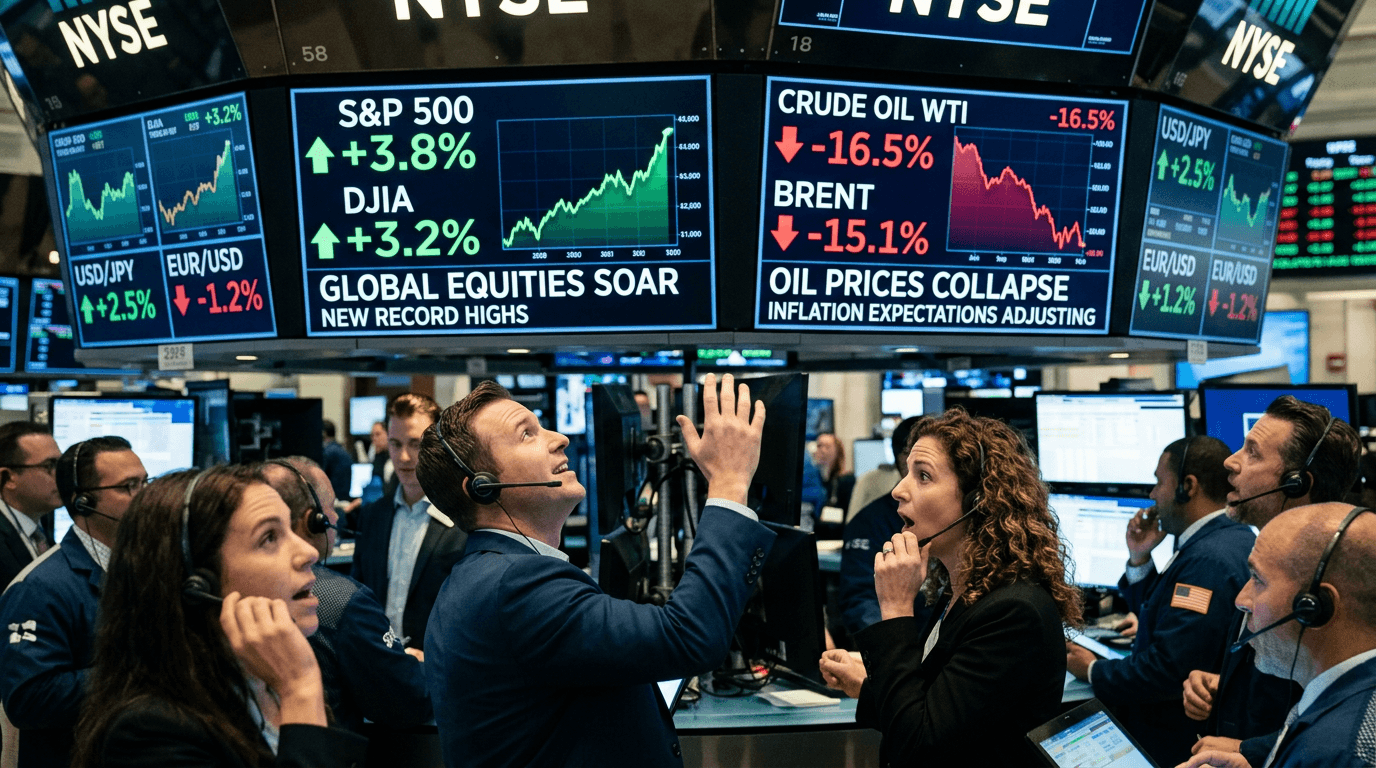
Iran's declaration of the complete reopening of the Strait of Hormuz has reverberated through global markets, sparking one of the most significant risk-on rallies seen in recent months. This temporary reopening, aligned with a ceasefire agreement in Lebanon, marks a pivotal moment in geopolitical tensions that have previously destabilized energy markets and fueled inflation concerns worldwide. As investors assess this development, its implications extend well beyond just oil prices, reshaping expectations across equities, currencies, and fixed income markets.
The Geopolitical Breakthrough
On Friday, Iran's Foreign Minister Abbas Araghchi announced that "the passage for all commercial vessels through the Strait of Hormuz is declared completely open for the remaining period of the ceasefire," directly linking the reopening to regional peace efforts. Although temporary, this announcement signals potential progress towards de-escalation in a conflict that had severely disrupted one of the world's most critical chokepoints. The Strait of Hormuz, responsible for about one-fifth of the world's oil and liquefied natural gas supply, is crucial to global energy security. Its effective closure had led to what analysts referred to as "the biggest supply disruption in history," driving oil prices to unsustainable levels and threatening economic stability worldwide.
Explosive Stock Market Rally
Wall Street reacted with immediate enthusiasm to the reopening announcement, with the S&P 500 and Nasdaq 100 achieving new all-time highs. This rally reflected a broader shift in market sentiment, as investors began unwinding the risk premiums they had built into portfolios to hedge against energy shocks and inflation. Markets that had previously moved downward together during periods of heightened geopolitical tension are now "moving higher in tandem as those perceived tail risks fade." This synchronized rally across asset classes highlights how investor psychology had been dominated by supply chain concerns related to the strait's closure.
Beyond headline indices, the market reaction was widespread. Healthcare stocks, including companies like NVST, BAX, and SGRY, benefitted from reduced inflation expectations, as did other sectors sensitive to energy costs. The breadth of the rally underscores how geopolitical uncertainty had cast a shadow across diverse market segments. Crypto markets also participated, with Bitcoin adding approximately $12,000 to its valuation as risk appetite surged.
Oil Market Capitulation
The energy sector witnessed a dramatic reversal, with crude prices collapsing as the reopening news spread. Brent crude, the global benchmark, fell 13 percent to just $86 per barrel, while WTI crude plunged more than 10 percent to $82. This swift and substantial decline reflects the market's recognition that a major supply constraint is being lifted. Oil analysts point out that these price levels, while still elevated compared to pre-conflict levels, signal an unmistakable directional shift.
The decline in oil prices has profound implications for inflation dynamics. By easing pressure on energy costs, the reopening reduces upward price pressures on fertilizers, transportation, and other supply chain inputs that depend on petroleum products. This relief is already evident in fixed income markets, where the 10-year Treasury yield dropped 6 basis points to 4.25 percent as investors reassess inflation trajectories.
Currency And Precious Metals Shifts
A weakening dollar has accompanied the risk-on sentiment, with EUR/USD rebounding toward 1.1620 and GBP/USD strengthening near 1.3365. A softer dollar typically accompanies periods of elevated risk appetite, as investors rotate away from safe-haven currencies toward higher-yielding assets. Meanwhile, gold has gained as inflation concerns ease and investors shift towards equities and cyclical assets, although the precious metal has also benefited from some safe-haven demand amid ongoing uncertainty about the ceasefire's durability.
Critical Questions For Investors
A critical question now arises: does this reopening represent a durable shift towards peace or merely a temporary respite? The Lebanon ceasefire was expected to last approximately 10 days, suggesting that the Strait of Hormuz reopening may also be temporary. This time-limited aspect introduces significant uncertainty for long-term market positioning. Additionally, reports of an ongoing U.S. naval blockade of the strait add another layer of complexity to the situation.
Investors should closely monitor several key developments: the duration and sustainability of the ceasefire, statements from U.S. and Iranian officials regarding broader peace negotiations, and any changes to naval operations in the strait. If tensions reignite, markets could experience rapid reversals in positioning.
The Bottom Line
The reopening of the Strait of Hormuz has triggered a meaningful recalibration of market risk premiums. Lower oil prices, reduced inflation expectations, and improved geopolitical sentiment have created conditions for broad-based asset-class gains. However, the temporary nature of the ceasefire warrants cautious optimism. Investors should view this rally as a positive development while maintaining awareness that geopolitical risks remain elevated and could resurface quickly if negotiations stall.