
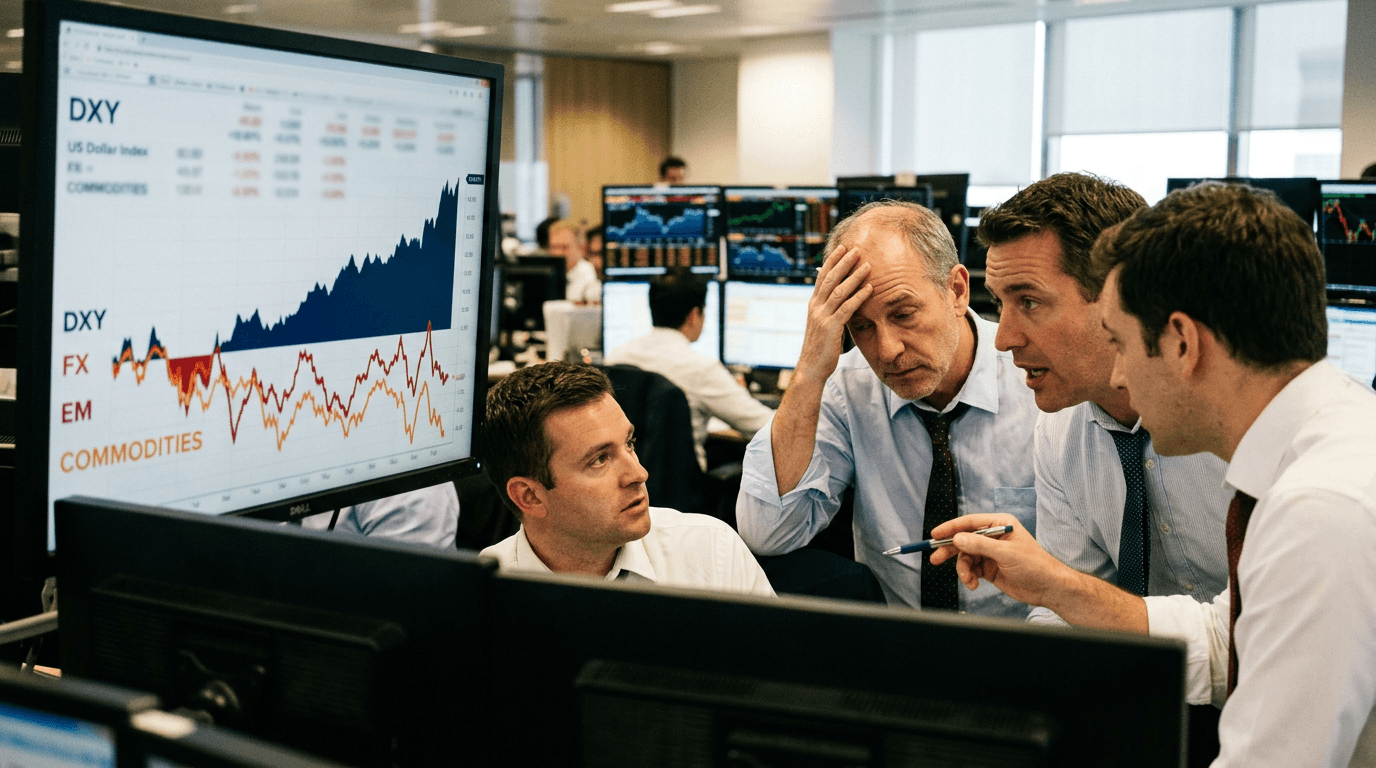
When the US Dollar Index breaks to a one-year high, it sends a powerful signal about how global capital is repositioning in response to risk and uncertainty.[2][7] In recent sessions, broad dollar strength has coincided with rising geopolitical tensions and choppy equity markets, drawing investors into the world’s reserve currency as a perceived safe haven.[7] This move is reverberating across FX, commodities, and emerging markets, reshaping trading conditions for both discretionary and systematic strategies.[7]
Safe-haven Flows And The Story Behind Dxy
The US Dollar Index (often referred to as DXY or USDX) tracks the value of the dollar against a basket of major currencies, dominated by the euro, yen, and pound, with smaller weights for the Canadian dollar, Swedish krona, and Swiss franc.[5] When this index pushes to a one-year high, it reflects broad-based appreciation of the dollar, not just idiosyncratic moves in a single pair.[2][7]
Safe-haven flows typically emerge when investors become more risk-averse—whether due to geopolitical shocks, policy uncertainty, or rising volatility in equities and credit markets.[7] In those environments, the dollar benefits from its role as the primary global reserve and funding currency, as well as from deep, liquid US Treasury markets that are seen as a store of value.
Recent price action shows the dollar climbing to its highest level in roughly a year against a range of major currencies.[2][7] News coverage has linked this rally not only to safe-haven demand but also to expectations that the Federal Reserve could keep policy rates elevated or even consider further tightening if inflation proves sticky.[2][7] Higher real yields in the US amplify the dollar’s appeal, reinforcing the safe-haven bid with a yield advantage.
Key takeaway: A one-year high in DXY is rarely a single-issue story—it usually reflects a mix of risk aversion, interest-rate expectations, and relative growth differentials, all converging into stronger demand for USD.[2][5][7]
PRESSURE ON EUR/USD, GBP/USD AND MAJOR FX PAIRS
Because the euro and pound carry the largest weights in the US Dollar Index, dollar strength tends to translate directly into downward pressure on EUR/USD and GBP/USD.[5] When DXY rallies, these pairs often move lower as the dollar appreciates broadly against European currencies.
In periods of elevated risk, investors may reduce exposure to regions seen as more vulnerable to energy shocks, geopolitical tensions, or slower growth, reallocating towards US assets and cash balances in dollars.[7] That dynamic can deepen selling in EUR/USD and GBP/USD, particularly if European data underwhelms or if local central banks appear less hawkish than the Federal Reserve.
For traders, this environment favors strategies that respect the prevailing dollar trend rather than fighting it. Momentum and trend-following systems might lean into short EUR/USD or GBP/USD setups, while mean-reversion traders must be more selective, waiting for clear signs of exhaustion or divergence before fading USD strength.
Practical takeaways for FX traders: - Bias: Expect rallies in EUR/USD and GBP/USD to face selling pressure while DXY remains near year-highs. - Risk management: Use tightened stop-losses when trading against the dominant dollar trend. - Cross-check: Always align pair trades with broader DXY behavior; isolated views on single pairs are more fragile when the dollar is being driven by global flows.[5][7]
Impact On Commodity Futures And Emerging Markets
A stronger dollar has important implications for commodity futures, as most major commodities—from crude oil to gold to industrial metals—are priced in USD globally. When the dollar appreciates, commodities become more expensive in local currency terms for non-US buyers, which can dampen demand and exert downward pressure on prices, particularly if global growth expectations are already soft.[5] This relationship is not perfect, but it is a recurring macro theme traders must be aware of.
Safe-haven demand for dollars can also unsettle emerging-market assets. Many emerging economies rely on dollar funding, and a stronger USD can tighten financial conditions by making external debt more expensive to service.[5] At the same time, portfolio flows may rotate out of higher-yielding but riskier EM bonds and equities into US Treasuries and cash, contributing to currency depreciation and higher local volatility.
For commodity and EM traders, this backdrop suggests: - Watch the dollar first: Major trend changes in DXY often precede or coincide with regime shifts in commodities and EM FX. - Hedge thoughtfully: Producers, importers, and macro traders should consider the dollar exposure embedded in their positions, not just the underlying asset. - Expect volatility spikes: Cross-asset volatility tends to rise when safe-haven flows intensify, making position sizing and margin management critical.[7]
Trading In A High-volatility, Strong-dollar Regime
When dollar strength is driven by both safe-haven flows and shifting rate expectations, markets often experience sharp, correlated moves across asset classes.[2][7] FX, equities, rates, and commodities can move together as investors de-risk and rebalance, increasing short-term volatility and the frequency of market “mini shocks.”
In this regime, robust process beats conviction. Successful traders typically: - Emphasize risk controls: Define maximum loss per trade, daily loss limits, and clear conditions for reducing overall exposure. - Use scenario planning: Map how their portfolios react to further dollar strength, a sudden reversal, or policy surprises, and adjust hedges accordingly. - Focus on liquidity: High-volatility periods can see widening spreads and thinner order books in certain instruments; concentrating risk in more liquid contracts can improve execution quality.
Simulated trading environments can be particularly useful in stress-testing strategies against strong-dollar scenarios. They allow traders to rehearse how their systems behave under different volatility profiles, interest-rate shocks, and cross-asset correlations—without putting real capital at risk. This kind of preparation can help bridge the gap between theoretical understanding of macro themes and practical decision-making in live markets.
Looking Ahead: What To Watch As Dxy Holds Year Highs
A one-year high in the US Dollar Index is a milestone, but not a conclusion. For traders and investors, the most important questions from here are whether dollar strength extends, stabilizes, or reverses—and what catalysts could drive that shift.[2][7]
Key signposts to monitor: - Central bank expectations: Market-implied paths for Federal Reserve policy, particularly around any indication that rate hikes are done versus renewed tightening.[2][7] - Risk sentiment: Measures of equity volatility and credit spreads, which often track swings between risk-on and risk-off positioning. - Global growth data: Divergences in economic momentum between the US and other major regions, which can either reinforce or undermine the dollar’s relative appeal.
In practical terms, traders should treat the current strong-dollar, safe-haven environment as an opportunity to refine their macro framework, enhance risk management, and stress-test their strategies. Whether you trade FX, commodities, or index futures, understanding how and why the US Dollar Index has reached a one-year high—and how that ripples through correlated markets—can be a decisive edge in navigating the next phase of the cycle.[2][5][7]