
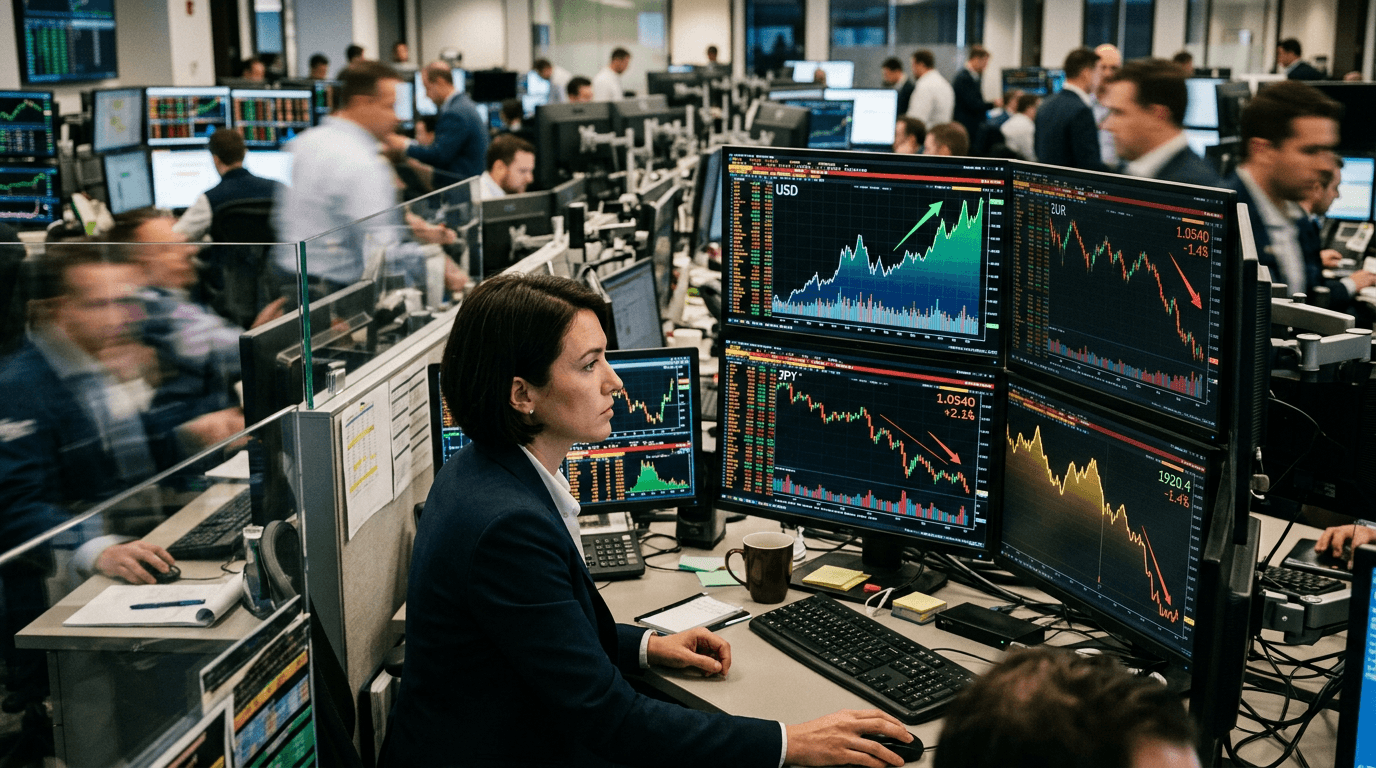
The US dollar’s latest rally has pushed the greenback to its highest level in more than a year, reinforcing a powerful theme that has defined much of the FX and commodities complex recently: strong USD, higher US rates, and mounting pressure on major currencies and gold.[1][2][6] For traders, this is not just a headline—it’s a regime shift that affects everything from FX pairs to futures and precious metals.
WHAT’S DRIVING THE DOLLAR’S SURGE
The dollar index, which measures the currency against a basket of six major peers, recently touched around 101.8, its highest level in 13 months and on track for its strongest monthly gain since mid‑2025.[1][2][8] This move is being driven by two intertwined forces: expectations of further Federal Reserve rate hikes and a renewed bid for the dollar as a safe‑haven asset.
Fed funds futures now price roughly a 30–35% probability of at least a 25‑basis‑point hike at the July meeting and about two‑thirds odds of a move by September, reflecting markets’ belief that the Fed is not yet done with tightening.[1][3][5] A hawkish tone from policymakers, persistent inflation concerns, and solid underlying US growth data have all contributed to that repricing.
At the same time, a sell‑off in global equities—particularly in US technology stocks—has driven investors toward the relative safety and liquidity of the dollar.[1][3] Geopolitical uncertainty, including tensions around US‑Iran negotiations, has further supported demand for the greenback as a defensive asset.[1][3][4] The takeaway: this dollar strength is not a single‑day event, but a reflection of both policy expectations and risk sentiment.
Pressure On Major Currencies
The flip side of a strong dollar is weakness in other majors. The euro has slipped below $1.14, with the latest move taking it down around 0.2% on the day as the dollar index pushed to that 13‑month peak.[1][2][3] Sterling has faced similar headwinds, with traders questioning how much further the Bank of England can tighten against a softer growth backdrop, especially when the Fed is perceived as staying more hawkish.
Against the Japanese yen, the dollar has climbed toward 161.8, bringing the yen close to levels not seen since the mid‑1980s.[1][3] With the Bank of Japan still moving very cautiously away from ultra‑easy policy, yield differentials remain heavily in the dollar’s favor, encouraging carry trades that further amplify dollar strength.
For FX traders, the key takeaway is that relative monetary policy expectations remain the dominant driver. Where central banks are seen as pausing or nearing the end of tightening cycles (euro area, UK, Japan), currencies are under pressure versus the dollar. Where policy still looks hawkish (US), the dollar’s bid is being reinforced.
Gold Under Fire: Why Bullion Is Struggling
Gold has been one of the clearest casualties of this strong‑dollar, higher‑rates narrative. Spot prices continue to grind lower, with bullion now heading toward a fourth consecutive monthly decline as the dollar rallies and real yields stay elevated.[2][4] Higher interest rates raise the opportunity cost of holding a non‑yielding asset like gold, while a stronger dollar makes bullion more expensive for non‑US buyers.
Recent commentary highlights that investors are reacting to a combination of rising inflation concerns, higher energy prices, and geopolitical tensions—but instead of flocking to gold, they are choosing the dollar and US assets as their preferred hedge.[4] In other words, gold is losing out in a competition for safe‑haven capital.
For traders, this divergence matters. The traditional assumption that gold automatically rallies on macro stress is being challenged when the stress is accompanied by rising US yields and a firm dollar. The takeaway: in this environment, gold behaves less like a classic crisis hedge and more like a rate‑sensitive asset, vulnerable when the Fed is expected to stay hawkish.
Implications For Traders And Portfolios
A 13‑month high in the dollar index and a multi‑month losing streak in gold signal a regime where US assets and cash are being repriced relative to the rest of the world.[1][2][4][8] For discretionary traders and systematic strategies alike, several practical implications follow:
First, FX trends can be more persistent when driven by policy expectations rather than short‑term data noise. As long as markets keep assigning meaningful odds to further Fed hikes, the path of least resistance for EUR/USD, GBP/USD, and USD/JPY may remain skewed in the dollar’s favor, even with occasional pullbacks around data releases.[1][2][3][5]
Second, cross‑asset correlations may look different from prior cycles. Equity weakness, especially in high‑beta tech names, is coexisting with dollar strength rather than immediate gold rallies.[1][3][4] That challenges traditional “risk‑off” playbooks and may require updated hedging strategies—using FX and rates instruments alongside, or instead of, bullion.
Third, portfolio construction needs to factor in higher funding costs. As policy expectations shift, leveraged positions and carry trades must be reassessed, particularly where exposure to short‑dollar funding is involved. The takeaway: risk management in a strong‑USD, rising‑rates world is less about a single trade and more about aligning the whole portfolio with the macro backdrop.
How Simulated Finance Traders Can Leverage This Environment
For traders using simulated finance platforms, this is an ideal market regime to test and refine strategies without real‑world capital at risk. A trending dollar, pressured majors, and a clear macro narrative create a rich environment for experimentation.
Trend‑following approaches in major FX pairs can be stress‑tested by designing rules that respond to breaks in key levels—such as EUR/USD below 1.14 or USD/JPY approaching multi‑decade highs.[1][2][3] Mean‑reversion strategies can be explored around data releases and central bank speeches, where the dollar sometimes eases from peaks after bursts of information.[5]
On the commodities side, simulated gold futures and options provide a sandbox for understanding how rate expectations and dollar strength translate into price action. Traders can experiment with scenarios where the Fed delivers the expected hike versus surprises the market, and measure how gold and the dollar respond in each case.[1][3][4]
Risk‑management drills are equally important. Simulated portfolios allow traders to practice position sizing, stop‑loss placement, and diversification—combining FX, equity indices, and precious metals—to see how different mixes behave when the dollar rallies sharply or when the narrative reverses.
The overarching takeaway for SimFi participants: this strong‑USD, higher‑rates backdrop is not just a news story, but a live teaching environment. By observing how majors and gold react to shifts in Fed expectations and global risk sentiment, traders can build playbooks they may later apply in real markets, with a clearer understanding of both opportunity and risk.