
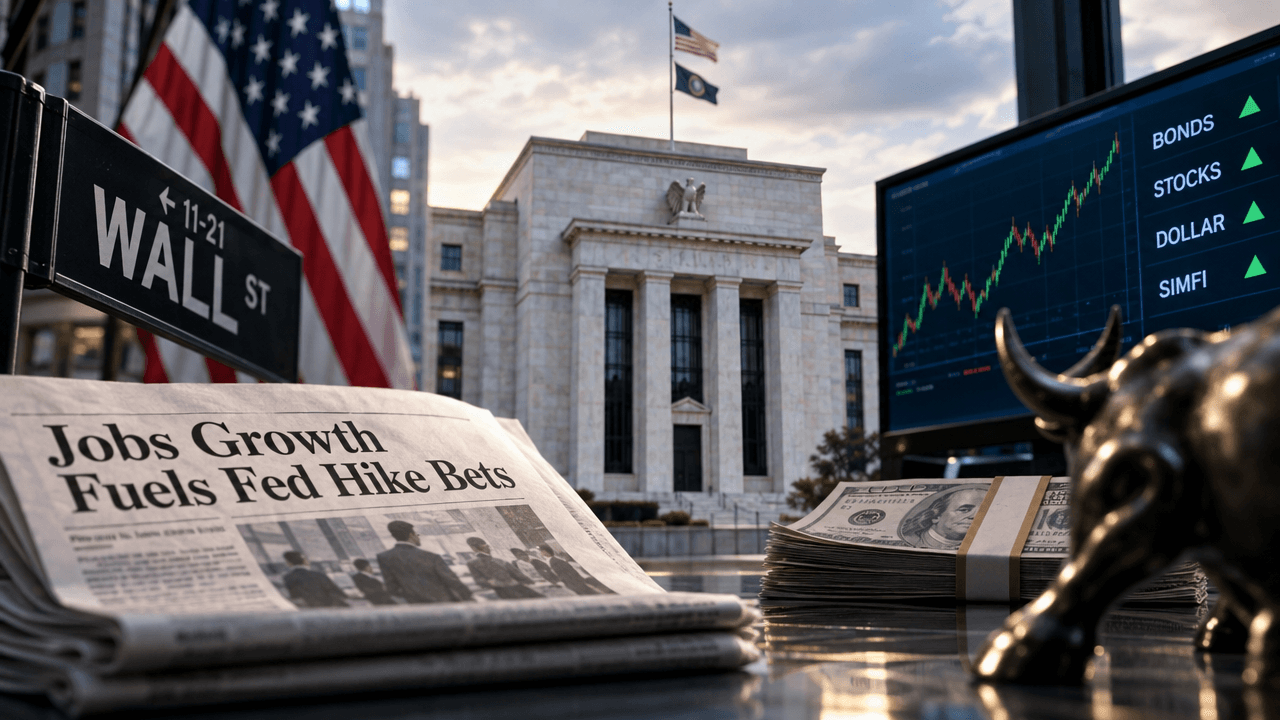
A stronger-than-expected U.S. jobs report has pushed markets to increase their bets on a Federal Reserve interest-rate hike in December. Futures markets are now pricing in more than an 80% probability of a quarter-point increase, up sharply from the odds seen before the employment data. The Federal Open Market Committee is scheduled to meet on December 8–9, 2026. [1][6]
The shift matters because interest-rate expectations influence nearly every major financial market. Treasury yields, the U.S. dollar, equity valuations, commodities, and market volatility can all react as traders reassess the likely path of monetary policy.
The Data Behind The Market Move
The October employment report provided the main catalyst. U.S. employers added 165,000 nonfarm jobs, substantially above forecasts near 60,000 to 70,000. September payroll growth was also revised higher, while the unemployment rate declined from 4.2% to 4.1%. [6][10]
Taken together, the figures suggested that the labor market remains more resilient than many investors had expected. A stronger labor market gives consumers greater income stability and can support household spending. However, it can also make the Federal Reserve more cautious if wage growth and demand continue to contribute to persistent inflation.
For the Fed, the report reduces concern that higher interest rates are causing an abrupt deterioration in employment. If the economy can continue creating jobs while unemployment remains relatively low, policymakers may have more room to focus on inflation risks rather than immediately supporting growth.
Why A December Hike Is Back In Focus
Interest-rate decisions are based on a broad collection of economic indicators, but employment is one of the most influential. The Fed’s mandate includes maximum employment and price stability, meaning policymakers must balance labor-market strength against inflation.
Recent hawkish commentary from Fed officials has reinforced the view that another increase remains possible. A hawkish central bank generally signals that it is more concerned about inflation and may favor higher rates for longer. That message can move markets even before any formal policy decision is made.
The latest jobs report strengthened that narrative. A 165,000 increase in payrolls was not simply a sign that employment was stable; it was evidence that hiring had accelerated. With unemployment falling to 4.1%, investors began to conclude that the economy could withstand another 25-basis-point rate increase. [7][11]
Still, market pricing is not a guarantee. Futures reflect probabilities, not certainty. Inflation data, consumer spending, wage growth, financial conditions, and additional employment reports could all change expectations before the December meeting.
How Markets May Respond
A higher probability of a Fed hike typically places upward pressure on short-term Treasury yields because those securities are especially sensitive to expected central-bank policy. If traders anticipate higher rates, bond prices generally fall as yields rise.
The U.S. dollar may also benefit when markets expect tighter policy. Higher expected returns on dollar-denominated assets can attract international capital. A stronger dollar can pressure commodities priced in dollars, including gold and crude oil, although geopolitical risks and supply conditions may offset that effect.
Equity markets can face a more complicated reaction. Banks and financial companies may benefit from higher rates if lending margins improve, but growth stocks can come under pressure because their future cash flows are discounted at higher rates. Technology companies and other long-duration assets are particularly sensitive to changes in bond yields.
The effect on stocks is not always negative. If a rate hike is interpreted as confirmation that economic growth remains healthy, investors may view it as a sign of confidence rather than a threat. The market’s response depends on whether the increase is already priced in and what the Fed communicates about future decisions.
What Traders Should Watch Next
The most important question is whether future data confirms or challenges the October employment report. Traders should monitor inflation releases, wage growth, jobless claims, retail sales, and revisions to previous payroll figures.
Inflation will be especially important. A strong labor market combined with stubborn price growth would give policymakers a stronger reason to raise rates. By contrast, weaker inflation or a sudden deterioration in hiring could encourage the Fed to delay action, even if futures currently assign high odds to a December move.
The Fed’s statement and press conference will also matter. Markets will look for clues about whether the December hike would be a one-time adjustment or part of a longer tightening cycle. A quarter-point increase accompanied by cautious language could produce a very different reaction from the same increase paired with guidance that additional hikes are likely.
For SimFi traders, this event is an opportunity to practice scenario-based risk management. Before entering a position, define what could happen if the Fed hikes, holds rates steady, or signals further tightening. Consider how each scenario could affect the dollar, equity indexes, Treasury yields, and gold. Avoid relying solely on the headline probability, and be prepared for volatility if the policy decision differs from market expectations.
The Bigger Picture
Markets are increasing their bets on a December Fed rate hike because the latest labor data indicate that the U.S. economy has retained considerable momentum. Payrolls rose by 165,000, unemployment fell to 4.1%, and recent Fed commentary has kept inflation risks in focus. [6][12]
The key lesson is that interest-rate expectations can change quickly when new data challenge the prevailing narrative. Traders should treat the current probability as a useful signal, not a promise. The most prepared participants will continue to evaluate the data, manage position size, and plan for multiple outcomes as the December meeting approaches.