
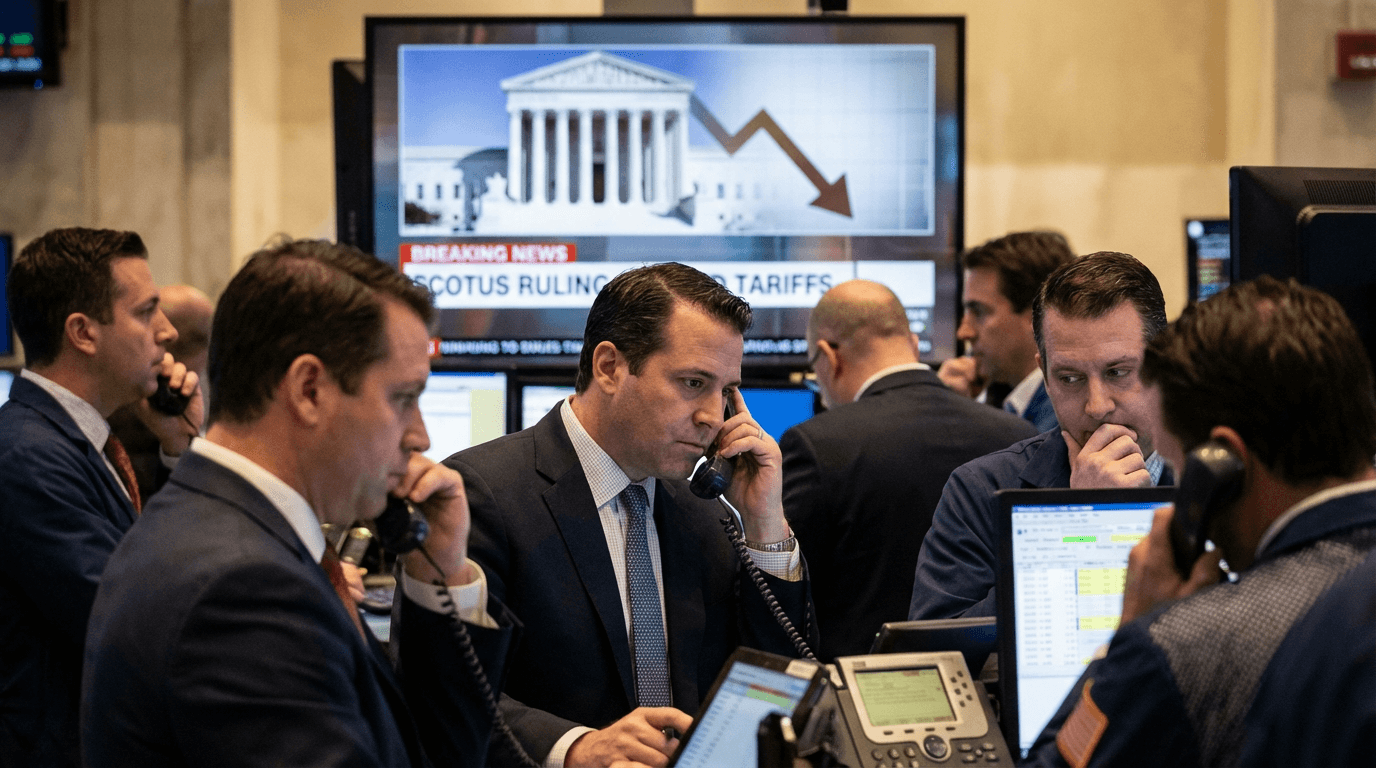
The Supreme Court's landmark decision to strike down President Trump's sweeping tariffs sent shockwaves through financial markets on Monday morning, with US futures for the S&P 500, Dow Jones, and Nasdaq all declining 0.2-0.3% in early trading. This sharp pullback reflects investor uncertainty about what comes next for trade policy and the broader implications for corporate earnings and economic growth. The 6-3 ruling, announced on Friday, has fundamentally reshaped the landscape for traders, businesses, and policymakers navigating an increasingly volatile trade environment.
Understanding The Supreme Court's Decision
On February 20, 2026, the Supreme Court ruled that President Trump exceeded his constitutional authority when he imposed tariffs using the International Emergency Economic Powers Act (IEEPA). The case, Learning Resources, Inc. v. Trump, consolidated multiple challenges to the tariffs the administration had imposed throughout 2025, including duties on steel, aluminum, Chinese imports, and reciprocal tariffs affecting nearly all US trading partners.
Chief Justice John Roberts, writing for the majority, emphasized that IEEPA does not grant the president broad tariff authority. Instead, the court held that tariffs constitute a fundamental "power of the purse" that belongs exclusively to Congress. The court applied the major questions doctrine, requiring that if Congress intends to delegate such significant economic power to the executive branch, it must do so explicitly and with clear limitations. Roberts noted that Trump's interpretation would have given the president "power to unilaterally impose unbounded tariffs," unconstrained by procedural safeguards and reviewable by courts—a power the Constitution does not permit.
The decision was supported by both conservative justices like Neil Gorsuch and Amy Coney Barrett, as well as the court's three Democratic appointees, demonstrating broad agreement that the administration had overstepped its authority.
Why Markets Reacted With Caution
The initial market decline reflects genuine uncertainty rather than a straightforward positive or negative reaction. On one hand, traders might view the ruling favorably—the elimination of Trump's tariffs removes trade barriers and could lower inflation, reduce supply chain disruptions, and restore predictability to international commerce. Lower tariffs typically support corporate profit margins and could benefit exporters.
However, the market's hesitation suggests several competing concerns. First, the ruling creates immediate policy uncertainty. Trump's trade team has vowed to pursue other legal strategies to maintain tariffs, potentially using different statutes with more explicit tariff authority. This uncertainty about what comes next has made investors cautious. Second, many businesses have already adjusted their supply chains, sourcing, and pricing strategies in response to the 2025 tariffs. Sudden reversals can create their own disruptions. Third, some investors had potentially positioned their portfolios in anticipation of sustained tariff policies, making this reversal potentially painful for those positions.
The Refund Question Looms Large
One critical issue the Supreme Court did not address is whether importers who paid more than $200 billion in tariffs throughout 2025 will receive refunds. Justice Brett Kavanaugh noted in his dissent that this refund obligation "may be required," but acknowledged the complexity: some importers have already passed tariff costs to consumers, creating a web of financial consequences that extends far beyond importers themselves.
This uncertainty has significant implications for corporate balance sheets. Companies that absorbed tariff costs in 2025 may recover billions if refunds are ordered, potentially boosting Q1 and Q2 2026 earnings. Conversely, if no refunds are mandated, these costs become permanent losses. For traders on SimFi platforms, this represents an important variable to monitor as more clarity emerges in coming weeks.
What Comes Next For Traders
The Trump administration's next move will likely shape market direction in the coming weeks. While IEEPA has been struck down as a tariff authority, other statutes may provide legal avenues for imposing targeted duties. The court's opinion suggests that tariffs imposed with explicit congressional authorization or under specific limited circumstances might survive constitutional scrutiny. Traders should watch for announcements regarding alternative tariff proposals or congressional action.
Additionally, the Court's emphasis on the major questions doctrine signals judicial skepticism toward broad executive powers in areas of significant economic impact. This principle may extend beyond tariffs, potentially affecting other emergency declarations or regulatory actions. For portfolio strategy, this suggests a moment to reassess assumptions about policy continuation and governmental authority.
Practical Takeaways For Simfi Traders
The tariff ruling underscores several timeless trading principles. First, policy uncertainty creates trading opportunities for those who can accurately forecast outcomes. Second, major court decisions often trigger short-term volatility before markets settle into a new equilibrium. Third, the details matter enormously—the refund question, alternative tariff strategies, and congressional responses will shape actual market impact far more than the headline ruling.
For SimFi traders, this moment offers valuable practice in navigating policy-driven volatility, assessing uncertainty, and positioning for multiple scenarios. Whether tariffs return through new legislation or remain struck down, the underlying market fundamentals and economic data will ultimately drive sustainable price movements.