
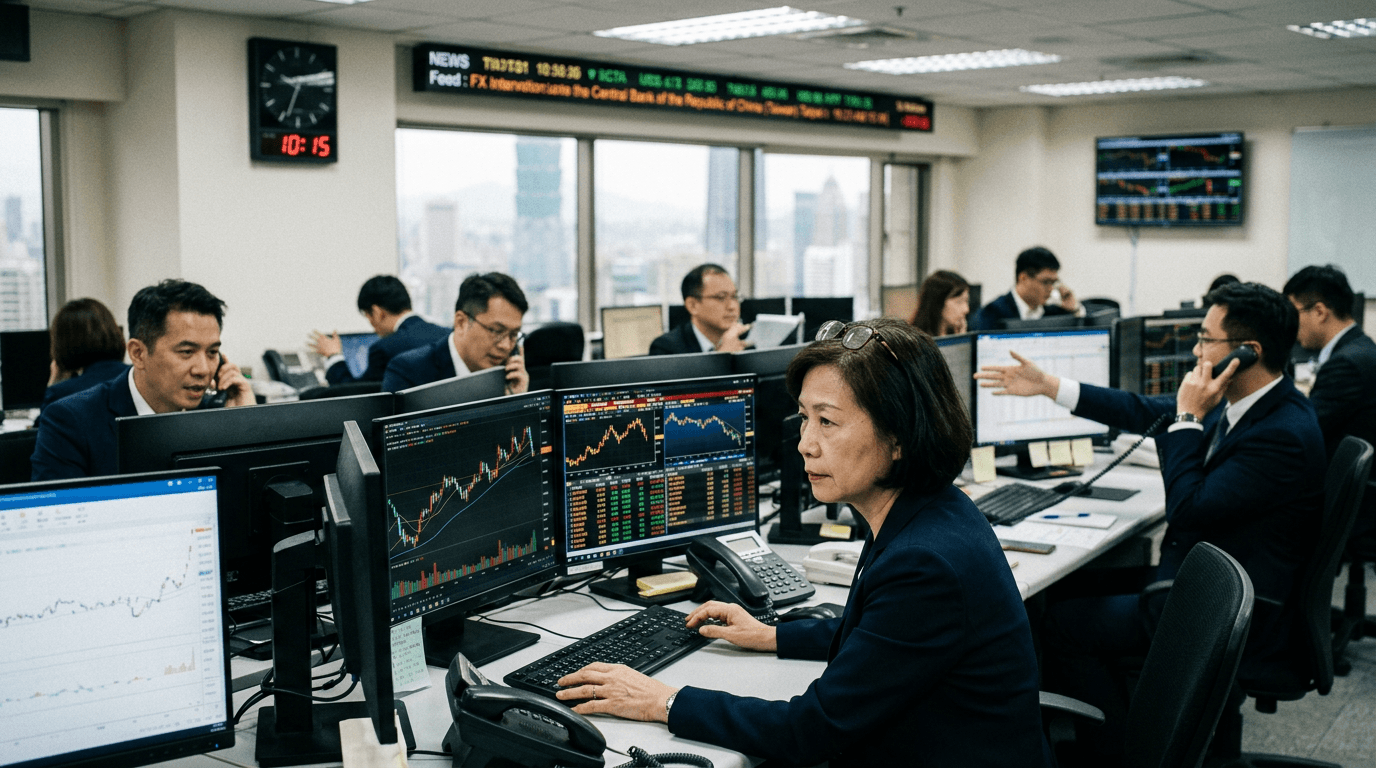
Taiwan’s central bank has moved firmly into the spotlight of global FX markets, stepping up its efforts to curb sharp swings in the Taiwan dollar as capital flows and tech-sector cyclicality drive increasingly choppy trading.[13] For traders, investors, and risk managers, this shift is more than a local story—it touches regional carry strategies, semiconductor-linked equities, and the broader narrative of how central banks manage volatility in an age of AI-driven capital flows.[8][13]
WHAT’S DRIVING TAIWAN’S CURRENCY VOLATILITY
Taiwan sits at the heart of the global semiconductor and AI hardware supply chain, making its currency highly sensitive to tech-related capital flows and export cycles.[13] When foreign investors pile into Taiwan’s equity market on the back of an AI or chip boom, the Taiwan dollar (TWD) tends to strengthen quickly; when sentiment reverses or global risk appetite weakens, outflows can trigger abrupt depreciation.
Over the past year, this dynamic has produced some of the sharpest moves in the Taiwan dollar since the 1980s.[13] The swings have been amplified by global shocks, including Middle East conflicts and risk-off episodes that push investors to rebalance portfolios and hedge exposures.[3][9] These factors create an environment where the exchange rate can overshoot on both the upside and downside.
From the central bank’s perspective, this volatility threatens price stability, complicates planning for exporters and importers, and raises the risk of disorderly market conditions.[2][10] As a result, the Central Bank of the Republic of China (CBC) is increasingly prioritizing stability over allowing the currency to fully reflect short-term market sentiment.[2][10]
How The Central Bank Is Intervening
Officially, Taiwan’s central bank maintains that the NT dollar exchange rate is determined by market forces and that intervention is aimed at maintaining an orderly market when seasonal or irregular factors disrupt trading.[10] In practice, the CBC has become far more active in recent months, extending its reach deeper into the FX market to “stamp out” excess volatility.[13]
Intervention typically takes the form of the CBC buying or selling US dollars in the spot market to dampen sharp moves in the Taiwan dollar.[16] When the TWD strengthens rapidly, the central bank may buy foreign currency and sell TWD, leaning against appreciation; when the TWD weakens excessively, it can sell foreign currency to support the local unit.[3][9][11] This “lean against the wind” strategy has long been part of Taiwan’s FX playbook, but the scale and frequency have recently increased.[6][11][13]
Evidence of this stepped-up activity is visible in foreign exchange reserve data. Taiwan’s reserves have seen notable monthly declines as the central bank sold US dollars to stabilize the currency amid capital outflows and global market stress.[3][9] At the same time, official reports show net purchases or sales of US dollars framed explicitly as efforts to “smooth currency volatility,” leaving little doubt that FX intervention is now a core policy tool.[11]
The CBC also emphasizes that it has ample liquidity and capacity to intervene when needed, pointing to its large reserves and past success in navigating crises such as the COVID-19 shock.[8][10] This signaling is designed to reassure markets that the central bank can contain disorderly moves and discourage speculative attacks or one-way positioning.
Implications For Fx, Carry Trades And Equity Futures
For FX traders, more active intervention fundamentally changes the risk-reward profile of Taiwan dollar strategies. When a central bank is explicitly leaning against sharp moves, directional bets on TWD can face “policy headwinds,” with profit potential capped by the bank’s tolerance for volatility.[13][16] Short-term traders may find that breakout moves fail to follow through as the CBC steps in around key levels.
Regional carry strategies are also affected. In a typical carry trade, investors borrow in a low-yield currency and invest in a higher-yield currency, earning the interest differential. If the Taiwan dollar is part of such strategies, central bank efforts to stabilize the exchange rate can reduce the currency component of returns while altering perceived risk.[8][13] A less volatile TWD may look attractive from a risk-control standpoint, but intervention uncertainty adds another variable: traders must gauge not only market forces but also policy reaction functions.
Local equity futures tied to Taiwan’s technology-heavy stock indices are influenced as well. When FX volatility is compressed, it can encourage foreign investors to take more exposure to Taiwan equities without fear of large currency swings eroding returns.[8][13] On the other hand, aggressive intervention during risk-off periods may signal deeper concerns about capital flows, triggering hedging activity in futures markets.
Practically, traders using TWD crosses or Taiwan-related equity futures need to account for:
- Intervention “zones,” where the central bank is more likely to act.
- Reserve trends, which signal the intensity and direction of recent operations.[3][9][11]
- The interaction between global tech sentiment and CBC tolerance for currency moves.[13]
What Traders And Investors Should Watch
For market participants, the key is not to avoid Taiwan altogether, but to integrate the central bank’s behavior into their process.
First, monitoring official communication is essential. The CBC has openly stated it will intervene when needed to ensure forex stability and maintain market order, while stressing that interventions are aimed at curbing excess volatility rather than engineering a permanent competitive devaluation.[2][8][10] Changes in language, tone, or emphasis can offer early clues about shifting tolerance for currency moves.
Second, FX reserve data and quarterly intervention figures provide a quantitative window into the scale of operations.[3][9][11] A sharp drop in reserves or a surge in net FX sales/purchases may indicate that the central bank is actively defending certain ranges, which can be incorporated into technical and macro analysis.
Third, traders should align TWD strategies with macro themes. When AI and semiconductor optimism drive inflows, the central bank may lean more heavily against appreciation to protect exporters.[13] In periods of geopolitical tension or global risk aversion, intervention could focus on preventing disorderly depreciation and guarding against sudden outflows.[3][9]
For simulated trading environments and educational platforms, Taiwan’s current policy stance creates a rich case study. Participants can test:
- How different intervention scenarios affect FX trend-following systems.
- The behavior of carry trades when a central bank targets volatility rather than a strict level.
- The correlation between tech-sector shocks, TWD moves, and equity futures performance.
Practical Takeaways For Simulated And Live Trading
From a practical perspective, several action points stand out:
- Treat TWD as a “managed volatility” currency. Expect smoother moves than pure free-float FX pairs, but be prepared for sudden, policy-driven inflection points.[10][13]
- Avoid over-reliance on purely technical signals near historically sensitive levels for the Taiwan dollar. Integrate central bank behavior, reserve trends, and policy communication into your framework.[3][6][11][13]
- When designing strategies in a simulated finance environment, build scenarios where the central bank increases, decreases, or pauses intervention. Compare strategy robustness across these regimes to understand policy risk.
- For portfolios with Taiwan equity exposure, consider currency hedging strategies calibrated to the central bank’s stated goal of curbing excess volatility, rather than large trend moves.[2][8][10]
Ultimately, Taiwan’s intensified efforts to curb currency swings underscore a broader theme in modern markets: central banks are increasingly active in managing not just interest rates, but also exchange-rate volatility. For traders and investors, success lies in respecting that intervention is part of the landscape, learning to read it, and integrating it into disciplined, risk-aware strategies.