
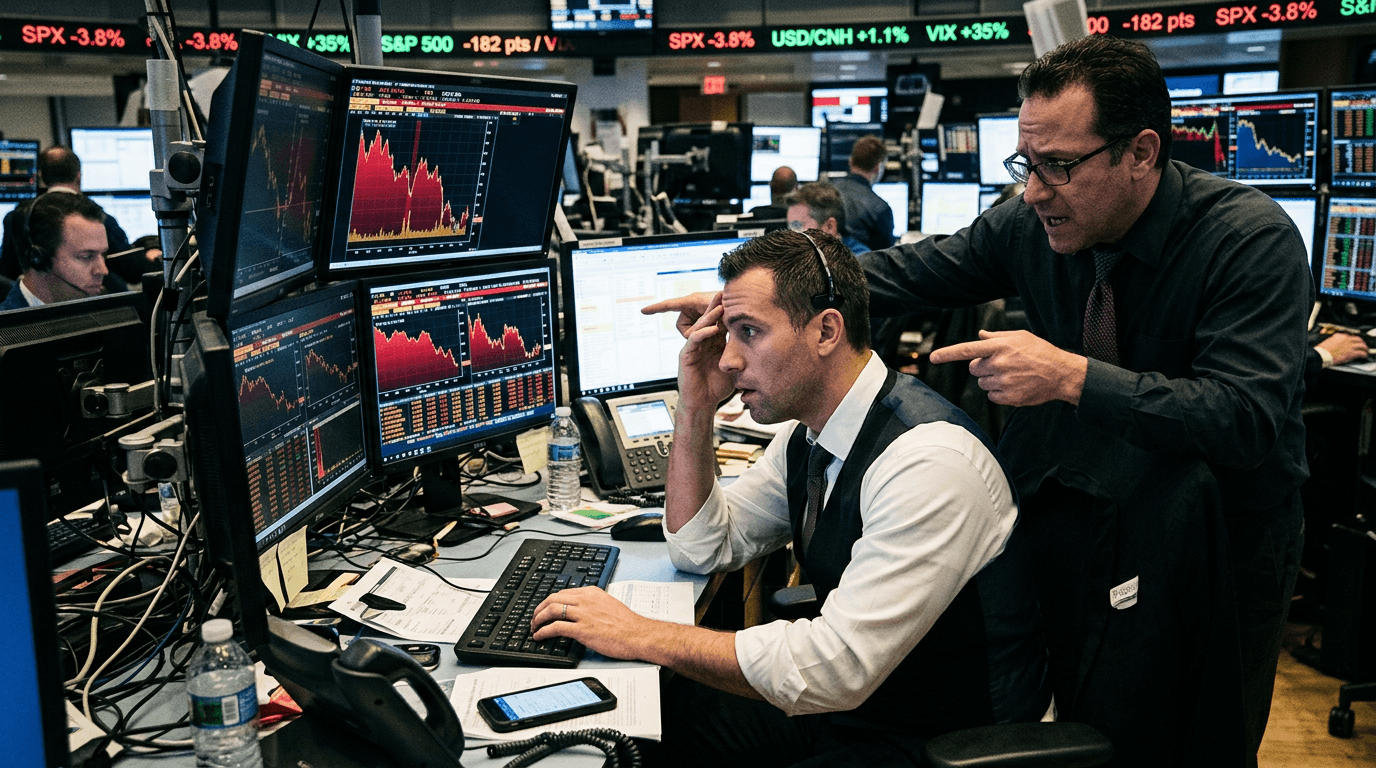
The latest tariff flare-up between the United States and China is a reminder that geopolitics can shake markets as forcefully as any central bank decision or economic data release.[1] With US tariffs on Chinese imports now hiked to roughly 145% and Beijing responding in kind, traders are confronting a renewed trade-war dynamic that is rippling across equities, currencies, and commodities.[1][3] For both discretionary and systematic traders, this is an environment where understanding the transmission channels of a shock is as important as reading a price chart.[1][3]
WHAT JUST CHANGED IN THE US–CHINA TARIFF LANDSCAPE
US tariffs on Chinese imports have surged to at least 145%, significantly exceeding the already elevated levels prevailing during earlier phases of the trade conflict.[1][4] The latest increase layers new broad-based tariffs onto existing measures that had already driven average US tariff rates on Chinese goods far above pre‑trade‑war norms.[1][3][4] Economists had long warned that breaching certain tariff thresholds could meaningfully disrupt trade volumes and supply chains; the new level crosses those lines by a wide margin.[1][3] In parallel, China has retaliated with its own set of counter‑tariffs, continuing the tit‑for‑tat pattern that characterized previous rounds of the US–China trade war.[1][3]
This escalation comes against a backdrop where prior negotiations had at times rolled back some of the steepest duties before re‑escalating, creating a pattern of oscillation between partial de‑escalation and renewed confrontation.[3][5] Policy signals have been mixed: on one hand, efforts to consolidate tariffs into more uniform rates; on the other, targeted surcharges linked to issues such as synthetic opioids or forced labor.[1][2][5] The latest move pushes the balance firmly back toward confrontation and uncertainty, and markets are reacting accordingly.[1][3]
How Global Markets Are Reacting
The immediate reaction has been classic “risk‑off”: global equity index futures are under pressure as investors mark down earnings expectations and attach a higher risk premium to trade‑sensitive sectors.[1] US benchmarks had already shown sensitivity to tariff headlines in prior episodes, with sizeable single‑day declines when investors reassessed the likelihood of a prolonged trade war.[1][3] Export‑oriented indices in Asia and Europe are particularly vulnerable, given their dependence on integrated supply chains that link both the US and China.[1][3]
In currencies, the US dollar is catching a safe‑haven bid as investors seek liquidity and perceived security, while traditional havens such as the Japanese yen and Swiss franc tend to outperform high‑beta and emerging‑market currencies in similar shocks.[1][3] The offshore Chinese yuan (CNH) and broader Asia‑FX complex are seeing increased volatility as traders price in weaker Chinese export prospects, potential capital outflows, and the risk of further policy responses from Beijing.[1][3] Higher tariffs also feed through to commodities: industrial metals and energy are sensitive to growth expectations, while gold often benefits from risk aversion and rising geopolitical uncertainty.[1][3]
Key Implications For Traders
For equity traders, the most direct impact is on sectors with high China exposure, such as semiconductors, consumer electronics, autos, machinery, and luxury goods.[1][3] Companies that rely heavily on Chinese inputs or Chinese demand face margin pressure and revenue risk, which can widen the dispersion of returns within indices and create both risks and opportunities for stock pickers and sector‑rotation strategies.[1][3] Index traders should expect higher intraday volatility and more gap risk around policy headlines and official statements.[1][3]
In FX, volatility in CNH and regional Asia‑FX pairs can spill over into broader risk sentiment, affecting high‑yield currencies, carry trades, and cross‑asset correlations.[1][3] Strategies that were calibrated to lower‑volatility regimes may underperform if they do not adjust position sizing and stop‑loss logic to the new environment.[1][3] For rates and credit, a prolonged trade shock can tighten financial conditions indirectly: weaker growth prospects, cautious corporate investment, and potential rating concerns for highly levered, trade‑exposed firms.[1][3]
For systematic and quant traders, the structural shift in trade policy is a regime change variable: it can alter correlations between equity indices and FX, between commodities and growth proxies, and between credit spreads and volatility indices.[1][3] Backtests that include prior trade‑war episodes can be helpful, but this escalation to 145% tariffs pushes into territory where historical analogues are limited, so model risk is elevated.[1][3][4]
Scenarios To Watch Next
From a market‑risk perspective, the trade conflict can evolve along several paths, each with different implications for volatility and trend persistence.[1][3]
In a rapid de‑escalation scenario, the latest tariffs serve primarily as negotiating leverage, with both sides signaling openness to talks and partial rollbacks.[1][3] Markets would likely respond with a relief rally in equities, a pullback in the dollar and safe havens, and a rebound in cyclicals and trade‑sensitive sectors.[1][3]
In a “slow burn” scenario, high tariffs remain in place but do not escalate further, and companies gradually reconfigure supply chains.[1][3] This would imply a structurally higher cost base, periodic headline‑driven volatility, and a more fragmented global trade landscape, but not an outright crisis.[1][3] In such an environment, dispersion, factor rotations, and regional divergences tend to matter more than single, global beta trades.[1][3]
In a severe escalation scenario, additional measures such as export controls, technology restrictions, or financial sanctions accompany tariffs.[1][3] That would be more systemic, potentially triggering sustained risk‑off moves, funding stress in parts of EM, and more pronounced safe‑haven surges.[1][3] Traders need to continuously reassess which path the data and policy communication are pointing toward.
Practical Takeaways For Simulated And Real-money Trading
For traders operating on simulated finance platforms, this is an ideal environment to stress‑test strategies against a full trade‑war regime without capital at risk.[1][3] Practically, that means: revisiting assumptions about volatility, correlations, and liquidity; running scenarios where tariff news arrives unexpectedly; and examining how your portfolio behaves when CNH or key equity indices gap on the open.[1][3]
Risk management should move to the foreground. Position sizing based on historical volatility may be too aggressive when the distribution of returns is shifting, so scaling down risk per trade or using wider, more thoughtfully placed stops can help strategies remain robust.[1][3] Diversification across asset classes becomes more valuable when a single policy theme drives multiple markets at once, but traders must be aware that diversification benefits can shrink in stress periods.[1][3]
Finally, traders should treat policy and macro headlines as a repeatable part of the landscape, not a one‑off shock. Building routines around major events—monitoring official statements, scheduling risk reviews after key announcements, and documenting how markets reacted—turns a chaotic‑seeming environment into a series of learnable episodes.[1][3] Whether trading live capital or in a simulated environment, the goal is the same: to translate headline risk into structured scenarios and disciplined decision‑making rather than emotional reactions.