
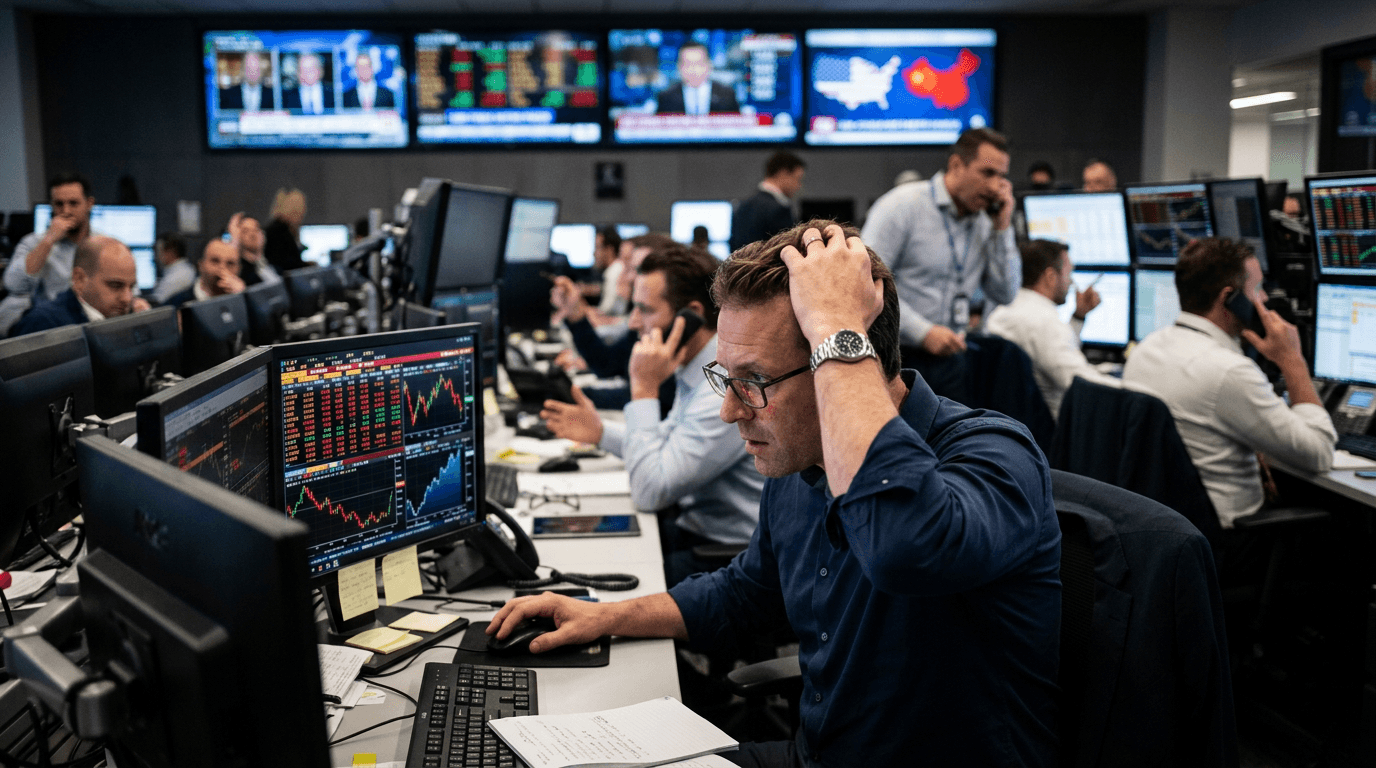
Global markets were jolted as the US announced steep tariff hikes on a broad range of Chinese goods, reportedly reaching levels as high as 145%, with China retaliating by raising its own tariffs on US imports up to 125%. The renewed escalation between the world’s two largest economies is hitting risk sentiment, pressuring global equities, and driving investors back into traditional safe havens in FX and bonds.
Global Markets Reprice Trade Risk
Markets have seen this movie before: tariff headlines spike uncertainty, risk assets sell off, and defensive plays outperform. During previous rounds of US–China trade tensions, stock indices dropped sharply on tariff announcements, while volatility jumped and safe‑haven assets rallied.[1][6]
The latest moves matter not just because of the size of the tariffs, but because they signal a breakdown in negotiations and a potential shift toward a more entrenched, multi‑year trade conflict. When tariffs reach triple‑digit levels, they are effectively a barrier to trade, forcing companies to rethink supply chains and pricing altogether.
The International Monetary Fund has previously estimated that escalating US–China tariffs could shave about 0.3% off global GDP in the short term, with roughly half of the damage coming from weaker business and market confidence rather than the tariffs themselves.[2] As confidence deteriorates, capital expenditure is delayed, hiring plans are put on hold, and equity risk premia rise.
For traders, that means higher headline risk, more gap risk around policy announcements, and a market regime where macro news outweighs micro fundamentals in the short term.
Why Tariffs Hit Growth, Earnings And Valuations
Tariffs function like a tax on cross‑border trade. US tariffs on Chinese imports raise costs for US firms and consumers, while Chinese tariffs on US goods hurt US exporters and their suppliers.[2][8] Studies of the earlier trade war period (2018–2019) found that:
- US tariffs were largely passed on to domestic prices, hurting consumers and import‑reliant firms.[8]
- Retaliatory Chinese tariffs disproportionately hit US exporters in agriculture, autos, and manufacturing supply chains.[8]
- Market reactions to tariff shocks were swift and negative for equities, as investors repriced future earnings.[5]
As tariffs ramp up toward 145% and 125%, they risk turning marginally viable trade flows into unprofitable ones. Firms may absorb some of the cost in margins, but beyond a point, higher prices reach end‑users or business is lost altogether. That threatens:
- Revenue growth for global companies integrated into US–China supply chains.
- Profit margins in sectors with low pricing power (retailers, OEM manufacturers, electronics assemblers).
- Capital investment plans, as uncertainty about trade rules clouds long‑term planning.[2][7]
Valuation multiples can compress in this environment. Investors demand a higher reward for bearing policy and earnings uncertainty, particularly in cyclical sectors such as industrials, autos, semiconductors, and consumer discretionary.
For indices heavy in global exporters or trade‑sensitive names, the drag can be meaningful even if domestic demand remains reasonably solid.
Currency, Bond And Commodity Reactions
The immediate market reaction to tariff escalations tends to follow a familiar pattern: selling of risk assets and rotation into perceived safe havens.[1][6] That typically includes:
- FX: Support for the US dollar, Japanese yen, and Swiss franc as funding is pulled from higher‑beta currencies. Emerging‑market FX with trade or commodity exposure to China often comes under pressure.
- Bonds: Buying of US Treasuries, German Bunds, and other high‑grade sovereigns, pushing yields lower as investors seek safety and liquidity.
- Commodities: Industrial commodities such as copper and energy can weaken on fears of slower global trade and growth, while gold often benefits as a hedge against uncertainty.
At the same time, trade tensions can stir concerns about currency policy. Previous episodes saw accusations of competitive devaluation and “currency manipulation” enter the narrative.[4] While outright currency wars are not inevitable, markets will closely watch for any signs that either side is using FX policy—directly or indirectly—to offset tariff impacts.
For volatility traders, this backdrop usually brings:
- Higher implied volatility in equity indices and trade‑sensitive FX pairs.
- Fatter tails in return distributions, as policy headlines can trigger outsized intraday moves.
- Opportunities in relative‑value trades between safe‑haven assets and risk proxies.
Key Watchpoints For Traders And Investors
In a tariff‑driven risk-off environment, it pays to be systematic about what you monitor and how you adapt:
1. Policy signaling Track statements from US and Chinese officials, not just formal tariff announcements. Markets often move on tone changes—whether conciliatory or confrontational—well before legal measures are implemented.
2. Economic data and leading indicators Watch trade volumes, export orders, business surveys, and manufacturing PMIs in open economies and key supply‑chain hubs.[7] Deterioration here can validate the equity market’s pessimism—or, conversely, reveal overshooting in risk assets if hard data proves more resilient.
3. Sector and factor performance Trade‑sensitive sectors (semiconductors, machinery, autos, luxury goods) and small caps with concentrated exposure to either the US or China are particularly vulnerable. Defensive sectors (utilities, staples, healthcare) often outperform when tariff risks rise.
4. Corporate guidance Earnings season becomes critical. Listen for mentions of “tariffs,” “supply chain re‑engineering,” and “input cost pressures.” The way management teams quantify and hedge tariff exposure can shape market leadership for months.
Practical Takeaways For Simulated And Live Traders
For traders using simulated finance (SimFi) platforms and live markets alike, the latest US–China tariff escalation offers a real‑time case study in macro‑driven regime change:
- Respect headline risk Position sizing and leverage should account for the possibility of abrupt moves on policy news outside regular data calendars. Consider using wider but clearly defined stop levels and reducing position concentration around key announcement windows.
- Think in scenarios, not forecasts Map out at least three policy paths: further escalation, prolonged stalemate, and partial de‑escalation. For each, sketch how equities, FX, rates, and commodities might behave. This scenario thinking can help guide both directional and relative‑value strategies.
- Differentiate time horizons Intraday traders may lean into volatility and trade reactions around headlines. Swing and position traders may focus more on how sustained tariff levels shape growth expectations, yield curves, and cross‑asset correlations over weeks and months.
- Use SimFi to pressure‑test strategies A simulated environment is ideal for stress‑testing strategies against historical analogues of trade shocks—such as prior US–China tariff flare‑ups—and exploring how your approach performs under higher volatility, wider spreads, and rapid shifts in correlations.
Ultimately, the latest tariff salvos are not just another headline; they are a potential inflection point for global trade architecture, corporate earnings paths, and cross‑asset relationships.[2][7][8] For informed traders, the challenge is to move beyond the noise, understand the underlying transmission mechanisms, and design robust strategies that can survive—and even thrive—amid renewed trade war turbulence.