
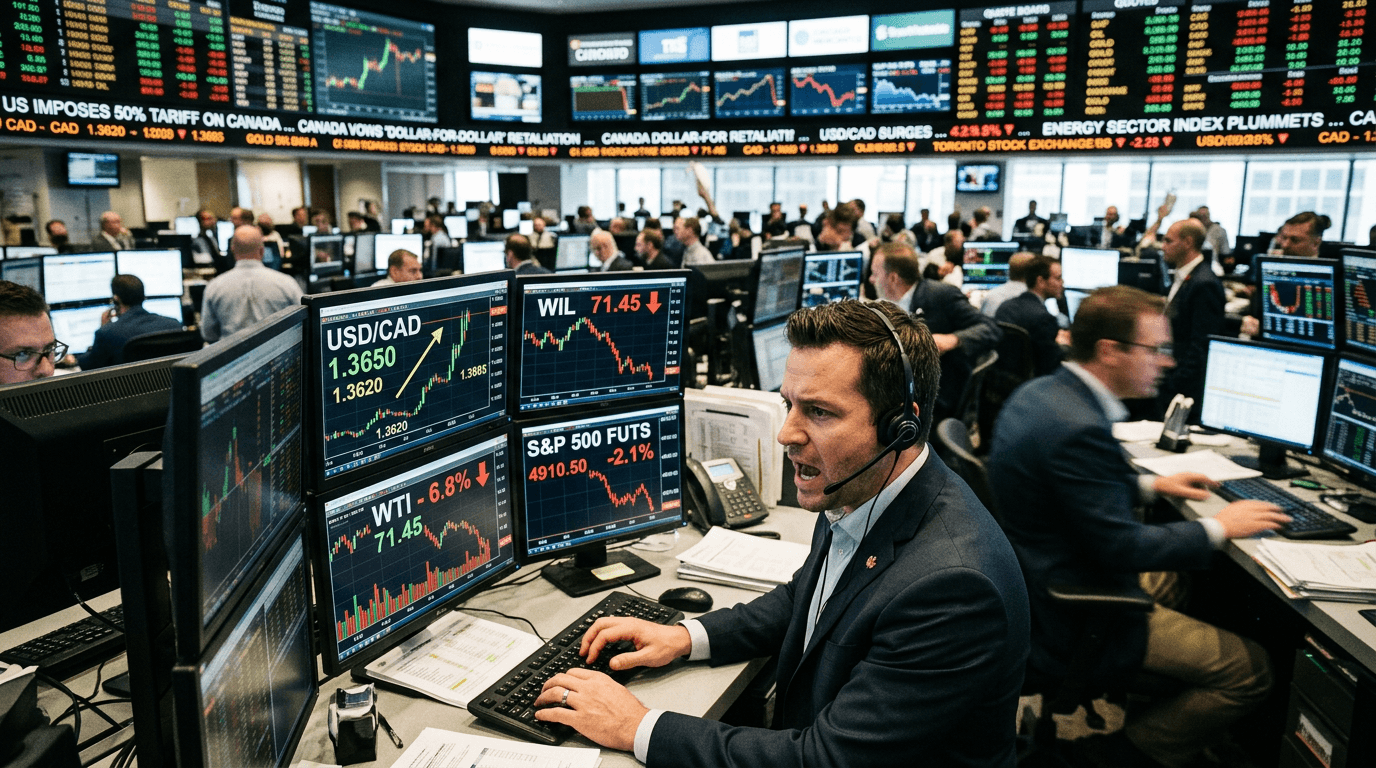
A 50% tariff on billions of dollars’ worth of Canadian goods marks a sharp escalation in North American trade tensions and a fresh source of volatility for FX and futures markets.[4][6][10] With Canada vowing “dollar-for-dollar” retaliation, traders now have to price not just higher costs for cross-border commerce, but a potential slowdown in regional growth and a more fractured policy backdrop.[6][7][10]
Trade Shock: What Has Actually Changed
After trade talks between Washington and Ottawa broke down, the U.S. moved ahead with 50% duties on an estimated $20–28 billion of Canadian exports, roughly 5% of what Canada ships to the U.S. annually.[4][6][10] The measures target a wide set of products, from consumer items like wine and hockey sticks to industrial goods such as cement, furniture, electrical equipment, and machinery.[3][6][8][9] The tariffs are being imposed under Section 338 of the Tariff Act of 1930, a rarely used provision that allows the U.S. president to levy import taxes of up to 50% when American businesses are deemed to face discriminatory treatment abroad.[1][10]
Importantly for markets, the new duties come on top of existing tariffs on Canadian copper, aluminum, steel, and non-U.S. auto parts, extending what was already a complex trade environment.[3][8] At the same time, key commodities like oil, gas, critical minerals, and potash are explicitly excluded, limiting the direct hit to Canada’s resource-heavy export base.[3] This mix of broad consumer and industrial tariffs, but narrower coverage of core commodities, sets up a nuanced impact profile across FX, equity index futures, and sector-specific contracts.
Canada has made clear it will not let these measures stand unchallenged. Ottawa has pledged to match the U.S. tariffs “dollar for dollar,” with retaliatory duties set to begin in early September and detailed product lists to follow.[6][7][10] That commitment to symmetry matters for traders: it signals a tit-for-tat dynamic rather than a quick negotiated rollback, raising the odds that elevated trade uncertainty becomes a structural feature of North American markets in the near term.
FX MARKET IMPLICATIONS: USD/CAD IN THE CROSSHAIRS
Currency markets typically respond to trade shocks through three main channels: growth expectations, risk sentiment, and relative policy outlook. Tariffs that raise costs and disrupt supply chains tend to weigh on the growth prospects of both countries involved, but often more heavily on the smaller, more export-dependent economy. In this case, Canada is more reliant on access to the U.S. market, and a prolonged dispute could marginally dent Canadian GDP and business confidence.
That asymmetry can translate into bouts of upward pressure on USD/CAD as investors rotate toward perceived relative safety and liquidity. At the same time, the exclusion of oil and key resource exports from the tariff list helps preserve one of Canada’s key macro buffers, limiting the downside for CAD compared with a broader commodity-focused shock.[3] For simulated traders, this environment favors scenario-based thinking: testing paths where USD/CAD spikes on headline risk, then consolidates as markets adjust to a more finely scoped tariff regime.
Beyond the headline pair, cross-currency implications matter. Commodity-linked FX such as AUD and NZD can be indirectly affected if the tariffs deepen global risk aversion or prompt investors to reassess the resilience of small, open economies. Traders who focus on relative trades—such as CAD against other commodity currencies—may find opportunities in how differently markets price trade risk versus resource fundamentals.
Equity Index Futures: Sector Rotations And Volatility
For North American equity index futures, the immediate impact is felt through sector-level earnings sensitivity to tariffs and retaliation. Consumer-facing companies that rely heavily on Canadian imports—think retailers and beverage firms—face margin pressure if higher duties cannot be fully passed on to customers. On the Canadian side, manufacturers and exporters of targeted goods may see earnings expectations revised lower, especially in industries like furniture, food and beverage, and specialty equipment.[3][6][11]
Index futures linked to broad benchmarks such as the S&P 500 and TSX are likely to reflect this via two mechanisms: short-term volatility around policy headlines, and slower-moving adjustments to sector weightings as investors rotate capital. Historically, tariff episodes have produced quick spikes in implied volatility followed by periods where markets become more selective, favoring domestically oriented, less trade-sensitive businesses.
Simulated traders can use this backdrop to practice several approaches. One is event-driven trading: designing playbooks for how index futures might react to new announcements, negotiations, or signs of de-escalation. Another is relative sector analysis within indices, exploring how industrials, consumer discretionary, and materials might diverge as the tariff picture evolves.
Commodities And Currency-linked Contracts
Even though oil, gas, and critical minerals are excluded from the latest tariff list, the broader trade climate still matters for commodity-linked markets.[3] Tariffs that weigh on regional growth can reduce expected demand for construction materials, manufactured goods, and certain consumer products, which in turn affects pricing for inputs such as metals and chemicals.
For futures tied to energy and base metals, the key question becomes whether the trade dispute stays compartmentalized to specific goods or spills over into wider restrictions. If the conflict remains focused on targeted categories like wine, cement, and equipment, the impact on macro-sensitive commodities may be contained.[3][6] But if retaliation broadens over time, risk premia could rise across a wider range of contracts, including those linked to transportation and logistics.
Currency-linked futures and options offer another lens. Structured trades that combine FX views with commodity exposure—such as CAD-linked energy strategies—can be used in a simulated environment to test how portfolios respond when trade policy shocks collide with cyclical price trends. This is particularly relevant for traders looking to understand correlation shifts during stress.
How Simulated Traders Can Turn Volatility Into A Learning Edge
For participants on a SimFi platform, this episode is an opportunity to build and test robust trading frameworks without real-world capital at risk. The combination of a large, headline-grabbing tariff, clear retaliatory promises, and sector-specific targeting provides a rich scenario set for strategy development.[4][6][10] Traders can design and backtest playbooks for:
1) USD/CAD reactions to new policy statements, negotiation progress, or data showing real economic impact. 2) Relative performance of U.S. versus Canadian equity index futures under different escalation or de-escalation paths. 3) Sector and factor rotations—such as shifts between export-heavy names and domestically focused companies—triggered by trade uncertainty. 4) Risk management techniques, including position sizing and hedging, tailored to headline-driven markets.
By running these scenarios in a simulated setting, traders gain experience in combining macro narratives with technical signals, testing how strategies hold up when unexpected policy moves hit the tape. The goal is not to predict every twist in the trade story, but to become more adaptable and disciplined in the face of fast-changing information.
Conclusion
The U.S. decision to impose 50% tariffs on Canadian goods, and Canada’s pledge to retaliate dollar for dollar, has reintroduced trade conflict as a central driver of North American market dynamics.[4][6][7][10] While the direct economic hit may be limited by the scope of targeted goods and the exclusion of key commodities, the signal to investors is clear: policy risk around trade is back on the table in a meaningful way.[3][6] For FX and futures traders, that means more headline volatility, more nuanced sector impacts, and a renewed need for well-structured scenarios and risk management.
In a simulated finance environment, this is precisely the kind of real-world shock that can help traders sharpen their skills. By studying how USD/CAD, equity index futures, and commodity-linked contracts respond as the dispute unfolds, market participants can turn a complex policy event into a practical learning laboratory—one that prepares them for the next time trade and politics collide.