
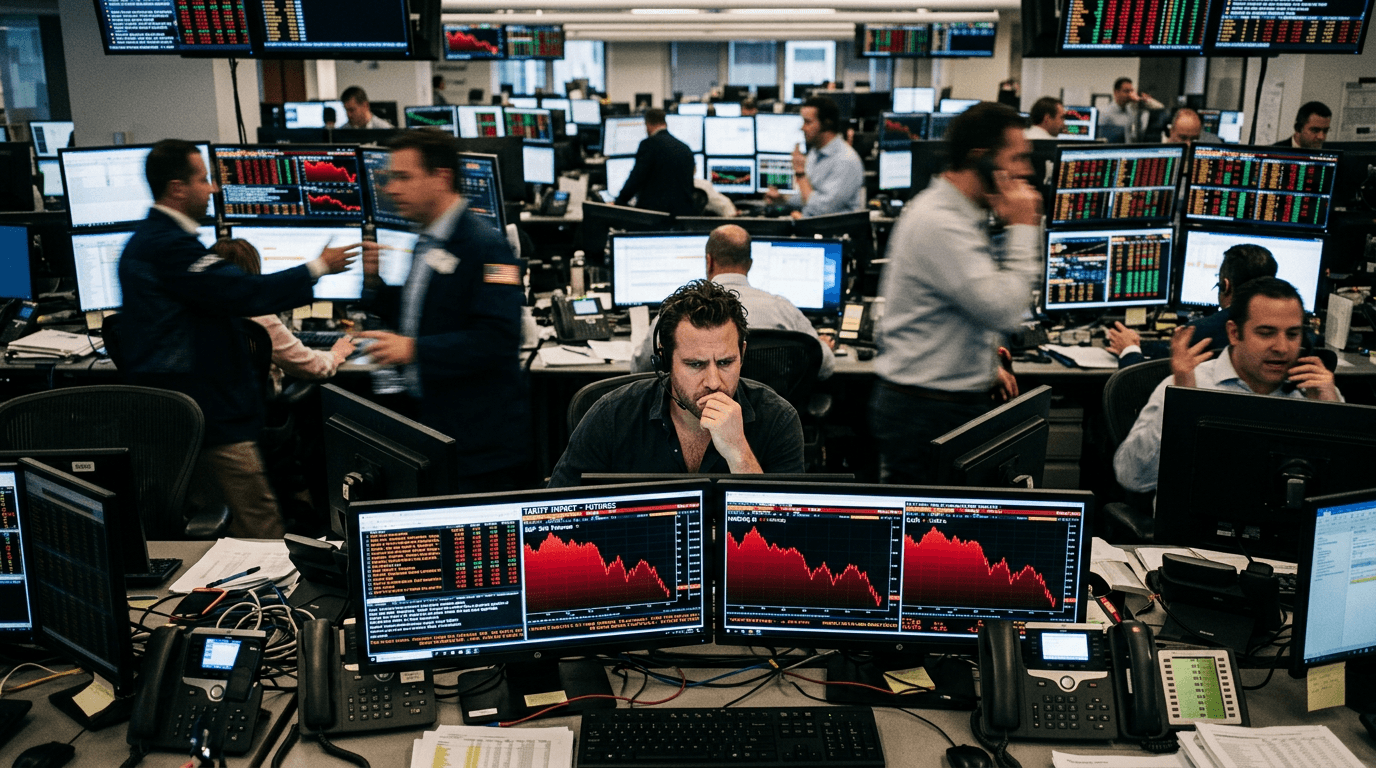
US equity futures are whipping back and forth as investors try to price a moving target: how far the latest tariff measures will go, and what they mean for growth, inflation, and central bank policy. After an extended period of low volatility, this sudden re-pricing of trade risk is leaving risk sentiment fragile. The swings in S&P 500, Nasdaq, and Dow futures are not happening in isolation—they’re part of a broader repricing across global equities, currencies, and commodities as markets grapple with renewed stress in global trade flows.
WHAT’S DRIVING THE LATEST FUTURES SWINGS
Tariffs themselves are simple—taxes on imported goods. The market impact, however, is anything but. Investors are trying to connect three moving pieces: how tariffs affect corporate profits, how they change inflation dynamics, and how central banks will respond.
Higher tariffs raise input costs for companies that rely on imported components or finished goods. Some can pass those costs to customers, others cannot. That uncertainty forces investors to reassess earnings expectations across sectors, which feeds directly into index futures pricing.
At the same time, tariffs are inherently inflationary in the short term, because they push up prices on affected goods. If inflation rises while growth slows due to weaker trade and business confidence, central banks face a more complex trade-off. Markets are now bouncing between two narratives: one where the Fed cuts aggressively to cushion growth, and another where it moves cautiously because inflation proves sticky.
This tug-of-war plays out in futures as rapid repricing whenever new headlines, data, or political comments hit the tape. Algorithms amplify these moves by reacting to keyword-driven news flows, pushing intraday volatility higher even when fundamentals have not meaningfully changed.
How Tariff Uncertainty Hits Risk Sentiment
Tariffs are not just a one-time shock; the real damage comes from uncertainty. When investors do not know how high tariffs might go, how long they will last, or which products could be targeted next, they demand a higher risk premium for owning equities and other risk assets.
That shows up in several ways. Equity index volatility typically spikes, as seen in past trade flare-ups when the VIX jumped to levels last witnessed during major crises. Correlations between stocks rise as macro headlines drown out company-specific fundamentals, making diversification less effective in the short term.
Corporate management teams tend to respond to uncertainty by delaying capex, hiring, and long-term commitments. That can dampen growth expectations and lead analysts to trim earnings forecasts. Sectors with global supply chains—technology hardware, autos, industrials—often get hit hardest, while more domestically focused or defensive areas may hold up relatively better.
Currencies and commodities transmit the stress as well. Safe-haven currencies such as the US dollar, Swiss franc, or Japanese yen may strengthen, while trade-sensitive currencies weaken. Industrial commodities linked to global manufacturing can come under pressure, even as some agricultural products spike if they sit at the center of tariff lists.
For traders watching futures, this creates an environment where risk sentiment can flip quickly. A single headline hinting at escalation or compromise can send futures sharply lower or higher, often before cash markets open, setting the tone for the entire session.
Scenarios: From Escalation To Deal-making
In navigating this environment, it helps to think in scenarios rather than fixating on a single forecast.
In an escalation scenario, tariffs broaden in scope and size, and additional sectors or trading partners are drawn in. Markets would likely price slower global growth, wider credit spreads, and more persistent volatility. Equity futures could see repeated downside shocks, with rallies sold until there is clear evidence of a policy shift.
In a “muddling through” base case, tariffs rise from current levels but stop short of full-blown trade war conditions. Legal, business, and political pressures encourage negotiated carve-outs and phased rollbacks. Under this path, markets may remain choppy but avoid a deep bear market, with periods of recovery when investors sense that the worst outcomes are being avoided.
In a de-escalation scenario, policymakers use market volatility as a signal to soften their stance, delay implementation, or pursue targeted deals. Here, risk assets could recover meaningfully, especially if accompanied by more supportive central bank policy. Historically, episodes of trade-related drawdowns have often been followed by sharp rebounds once clarity improves.
None of these scenarios will play out in a straight line, which is why futures remain volatile. Markets must constantly update the probabilities attached to each path as new information arrives.
Navigating Volatility: Practical Ideas For Traders
For traders and investors, the most important response to tariff-driven volatility is not prediction, but preparation. Volatility itself is not inherently bad; it is the mismatch between volatility and position sizing that causes damage.
First, define your risk per trade and per day. When futures are swinging more than usual, reduce leverage and tighten exposure rather than chasing every move. For many traders, cutting position sizes during high-vol regimes is the single most effective way to stay in the game.
Second, be explicit about your timeframe. Short-term traders might look to capitalize on overreactions and range expansions, while longer-term investors may view drawdowns as opportunities to build positions in quality assets at better prices. Mixing timeframes in a single strategy often leads to emotional decision-making.
Third, use tools beyond price alone. Monitor volatility indices, credit spreads, and FX moves to gauge whether a futures swing is part of a broad risk-off move or a more contained adjustment. Cross-asset confirmation (or lack of it) can help filter false signals.
Simulated trading environments can be particularly valuable in this context. Practicing how your strategy behaves during tariff headlines, gap opens, and rapid reversals—without real capital at risk—helps refine execution plans, stop-loss placement, and psychological resilience. Treat sim results as a stress test for your approach before you scale up in live markets.
What To Watch Next
Going forward, several signposts will help traders and investors assess whether volatility is likely to intensify or gradually normalize.
First, track the specifics of tariff announcements, not just the headlines. Markets care about effective tariff rates, implementation timelines, exemptions, and the scope of goods and countries affected. Small wording changes in official statements can meaningfully alter the outlook.
Second, pay close attention to business surveys and earnings commentary. Purchasing managers’ indices, export orders, and corporate guidance on margins and capex plans often provide earlier and more nuanced signals than headline GDP data.
Third, monitor central bank communication. If policymakers explicitly link their decisions to trade-related uncertainty and signal a willingness to adjust policy more rapidly, that can cap downside in risk assets—even if short-term volatility remains elevated.
Finally, keep an eye on liquidity conditions. When volatility spikes alongside signs of strained liquidity—widening bid-ask spreads, dislocations in credit markets, or abrupt moves in safe-haven assets—short-term risk of overshoots and forced liquidations increases.
In the end, tariff uncertainty is another reminder that macro shocks can arrive quickly and move markets faster than fundamentals change. For traders and investors willing to respect risk, stay disciplined, and adapt to higher volatility, these episodes can be navigated—and sometimes turned into opportunity—rather than simply endured.