
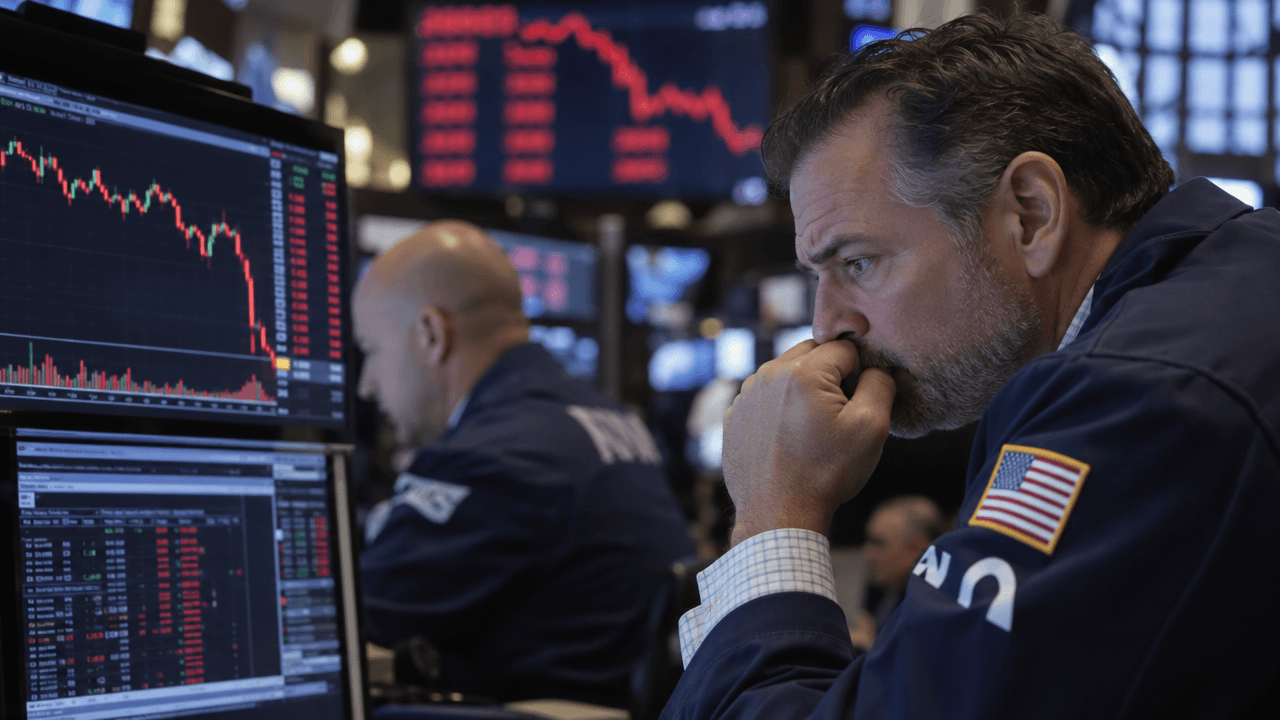
A sharp risk-off move swept through global markets as two powerful forces collided: renewed US tariff threats and a deepening selloff in artificial-intelligence stocks. The Nasdaq fell about 4% during the session, while investors moved toward defensive currencies and away from risk-sensitive foreign exchange, cryptocurrencies, and economically exposed assets. [1][3]
The decline was not simply another technology-sector pullback. It reflected a broader reassessment of risk. Investors are now weighing whether trade barriers could weaken global growth at the same time that the debt-funded AI investment boom may struggle to produce returns quickly enough to justify its enormous cost.
Tariffs Reintroduce Global Growth Fears
The US administration proposed country-specific tariffs affecting 14 major trading partners, including China, India, Japan, Switzerland, and the European Union. China also faced an additional 20% tariff linked to concerns about excess industrial capacity. [11]
Tariffs can affect markets through several channels. Import duties raise the cost of goods entering the United States, potentially increasing inflation for businesses and consumers. Companies may respond by passing those costs to customers, accepting lower profit margins, or shifting supply chains. Each option creates uncertainty for earnings forecasts.
The international impact can be even broader. Trading partners may retaliate, reducing demand for US exports and damaging companies with significant overseas revenue. Businesses may delay investment while they wait for greater clarity, which can weaken economic activity before the full effect of the tariffs appears in official data.
For traders, the immediate lesson is that tariff headlines can produce fast repricing. A proposal does not always become permanent policy, but markets often react before the final details are known. That makes headline-driven volatility especially important around official announcements, negotiations, and responses from affected countries.
The Ai Trade Faces A Return-on-investment Test
The second source of pressure was the ongoing selloff in AI-related stocks. Semiconductor manufacturers, memory companies, and firms connected to data-center infrastructure were among the hardest-hit areas. The central concern is whether the revenues generated by AI applications will eventually match the massive spending required to build computing capacity. [4][13]
The current AI investment cycle has relied heavily on capital expenditure and, increasingly, debt. That financing structure magnifies both gains and risks. If demand grows as expected, companies may generate substantial cash flow and justify high valuations. If adoption takes longer or customer returns disappoint, investors may question whether today’s spending levels are sustainable.
This is why an AI selloff can spread beyond a small group of technology shares. AI-related companies are linked to chipmakers, cloud providers, utilities, data-center operators, software businesses, and lenders. When investors reduce exposure to the theme, selling can move through the entire supply chain.
Valuation is another important factor. High-growth shares are particularly sensitive to interest rates because much of their expected value lies in future earnings. If investors demand a higher return for holding risk, those future earnings become less valuable in present terms. The result can be a rapid decline even when a company’s long-term business remains intact.
Why Defensive Assets Gain Attention
During a broad risk-off move, traders typically reduce positions in assets that depend heavily on strong economic growth and abundant liquidity. These can include high-beta equities, emerging-market currencies, commodity-linked currencies, and cryptocurrencies.
Defensive currencies often benefit from this repositioning. The Swiss franc strengthened against several major currencies despite Switzerland being included among the countries targeted by proposed tariffs. Its traditional safe-haven status helped attract demand as volatility increased. [10]
Government bonds also gained attention as investors looked for assets with a more defensive profile. Falling yields indicated that market participants were seeking safety and reassessing expectations for economic growth. Industrial metals declined as well, reinforcing concerns that trade restrictions could reduce manufacturing activity and global demand. [3]
Cryptocurrencies were pressured alongside other risk-sensitive assets. Although digital assets are sometimes described as an alternative form of money, their short-term trading behavior often resembles that of speculative technology investments. When investors reduce leverage and seek liquidity, crypto markets can experience especially rapid declines.
Practical Takeaways For Simfi Traders
The first takeaway is to separate the headline from the market mechanism. A tariff announcement matters because it can influence inflation, corporate margins, growth, interest rates, and currency flows. An AI selloff matters because it can change risk appetite across multiple sectors. Understanding those links is more useful than reacting to a single percentage move.
Second, monitor correlations during volatility. Assets that normally appear diversified may move together when investors rush to reduce risk. A technology stock position, a high-beta currency trade, and a cryptocurrency position may all be exposed to the same underlying factor: declining risk appetite.
Third, reduce unnecessary leverage when market conditions become headline-driven. Leverage can turn a manageable drawdown into a forced liquidation, especially when prices move sharply outside normal trading ranges. Position sizing, stop placement, and predefined maximum losses become more important than trying to predict the next headline.
Finally, distinguish between a trend change and a short-term shock. Tariff negotiations can reverse sentiment quickly, while doubts about AI profitability may take months to resolve. Traders should build scenarios rather than assume that the first market reaction will continue indefinitely.
A More Selective Market Ahead
The combination of tariff uncertainty and AI-related valuation concerns has created a more demanding environment for investors. Markets are no longer rewarding growth exposure indiscriminately; they are asking whether growth is profitable, durable, and sufficiently funded.
For SimFi traders, that environment offers a valuable learning opportunity. Risk management, cross-market analysis, and disciplined execution matter most when equities, currencies, bonds, and crypto assets begin responding to the same macroeconomic shock.
The broad risk-off move may eventually fade, but the questions behind it will remain relevant. Trade policy can reshape global supply chains, while the AI boom must prove that extraordinary investment can generate extraordinary returns. Until those questions receive clearer answers, volatility is likely to remain a central feature of the market.