
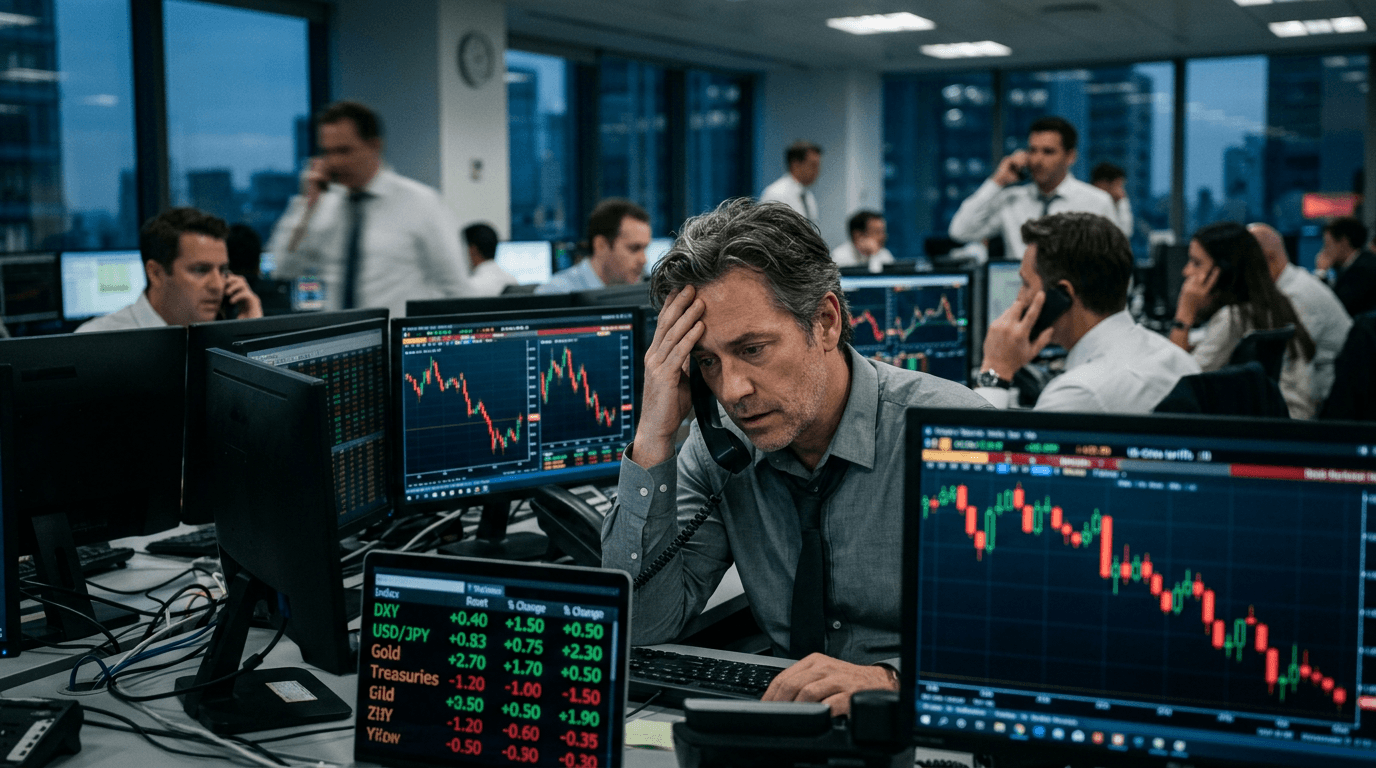
A new round of steep US tariffs on Chinese goods, with some lines reportedly facing duties of around 145%, has reignited full-blown trade-war fears and jolted global risk sentiment.[5][9] At the same time, prominent investors are warning that the US cycle may be nearing recession, turning a trade dispute into a broader macro scare that is rippling across equities, bonds, and foreign exchange markets.
TARIFF ESCALATION: WHY 145% MATTERS
The latest tariff moves mark a sharp intensification of the US–China trade conflict, with US duties on some Chinese imports now as high as 145% and Chinese retaliatory tariffs reportedly reaching up to 125% on selected US goods.[5][9] These levels go far beyond the single- or low double‑digit tariffs that characterized earlier trade tensions and effectively act as near‑prohibitive taxes on targeted flows.
Historically, US–China tariff rounds have reduced bilateral trade and raised costs for both consumers and producers, while leaving the overall US–China trade deficit largely unchanged.[2] The International Monetary Fund has estimated that additional US–China tariffs covering all trade between the two economies could subtract about 0.3% from global GDP in the short term, with roughly half of that impact coming via weaker business and market confidence rather than direct trade volumes.[2] That confidence channel is critical for markets: when firms cannot predict their cost base or market access, they delay investment, hiring, and capex, which feeds into weaker growth expectations.
At the same time, earlier modeling of broad tariff increases suggested a measurable drag on US growth and a modest boost to inflation as higher import costs pass through to consumer prices.[1] That combination—slower growth plus upward pressure on prices—complicates central bank policy and fuels fears of “stagflation lite,” a backdrop in which risk assets tend to struggle.
Takeaway: Tariffs at 145% are not just a trade story; they are a macro shock that hits growth expectations, corporate confidence, and valuation assumptions across global markets.[2][5]
Recession Jitters Join The Mix
Tariff escalation would be market‑moving on its own, but it is landing at a time when many investors already believe the US economy is late‑cycle and vulnerable to a downturn. The global backdrop is one of slower growth, elevated uncertainty, and rising geopolitical fragmentation, a combination central banks and international institutions have flagged as a key risk to financial stability.[10]
Trade wars interact with recession fears in several ways. Higher tariffs squeeze corporate margins, particularly in sectors that rely on global supply chains such as technology and manufacturing.[5] Firms respond by cutting investment and, eventually, payrolls, which dampens consumption. Financial markets then price in weaker earnings and rising default risk, particularly in lower‑quality credit. For policy makers, a tariff‑driven growth slowdown may collide with already tight or only gradually easing monetary conditions, increasing the odds of policy mistakes.
From a market psychology perspective, “recession risk” is as much about narrative as data. When high‑profile investors openly question the durability of the expansion, headlines amplify those doubts, and risk‑averse positioning can accelerate even before hard data rolls over.
Takeaway: Recession concerns act as a force multiplier for trade shocks, encouraging investors to de‑risk more aggressively than tariffs alone might justify.
RISK SENTIMENT: HOW MARKETS SHIFT IN RISK‑OFF MODE
Together, tariff escalation and recession talk have flipped the switch back to a classic “risk‑off” environment. In previous flare‑ups of the US–China trade war, global equities, oil, and crypto came under heavy pressure, while investors rushed into perceived safe havens such as US Treasuries and gold.[6] That same pattern is re‑emerging: volatility spikes, credit spreads widen, and investors become more selective, favoring quality balance sheets and defensive sectors.
In fixed income, risk‑off typically means lower yields on government bonds from economies seen as safe and liquid, as futures markets price in a higher probability of rate cuts or a slower path of policy tightening. Equity investors, meanwhile, shift from high‑beta cyclical names into defensives such as utilities, consumer staples, and dividend‑paying “quality” stocks, a positioning some strategists still favor as trade tensions persist.[5]
The broader lesson is that in a risk‑off regime, correlations change. Assets that normally move independently can suddenly trade in lockstep as the dominant factor becomes global risk appetite rather than idiosyncratic fundamentals.
Takeaway: When the market flips to risk‑off, macro narrative and positioning dominate, often overwhelming stock‑ or sector‑specific stories in the short term.[6]
FX WINNERS AND LOSERS IN A TRADE‑AND‑RECESSION SCARE
Foreign exchange markets are often the fastest to reflect shifts in global risk sentiment. When tariffs spike and growth fears rise, several familiar patterns tend to emerge.
Safe‑haven currencies—most notably the Japanese yen and Swiss franc—typically benefit as investors unwind carry trades and reduce exposure to higher‑yielding, higher‑risk currencies. The US dollar can also strengthen, both because of its safe‑haven status and because deleveraging in global funding markets often generates dollar demand. At the same time, currencies of export‑driven, China‑sensitive economies such as the Australian dollar, New Zealand dollar, and many Asian emerging‑market currencies tend to weaken as investors price in softer trade and investment flows.
The Chinese yuan (particularly the offshore CNH) is a focal point. Tariffs at 145% on some exports and 125% retaliation raise questions about China’s growth trajectory and policy response.[5][9] Authorities may allow some currency flexibility to cushion the shock, while trying to avoid disorderly depreciation that could trigger capital outflows. Markets watch the yuan closely as a barometer of how intense the trade conflict is becoming.
For emerging‑market FX more broadly, the combination of weaker global growth, lower commodity prices, and tighter external financing conditions can be toxic. Higher‑yielding EM currencies often see outflows in favor of lower‑yielding but safer alternatives, especially when global investors worry about recession.
Takeaway: In this environment, FX performance is driven less by yield and more by perceived safety, external balances, and exposure to global trade.
How Traders Can Navigate This Environment
For active traders and portfolio managers, the current mix of tariff escalation and recession fears calls for sharper risk management and scenario planning rather than simple “risk‑on versus risk‑off” binaries.
One practical approach is to map out a few core scenarios—such as further tariff escalation, a negotiated truce, or a policy‑driven growth backstop—and consider how key markets (equities, rates, FX, and commodities) might behave under each. Historical episodes of US–China tension provide useful templates for how quickly risk assets can sell off and how strongly havens can rally.[2][6]
On the FX side, traders may look to express views through relative value rather than outright directional bets—pairing one safe‑haven currency against another, for example, or expressing a view on which trade‑exposed economy is most vulnerable. In rates, the focus may shift to curve trades that reflect differing expectations about central bank responses to tariffs and growth scares.
Simulated trading environments can be particularly valuable in this kind of regime, allowing traders to test how their strategies perform under sharp volatility spikes, safe‑haven surges, and rapid changes in correlation without putting real capital at risk. Stress‑testing position sizing, stop‑loss rules, and hedging approaches across multiple “what‑if” paths can help refine a playbook before markets move.
Takeaway: Preparation and risk discipline matter more than predicting the exact path of tariffs or growth; scenario‑based planning helps traders respond quickly as the narrative evolves.