
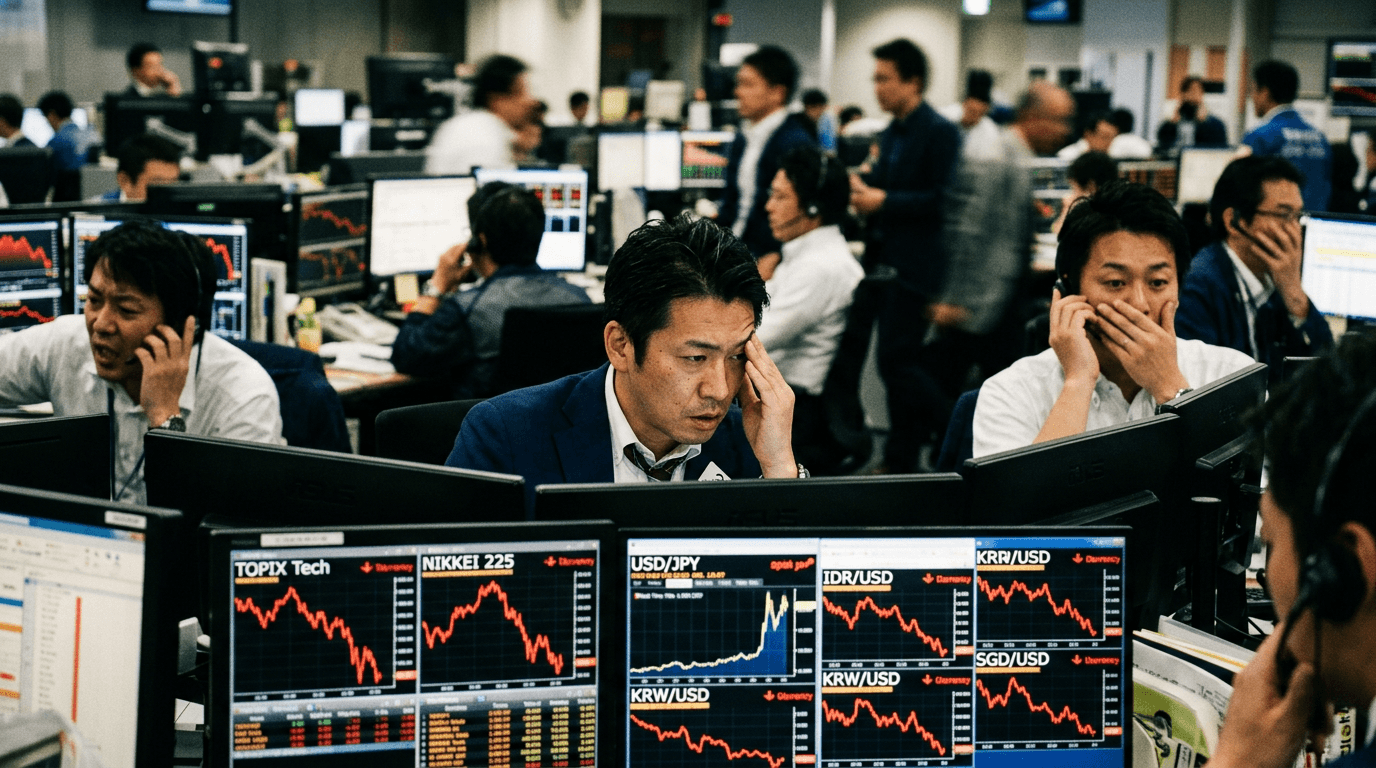
Asian equity markets have been hit by a brutal tech-led selloff, with benchmarks in Japan and Taiwan dropping as much as 6% in what some analysts are calling a “bloodbath” for AI and semiconductor names.[1][8] The move is not just an equity story: the sharp slide in risk assets is feeding directly into foreign exchange markets, pressuring high-beta and emerging market currencies while boosting traditional safe havens like the U.S. dollar and Japanese yen.
WHAT TRIGGERED THE TECH ‘BLOODBATH’?
The latest leg of the selloff was catalyzed by growing doubts about stretched valuations in global technology and AI-linked stocks.[5][8] After months of relentless gains, investors have become increasingly uneasy about how much future growth is already priced into chipmakers, cloud providers, and hardware manufacturers that power the AI boom.[8][12]
Analysts point to a mix of profit-taking and bubble fears: after a strong run-up, any disappointment in earnings, guidance, or macro data becomes a trigger for aggressive de-risking.[4][8][13] Recent tech earnings and outlooks, particularly from major semiconductor and AI infrastructure names, have underwhelmed segments of the market, reinforcing concerns that expectations had become overly optimistic.[4][10][12]
In some cases, single-stock moves have amplified the broader narrative. Sharp declines in high-profile U.S. tech leaders — including big AI and hardware names — have spilled over into Asian peers via supply-chain links and sector ETFs.[4][5][6] When flagship stocks correct, investors frequently reassess the entire complex, from device makers in Taiwan to memory producers in South Korea and software or internet platforms in Japan.
Macro factors are adding fuel. A stronger-than-expected U.S. labor market has kept alive the prospect of higher-for-longer interest rates, pushing real yields up and forcing investors to revisit growth stock valuations, which are particularly sensitive to discount-rate assumptions.[13] On top of that, lingering uncertainty around tariffs, trade rules for chips, and broader geopolitical tensions is weighing on global risk appetite.[5][7][10]
THE ASIA EQUITIES REACTION: FROM HOT AI TRADE TO FRAGILE SENTIMENT
Asia has been at the heart of the AI and semiconductor boom, so it is unsurprising that the region is also at the epicenter of the correction.[4][10][12] Tech-heavy markets such as Japan, South Korea, and Taiwan have suffered some of the steepest losses as investors unwind crowded positions in AI, chips, and related hardware.[1][3][6][12]
Japan’s Nikkei 225 — packed with major technology and investment names — has dropped sharply and moved into correction territory, falling more than 10% from its late-June peak.[1][6] Taiwan’s main index, dominated by leading chipmakers and foundries, has also slumped, reflecting the outsized role of AI demand in its earnings story.[1][3][8]
South Korea has seen particularly dramatic intraday swings. A recent session saw the Kospi plunge enough to trigger a temporary trading halt before closing nearly 6% lower, highlighting how fragile sentiment has become when it comes to high-flying tech shares.[6] That kind of price action is characteristic of crowded trades unwinding: once selling starts, forced de-leveraging and margin calls can turn a normal correction into a cascade.
Importantly, this is not simply about AI hype. The tech selloff comes against a backdrop of geopolitical flare-ups and elevated energy prices that are already making investors more cautious about growth.[9][10][13][14] When multiple stressors hit simultaneously — valuation fears, policy uncertainty, and geopolitics — equity volatility tends to spike, and Asia, as a region highly exposed to global trade and tech cycles, often sits in the crosshairs.
Risk-off Sentiment And The Flight To Safety
The shift in tone is classic “risk-off.” When investors lose confidence in the outlook for earnings or growth — or when they decide that risk premiums are no longer adequate — they tend to rotate out of equities and other risky assets and into safer, more liquid instruments.
In practical terms, that often means selling cyclical sectors like technology, consumer discretionary, and financials, and adding exposure to government bonds, defensive equities, and haven currencies. Elevated index declines, volatility spikes, and the triggering of market safeguards like trading halts all point to a rapid reassessment of risk, not a gradual rotation.[6][11][13]
Risk-off phases can feed on themselves. Falling asset prices reduce portfolio values, pushing some investors to cut risk further to stay within mandate limits or margin requirements. At the same time, headline phrases like “bloodbath” and “meltdown” can amplify fear, especially among retail traders, even if the underlying earnings and macro trends do not change radically overnight.[1][8]
Defensive Fx Flows: Why The Dollar And Yen Benefit
One of the clearest cross-asset effects of a broad risk-off move is in currencies. High-beta and emerging market FX — such as the Korean won, Taiwanese dollar, and various high-yield EM currencies — often weaken as global investors scale back exposure and repatriate capital. That tendency is particularly strong when the shock originates in equities and is linked to sectors that dominate specific countries or regions.
In contrast, the U.S. dollar and Japanese yen usually see renewed demand as defensive havens. The dollar benefits from its status as the world’s primary reserve currency and the depth of U.S. money markets; during periods of stress, institutions often prefer to hold dollar cash and Treasuries. The yen is supported by Japan’s large net foreign asset position and the tendency of Japanese investors to bring capital home when volatility rises.
While day-to-day moves can be influenced by domestic data and central bank expectations, the pattern is clear over multiple cycles: equity drawdowns and volatility spikes tend to coincide with weaker EM and high-yield FX, and stronger dollar and yen, especially when the shock is global rather than localized. Recent sessions have already seen the dollar hold firm against the yen and other majors even as equities swung, underscoring the resilience of haven demand.[9]
For traders, this means that currencies are not just a parallel market but an integral part of the risk-transfer mechanism when sentiment shifts. Understanding how equity stress propagates into FX can create opportunities in pairs like USD/JPY, as well as in crosses involving Asian and EM currencies.
What This Means For Traders And Simulated Strategies
For active traders — whether in live markets or on simulated finance (SimFi) platforms — this episode offers several practical lessons.
First, correlations are dynamic. During calm markets, tech stocks, EM FX, and haven currencies may move somewhat independently. Under stress, those relationships can tighten abruptly: tech-heavy indices fall together, EM and high-beta FX weaken, and dollar/yen catch safe-haven bids. Incorporating correlation regimes into your strategy design can help avoid surprises when volatility spikes.
Second, volatility clustering matters. A single big down day in equities often leads to more days of elevated volatility as markets digest new information and reposition.[5][11][13] Position sizing, stop placement, and margin planning should all assume that large daily moves can persist rather than revert immediately.
Third, cross-asset context is critical. Equity traders should watch FX and rates: a stronger dollar and firmer yields alongside falling tech stocks can signal a broader de-risking and valuation reset rather than a narrow sector wobble. FX traders, in turn, should monitor key tech indices in Japan, Taiwan, and the U.S. Nasdaq for clues about risk sentiment.
SimFi environments are particularly useful in this type of market because they allow traders to stress-test strategies across asset classes without real capital at risk. You can:
- Backtest how your equity or FX strategies would have performed in past tech corrections and risk-off episodes.
- Experiment with hedging approaches, such as pairing long EM FX with long dollar/yen, or offsetting tech exposure with haven assets.
- Practice intraday risk management in periods of high volatility, adjusting leverage and trade frequency as conditions evolve.
Finally, episodes labeled as “bloodbaths” can create both danger and opportunity. Momentum and mean-reversion strategies can behave very differently in these conditions, and liquidity can thin out just when price swings become more attractive. A disciplined framework — combining macro awareness, cross-asset monitoring, and robust risk controls — is essential to navigate these environments effectively, whether you are trading live or refining your edge in a simulated setting.